The Verse in the Middle: Quran 2:143 and Aristotle’s Golden Mean
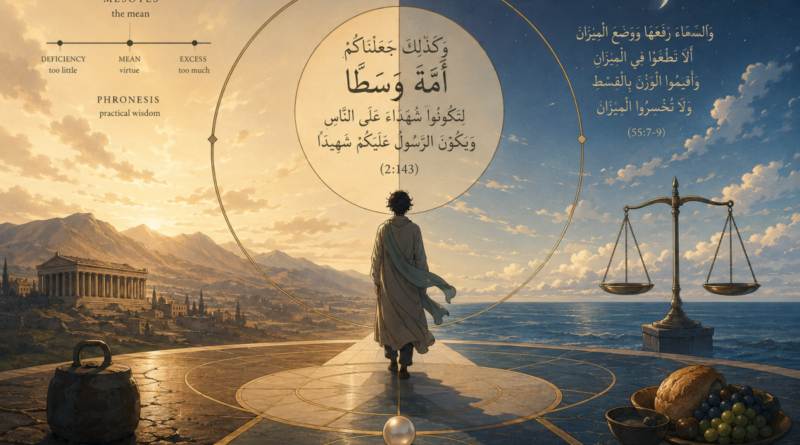
There is a detail about Sura 2 that is easy to pass over and difficult to forget once it has been noticed. The chapter runs to 286 verses, the longest in the Quran. Divide that number in half, and the result is 143. The first hundred and forty-three verses form one half of the sura; the remaining hundred and forty-three form the other. And the verse that closes the first half, the verse resting exactly on the seam between the two, is the one in which God names this community ummatan wasatan, a nation of the middle.
[2:143] We thus made you an impartial community (ummatan wasatan), that you may serve as witnesses among the people, and the messenger serves as a witness among you. We changed the direction of your original Qiblah only to distinguish those among you who readily follow the messenger from those who would turn back on their heels. It was a difficult test, but not for those who are guided by GOD. GOD never puts your worship to waste. GOD is Compassionate towards the people, Most Merciful.
The word for the middle occupies the middle. The Quran, in describing a people of balance, places that description at its own point of balance. Whatever else one makes of this, it is a striking instance of form performing content, and it is a fitting entrance into a very old question that runs through both scripture and Greek philosophy: whether the good life is found not at the extremes but at the center, and if so, what kind of center that is.
What Wasat Means
The verse reads: And thus We made you a moderate community, that you may be witnesses over humanity, and that the messenger may be a witness over you (2:143). Rashad Khalifa rendered wasatan as “impartial,” and the choice is instructive, because the Arabic root carries a cluster of meanings that no single English word captures.
Wasat is the geometric middle, the point equidistant from the edges. But in Arabic it is also the just, the balanced, the fair-minded, the one who stands between contending parties and can therefore judge between them. And there is a further sense, easy to miss, that the middle of a thing is often its finest part. The middle of the flock is the choicest, the heart of a lineage is called its middle, the central pearl of a necklace is the largest. To be wasat is not to be mediocre. It is to be central in the sense of being essential, the balanced point from which the whole is best seen and best judged.
The Quran fixes this range from within its own vocabulary, which is the surest way to settle what one of its words means. The same root appears in the law of expiation for a broken oath, where the penalty is to feed ten needy persons min awsati ma tut’imoona ahleekum, from the average of what you feed your families (5:89), the median standard, neither the finest fare nor the poorest. And it appears in the parable of the ruined garden, where the one who had warned his companions against their injustice is called awsatuhum, the most balanced, or the best, of them (68:28). In one place the word marks the ordinary middle; in the other it marks the wisest and most upright. The middle and the best are not two words that happen to share a root. They are one word, used in both senses on purpose, as if to say that the center, rightly understood, is also the finest place to stand.
This is why the verse ties the middle station to witnessing. A community placed at the center can testify precisely because it is not captured by either extreme. It sees both flanks. Balance, here, is not merely an ethical posture but an epistemic vantage. The one who stands in the middle can bear witness to what those at the edges cannot see about each other.
Aristotle’s Mean
Four centuries before the Quran, Aristotle built an entire ethics on a related intuition. In the Nicomachean Ethics, he argued that moral virtue is a mesotēs, a mean, lying between two vices: one of excess and one of deficiency. Courage is the mean between cowardice and recklessness. Generosity is the mean between stinginess and extravagance. Temperance stands between insensibility and self-indulgence. Proper pride sits between vanity and undue humility. In each case the virtue is not a separate thing standing apart from the vices but the balanced disposition between two ways of getting it wrong, one by too little and one by too much.
Aristotle was careful about a point that is often lost in casual retellings. The mean is not an arithmetic midpoint. If ten units of food are too much and two too little, the right amount is not automatically six, because the right amount for a wrestler in training differs from the right amount for a beginner. The mean is “relative to us,” fitted to the person, the circumstance, and the moment. Hitting it requires phronesis, practical wisdom, the trained judgment that knows how much, toward whom, at what time, and for what end. This is why he compared virtue to the center of a circle: there is only one center and countless ways to miss it, so the good is hard and error is easy.
There is one more subtlety worth carrying forward. Aristotle held that although virtue is a middle with respect to quantity, it is an extreme with respect to excellence. The balanced disposition is not the diluted option. It is the peak. This is exactly the sense in which wasat means the choicest part of the flock, and it is the first sign that these two traditions, so distant in origin, are circling the same insight.
Where They Converge, and Where They Part
The convergence is real. Both frameworks locate rightness in balance rather than at the poles. Both treat the extremes as failures rather than as bold options, and both understand the balanced state as something demanding rather than lazy. When the Quran instructs its readers to walk a middle way in spending, in worship, in speech, and even in the intensity of their religion, it is describing something Aristotle would have recognized instantly as the mean between deficiency and excess.
But the difference in grounding is just as real, and it is where the comparison becomes illuminating rather than merely tidy. For Aristotle, the mean is discovered. Reason and practical wisdom locate it, aiming at eudaimonia, human flourishing, as the natural end of a well-lived life. The measure is internal to human nature and human reason. For the Quran, the middle is conferred and commanded. We made you a moderate community, the verse says; the balance is a station God grants and a responsibility God assigns, bound up with the task of witnessing. The Quran also frames balance cosmically, as woven into creation itself:
[55:1] The Most Gracious.
[55:2] Teacher of the Quran.
[55:3] Creator of the human beings.
[55:4] He taught them how to distinguish.
[55:5] The sun and the moon are perfectly calculated.
[55:6] The stars and the trees prostrate.
[55:7] He constructed the sky and established the law (al-mizan).
[55:8] You shall not transgress the law (al-mizan).
[55:9] You shall establish justice; do not violate the law (al-mizan).
The word al-mizan, translated as the law, literally means the scale or balance. The scale is not only a human achievement of judgment; it is a feature of the order of things, and the human task is to keep from tipping it.
So the two traditions agree on the shape of virtue and differ on its source. One reads the mean off the grain of human reason; the other receives it as a trust laid on a community and reads it off the grain of creation. This is not a contradiction so much as a division of labor, and each side arguably supplies what the other leaves thin. Aristotle explains how the balanced person actually deliberates, moment by moment, in a way scripture leaves to the reader. The Quran supplies a reason the balance matters beyond personal flourishing, tying it to justice, witness, and the structure of the world.
The Quran’s Worked Examples
What makes the Quranic version more than an abstract slogan is that it does not merely name the middle path; it demonstrates it, case by case, in the ordinary textures of a life. The clearest example is the one that maps almost perfectly onto Aristotle’s treatment of generosity.
On spending, the Quran describes the servants of the Merciful as those who:
[25:67] When they give, they are neither extravagant, nor stingy; they give in moderation.
The vice of excess is extravagance; the vice of deficiency is miserliness; the virtue is the balanced point between them. A few chapters earlier, the same lesson arrives as a physical image:
[17:29] You shall not keep your hand stingily tied to your neck, nor shall you foolishly open it up, lest you end up blamed and sorry.
The closed fist and the flung-open hand are the two failures. Generosity is the hand held in between. Aristotle’s liberality, poised between prodigality and illiberality, is the identical structure, arrived at independently and stated almost identically.
The pattern repeats across domains. On the voice in worship:
Tone of the Contact Prayers (Salat)
[17:110] Say, “Call Him GOD, or call Him Most Gracious; whichever name you use, to Him belongs the best names.” You shall not utter your Contact Prayers (Salat) too loudly, nor secretly; use a moderate tone.
On bearing and speech, in the counsel of Luqman to his son, be moderate in your stride and lower your voice, neither swaggering nor shrinking, neither shouting nor mumbling.
[31:19] “Walk humbly and lower your voice—the ugliest voice is the donkey’s voice.”
On appetite, to eat and drink, but not to be excessive, a balance between indulgence and the denial of legitimate good.
[7:31] O children of Adam, you shall be clean and dress nicely when you go to the masjid. And eat and drink moderately. Surely, He does not love the gluttons.
Most striking of all, the Quran applies the mean to religion itself. To those inclined toward zealotry it says, Do not exceed the limits in your religion (4:171; cf. 5:77). Excess is a danger even in devotion. This is a remarkable extension of the principle, because it refuses to treat piety as the one domain where more is always better. There is a deficiency of religion, plainly, but there is also an excess of it, a fanaticism that overshoots the mark, and the balanced community is warned against both. Aristotle noted that some things admit no mean at all, that there is no right amount of murder or betrayal. The Quran adds a complementary observation he did not make: that even a genuine good, pursued without measure, can curdle into a vice.
A Midpoint Is Not a Mean
Set beside one another, the two traditions guard against the same misunderstanding, which is worth naming directly because it is the most common way the idea gets cheapened. The middle path is not the habit of splitting every difference. It is not lukewarmness dressed up as wisdom, nor the reflex of always choosing the option halfway between whatever two positions happen to be on offer. That reflex is itself a kind of thoughtlessness, an evasion of judgment rather than an exercise of it.
The mean, in both Aristotle and the Quran, is the demanding center that must be found freshly in each situation by a person or a community with the wisdom to locate it. Sometimes it lies close to one edge, because generosity toward the desperate looks nearer to lavishness than to thrift, and courage against a real threat looks nearer to boldness than to caution. The middle is not a fixed coordinate but a moving target, and hitting it is the whole of the art. This is why the Quran binds the middle station to witnessing and why Aristotle binds the mean to practical wisdom. Neither is describing passivity. Both are describing the hardest and most active thing a moral agent does: to see a particular situation clearly and to respond to it in exact proportion.
The Floor, Relative to Us
The fact that, according to Aristotle, the balance is relative to the individual and not universal is often overlooked. There is no single quantity of courage or generosity that fits every person in every circumstance, because the same act that is boldness in one situation is recklessness in another, and what counts as enough depends on who is acting and what they have been given. Carry that qualification into the Quran’s account of who is saved, and a familiar pair of verses opens up.
Twice the Quran states the criterion in nearly the same words.
[2:62 & 5:69] Surely, those who believe, those who are Jewish, the Christians, and the converts; anyone who (1) believes in GOD, and (2) believes in the Last Day, and (3) leads a righteous life, will receive their recompense from their Lord. They have nothing to fear, nor will they grieve.
The remarkable thing is what the verse leaves out. It names four communities and then dissolves the labels, resting the whole of salvation on three things that belong to no sect: belief in God, belief in the accounting to come, and a life of good deeds. This is the floor. Beneath it lies the refusal of God, the denial of the reckoning, the life given over to harm. Above it, the door is open.
But a floor is not the same for everyone standing on it, and this is where the mean relative to us returns with full force. The Quran is explicit that the demand is scaled to the person. God does not burden a soul beyond its capacity (2:286)—and it is worth noticing that this is the closing verse of the very sura whose midpoint gave us the middle community, so that Al-Baqarah opens its ethical vision on balance and closes it on proportion. God does not burden a soul beyond what He has given it (65:7), the sharper statement still, since responsibility rises with endowment and falls where little was granted. And no one is called to account until the message has reached them (17:15).
[17:15] Whoever is guided, is guided for his own good, and whoever goes astray does so to his own detriment. No sinner will bear the sins of anyone else. We never punish without first sending a messenger.
The floor is real, but its height is fitted to the light each person received, the capacity each was handed, the circumstances each was placed within. Much is asked of the one given much. Little is asked of the one given little, and nothing at all where nothing arrived.
So the same principle that governs the open hand and the measured stride governs the threshold of salvation itself. The criterion is fixed—belief, the reckoning, righteous work—but what it requires of a particular soul is not a flat quantity read off a chart. It is a mean relative to us, calibrated by a Judge who knows exactly what each was working with. This is not the lowering of the standard. It is the perfecting of it, a justice fine enough to weigh every life on its own scale, which is precisely the balance the sura set in the heavens and told us not to transgress.
The Center That Sees
Return, at the end, to where we began, to the verse sitting on the seam of the longest sura, the word for the middle lodged in the middle of the text. The placement reads almost like a demonstration of the very principle the verse announces. A community is called to the center not so that it can avoid commitment but so that it can see and judge, so that it can bear witness over humanity precisely because it has refused to be captured by either pole.
Aristotle reasoned his way to the mean from the study of human character and arrived at a peak disguised as a middle. The Quran received the middle as a trust and a name, tied it to justice and to the balance built into creation, and then illustrated it in the smallest gestures of a life, the open hand, the measured stride, the lowered voice, the plate not heaped past need. The two accounts do not merely agree that virtue lives at the center. They agree on what the center is for. It is the one place from which the whole can be seen. The choicest part of the flock, the largest pearl on the string, the still point that alone can tell the two edges apart. To stand there is not to stand nowhere. It is to stand where witness becomes possible.