Communist Vietnam bets on Korean-style ‘chaebols’ to boost growth
In a sprawling development in Hanoi, Vietnam’s largest conglomerate is embarking on a first-of-a-kind infrastructure project for a domestic private company in the communist state.
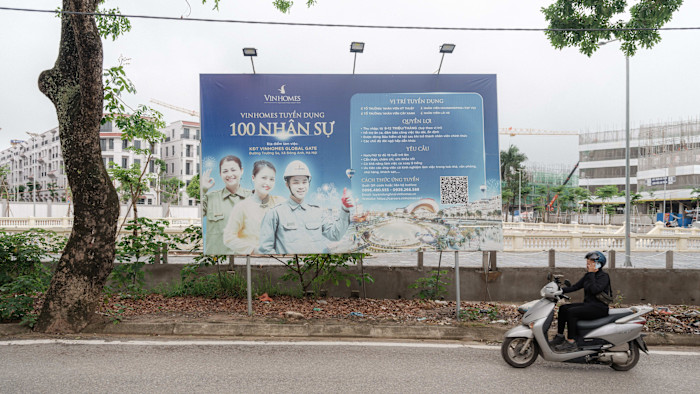
Vingroup is laying the groundwork for a high-speed rail line on a site that already has towering apartment blocks and luxury villas constructed by another group subsidiary. Cars and bikes produced by another Vingroup unit swarm the busy roads.
Awarding the contract for the $5.6bn bullet train project — a 120km line that will run from Hanoi to tourist destination Ha Long Bay and cut travel time from two-and-a-half hours to 30 minutes — to Vingroup marks a huge policy shift.
Normally, such contracts have been given to state-owned companies, but the homegrown industrial group is the kind of diversified, heavy-hitting conglomerate that Hanoi is betting on to propel its next wave of growth. With the global trade regime under threat from US tariffs, it wants to transform an economy that is overly reliant on exports and foreign direct investment.
As part of sweeping bureaucratic and economic reforms, To Lam, Vietnam’s most powerful leader in decades, is attempting to replicate South Korea’s chaebol model to create national champions. The idea is to prioritise them for big projects and facilitate their access to land and financing.
Vietnam’s effort to bolster the private sector “is a clear recognition that the capacity of the domestic companies is nowhere near the ambition and the demand of the economy”, said Nguyen Ba Hung of the Asian Development Bank.
Resolution 68, last year’s government decree on bolstering the private sector, targets the creation of at least 20 large enterprises capable of participating in global value chains by 2030. It elevates the private sector to “the most important driving force of the national economy” after having played second fiddle to state-owned enterprises and foreign companies. The aim is to double the number of private sector enterprises to 2mn by 2030.
“I think the first positive step is that [Resolution 68] seems to improve the confidence of the private sector to start investing in long-term assets, such as infrastructure,” said Hung. “The resolution seems to take some inspiration from the Korean chaebol model.”

The chaebol system was key to South Korea’s rapid industrialisation from the 1960s. Seoul encouraged the development of family-owned, diversified conglomerates through incentives, cheap financing and tax breaks. The conglomerates, which had strict export targets, transformed South Korea’s economy, though they also created monopolies and crowded out smaller companies.
Vietnam’s ambition to create domestic corporate champions follows years of rapid growth led by foreign investment. The country has been one of the biggest beneficiaries of manufacturers moving production from China to avoid higher US tariffs. The US has come to account for nearly a third of Vietnam’s exports.
Historically, Vietnam has also banked on state-owned companies to drive growth. But several of those have ended up saddled with heavy debts and corruption allegations.
“The [new] resolution is designed to create a more level playing field for domestic private companies, allowing them to compete more effectively with foreign firms and state-owned enterprises,” said Tyler Nguyen, chief market strategist at HSC Securities. “This strategy mirrors the development path taken by several Asian Tigers.”

Since Resolution 68, Vingroup, controlled by billionaire Pham Nhat Vuong, has won bids to construct at least two high-speed rail lines. It is also involved in developing metro lines in Hanoi.
Truong Hai Group, which makes vehicles and is commonly known as Thaco, has responded to a tender to develop a $67bn north-south high-speed rail line stretching across the country. Analysts have also identified steelmaker Hoa Phat Group and telecommunications company FPT as other potential Vietnamese chaebols.
The companies did not reply to requests for comment.

Vietnam’s present-day conglomerates emerged after a 1980s liberalisation drive that transformed the economy, and have become successful thanks in part to close ties to the government. But the latest reforms aim to give them a bigger impact on the economy. The country, which grew at 8 per cent last year, is aiming to generate at least 10 per cent GDP growth in the coming five years.
Between 2025 and April 2026, Vietnam has enacted more than 86 laws and 300 decrees to streamline bureaucracy and remove regulatory impediments, according to the World Bank.
“These reforms are clear-eyed, serious attempts by Hanoi to fix long-term structural weaknesses in Vietnam’s economy,” said Jian Xin Heng, senior analyst of country risk at BMI, a unit of Fitch Solutions.
“One of these weaknesses concerns Vietnam’s flagging productivity growth rate. Another [is] the disproportionate role the public sector plays in generating economic activity,” he said.

While analysts agree on a need to empower the private sector, some say Vietnamese corporate champions could face the same challenges as Korean chaebols.
“It makes sense to have a few champions to serve as a pathfinder. But at the same time, they would probably form a natural monopoly in the domestic market and it could be difficult for the [benefits] to be diffused to other smaller companies,” said ADB’s Hung. If subsidies and government support were directed to the wrong sectors, it would waste public resources, added BMI’s Heng.
In a May report, the World Bank noted that Vietnam had one of the highest corporate leverage ratios among major east Asian economies and that its banking sector faced liquidity constraints. “Vietnam’s policy direction is broadly right. The harder question is whether implementation can keep pace,” the World Bank said.
Others said that, if executed well, the reforms could have a ripple effect across the economy.
Private sector reforms would open up more investment opportunities in infrastructure, telecommunications and real estate, said Chad Ovel, a partner at Vietnam-focused private equity firm Mekong Capital.
“Now I think the investable universe for us has opened up . . . Under the new context where the private sector is seen as the growth engine of the economy, we’re going to see that the default is to allocate [big] projects to large Vietnamese conglomerates.”
Data visualisation by Haohsiang Ko in Hong Kong