U.S. Marines Practice Launching Kamikaze Attack Drones In South Korea
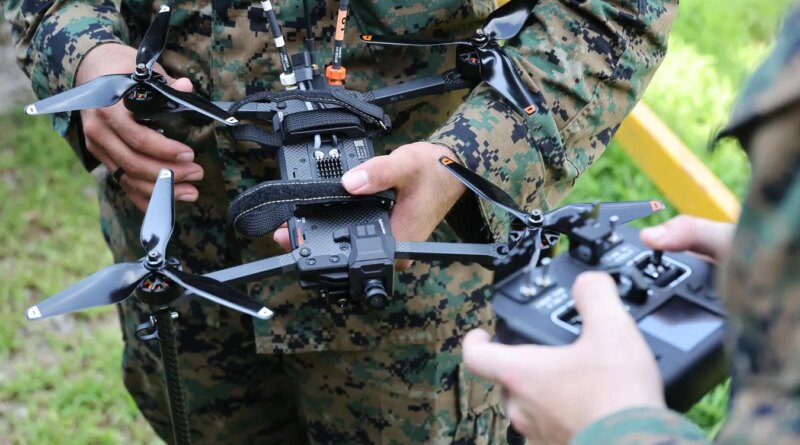
The Neros Archer, an FPV, or first person view, attack drone operated by U.S. Marine Corps is seen during a live-fire exercise at Pocheon on August 5, 2026. (Photo by KIM HONG-JI / POOL / AFP via Getty Images)
POOL/AFP via Getty Images
In a watershed moment for international security, the U.S. Marine Corps practiced suicide attacks with small drones less than 20 miles from the Demilitarized Zone dividing North Korea from South Korea.
The live-fire exercises, which are unprecedented in the history of the U.S. military’s activities on the Korean Peninsula, took place August 5 at Pocheon, South Korea as part of the Korean Marine Exercise Program, or KMEP, which sees U.S. Marines and South Korean Marines train and drill together.
Using One-Way Attack Drones
U.S. Marines conduct live-fire first-person view attack drone training in Pocheon, South Korea on Aug. 5, 2026 in a historic first for military activities on the Korean Peninsula. (U.S. Marine Corps photo by Cpl. Daniel Granados)
U.S. Marines
The exercise saw U.S. Marines of the 7th Marine Regiment fire FPV, or first person view, drones equipped with explosives to destroy armored vehicles. The Marines also simulated strikes on enemy troops.
The Marines used the Neros Archer unmanned aircraft system platform, which is also commonly used by the U.S. Army.
The Neros system can hit targets with pinpoint accuracy from a range of between 12 and 15 miles away. U.S. forces recorded video with a Skydio drone system, according to Yonhap News Agency.
The move is the latest step in the Pentagon’s push to increase the U.S. military’s combat posture in the Pacific over the past year.
Increased Focus on Korean Air Defense
A U.S. Marine instructs South Korean Marines on the use of cover and concealment during joint exercises in July 2026. Although U.S. and South Korean troops regularly train together, the U.S has been stepping up its efforts to increase joint readiness to respond to potential attacks from the North. (U.S. Marine Corps photo by Cpl. Daniel Granados)
U.S. Marines
Last August, the U.S. Air Force began transferring F-16 Fighting Falcon jet fighters from South Korea’s Kunsan Air Base to Osan, some 80 miles closer to the border with North Korea, for new “Super Squadron” training exercises.
At the same time, the service’s 51st Fighter Wing took measures to integrate more closely with South Korean airmen in practice combat drills.
The Super Squadron test, which concluded this April, marked a more alert and proactive shift in the U.S. military’s role in South Korean air defense.
The U.S. contribution of drone surveillance and weapons technology to South Korea has been on the rise since last September when the Air Force resurrected a defunct World War II fighter squadron as an MQ-9 Reaper drone unit permanently based in the country.
Nuclear Response Drills
U.S. Air Force Airmen and Marines simulate spraying a decontamination solution on a participant as part of a joint-force chemical, biological, radiological, nuclear response and decontamination training in South Korea in July 2026. (U.S. Air Force photo by Senior Airman Tabatha Chapman)
U.S. Air Force
In addition to the suicide drone attack drills this month, U.S. Air Force and U.S. Marine personnel in South Korea jointly practiced tactics and procedures in response to potential chemical, biological, radiological and nuclear attacks.
This exercise prepared U.S. service members to communicate in hazardous environments and to decontaminate themselves and others from toxins.
Drones exploding in close proximity to the DMZ are further evidence of increasingly energetic U.S. military activity in the region amid rising regional tensions. Although these drone exercises are the first of their kind, they are unlikely to be the last as the U.S. military seeks to enhance its use of unmanned technology and integrate more closely with allies in the Pacific.