The Craving Decoder: What Your Body Is Really Telling You
Chocolate at 3pm. Chips the second you walk in the door. That “I need pizza tonight” feeling that comes out of nowhere.
If you’ve ever wondered why cravings hit so hard — and whether they mean something’s wrong with you — you’re not alone. Let’s break down what’s actually happening when a craving strikes, which ones genuinely mean something, and what to do about it.
First, What Actually Is a Craving?
Hunger and a craving are two totally different animals.
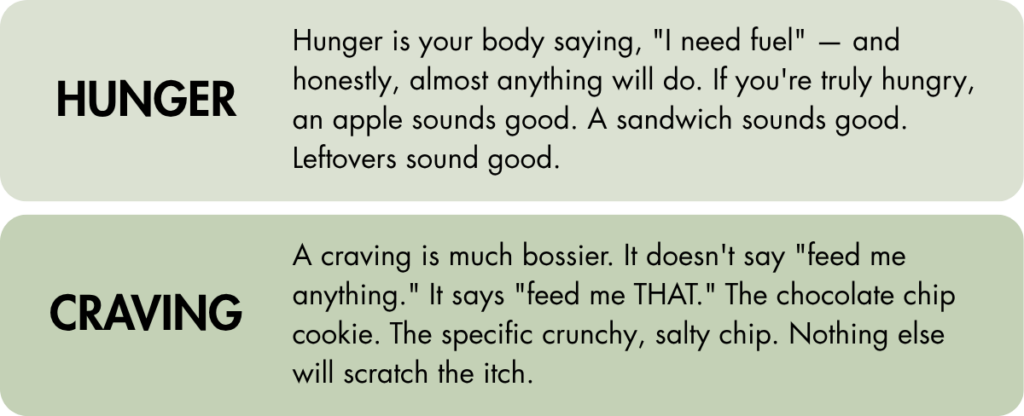
Here’s why: you’ve got two systems running at the same time.
- Your fuel gauge tracks your energy — whether you’ve actually eaten enough.
- Your reward system is the pleasure center — the part that lights up at the smell of popcorn, the sight of a frosted donut, or a pizza commercial.
These two are constantly talking to each other. And when something really tempting shows up, the reward system can shout right over the “I’m full” signal. That’s the “I couldn’t eat another bite… ooh, is that dessert?” moment. We’ve all been there.
So when a craving hits at 3pm, the single most useful question is: Am I actually hungry and running low on fuel — or am I just chasing a reward? Because those two need completely different answers.
Does Craving a Specific Food Mean Something?
Sometimes, yes — it’s just plain hunger. When you’re genuinely hungry, every food gets more tempting and harder to resist. So before decoding anything fancy, ask yourself: when did I last eat?
Interestingly, hunger and fullness don’t just turn the craving volume up or down — they change what sounds good. Hungry, we tend to lean savory. Full, we tend to lean sweet. Which tracks with the “always room for dessert” phenomenon — you just finished dinner, you’re not hungry at all, and somehow there’s still room for cake.
Here’s the myth to retire
The old idea that craving chocolate means you need magnesium, or a burger means you need iron, doesn’t hold up. When researchers measured what people actually craved and then tested their nutrient levels, there was no match. Nada. Zilch.
So where do cravings really come from? Usually one of these:
- Fuel cravings — You skipped lunch, skimped on protein, or didn’t eat enough overall. This is your body’s energy-deficit alarm, and it typically shows up as a savory craving.
- Reward cravings — You want pleasure, comfort, crunch, sweetness, or richness — even though you’re not physically hungry.
- Cue cravings — You saw it, smelled it, passed the bakery, or scrolled past it on TikTok. Visual food cues can be just as powerful as having the real thing in front of you.
- Emotional cravings — Stress, sadness, boredom, or celebration. Cravings tend to run highest during positive moods, then neutral moods, and lowest during negative moods — though for people who tend to emotionally overeat, high-calorie foods become especially tempting specifically during negative emotions. Cravings are personal: some people crave comfort food when upset, some lose their appetite entirely, and some crave treats when happy, because food is tied to celebration too.
- Habit cravings — Same time, same couch, same show, same snack. Habit is one of the most powerful predictors of eating behavior, which is why it can feel so automatic.
- Physiological cravings — Sleep loss, hormones, pregnancy, alcohol, intense exercise, under-fueling, or true sodium depletion.
Bottom line: your cravings aren’t a shopping list of nutrients you’re missing — they’re a status report on what your body’s been through.
Why Do Cravings Feel So Powerful?
Because your brain is a very persuasive salesperson. Highly craveable foods light up reward pathways and release dopamine, which creates that “I want it now” feeling. Cravings get louder when you’re sleep-deprived, stressed, overly hungry, or surrounded by cues — ads, smells, social media, or a coworker biting into a loaded burger with crispy fries (just saying).
Alcohol is a triple threat here. It lowers inhibitions, disrupts sleep, and makes salty, savory, high-fat food even more tempting.
Then there’s food design. Ultra-processed foods are often engineered to be hyper-palatable — the exact combination of salt, sugar, fat, starch, flavor, and crunch that keeps you reaching for more.
Even social media plays a role — and the science here is more nuanced than you’d think. You’d assume food videos just make cravings worse, and mostly, that’s exactly what happens: visual food cues reliably prime your appetite and increase the desire to eat. But there’s an interesting twist — when you imagine eating a specific food over and over, desire can actually decrease, a kind of mental satiation. So the honest takeaway is that food content is mostly a craving amplifier, but context and mindset matter more than we’d expect.
What Can You Do When a Craving Hits?
First, take the shame out of it. Everybody craves — even nutritionists! The goal isn’t to never crave. It’s to get better at navigating it.
- Check the fuel gauge first. When did I last eat, and did that meal have staying power? If you’re running on empty, that’s hunger, not a craving — eat a real meal or a substantial snack.
- Pause before you pounce. Give it 5 to 10 minutes. Cravings rise like a wave, peak, and then soften — most people cave right at the peak. Ride it out and it very often passes.
- Name it to tame it. Am I hungry, tired, stressed, bored, or triggered? Just naming it out loud takes a shocking amount of its power away.
- Build meals that hold you. Protein and fiber are the standouts here — the combo keeps you fuller for longer and steadies your blood sugar. Think Greek yogurt with berries, a veggie omelet with whole-grain toast, or a turkey avocado sandwich. It won’t erase cravings, but it means you’re not negotiating with a cookie from a place of chaos.
- And sometimes — enjoy the thing. Portion it, plate it, sit down, savor it, and move on. A planned, savored treat is a legitimate part of a healthy life.
Is “Food Noise” the Same as a Craving?
Related, but not the same. A craving is a strong pull toward one specific food. Food noise is the constant mental chatter running in the background all day — what should I eat, when should I eat, what’s in the pantry, what I “should” and “shouldn’t” have. It’s exhausting, and for some people it never quite turns off.
This is actually one big reason GLP-1 medications get so much attention: for a lot of people, they seem to turn the volume way down on that mental chatter and quiet cravings, by acting on appetite and reward pathways. But bottom line, medication or not: the foundation never changes. Protein, fiber, water, nutrient-dense meals, and enough fuel — that’s what steadies you underneath it all.
What Foods Do We Crave Most? Healthier Swaps for Every Craving
Most cravings fall into a few familiar buckets: sweet, salty/crunchy, starchy/carby, creamy/rich, and savory/umami. It makes sense — these foods hit the brain’s reward system hard, delivering big flavor, quick energy, comforting texture, or that irresistible salt-fat-sugar combo. Here’s what to make when each one strikes.
Sweet Cravings
Salty/Crunchy Cravings
Starchy/Carby Cravings
Creamy/Rich Cravings
Savory/Umami Cravings