Syria's Shibani updates Turkey on Kurds' integration, slams Israel during Ankara visit
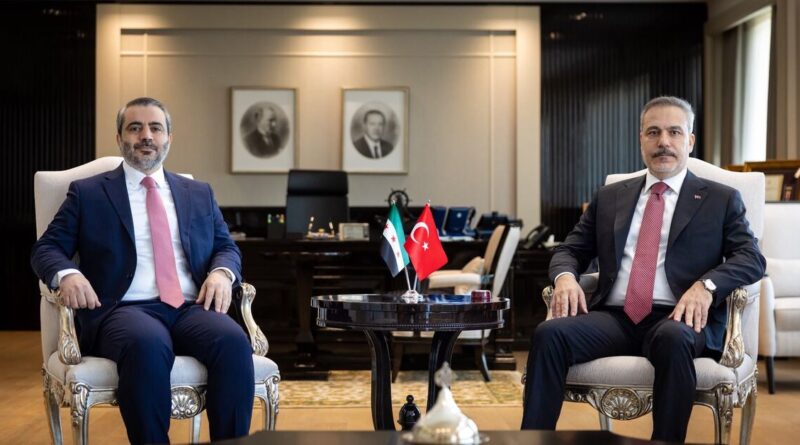
Turkey and Syria agreed to establish a High-Level Strategic Council during a meeting on Thursday between Syrian Foreign Minister Asaad al-Shibani and his Turkish counterpart, Hakan Fidan. The move further deepens security and political ties and is likely to further irritate Israel, which is pushing back against Ankara’s growing heft in its Levantine hinterland.
What happened: Speaking at a news conference after their talks, Fidan said Israel’s attacks against Syria were among the greatest threats to the stability of its southern neighbor and accused the Israeli government of escalating violence across the region.
Shibani joined in the salvos against Israel, saying its continued attacks on southern Syria threatened regional stability and calling on the Jewish state to return to the lines it held before Dec. 8, 2024, when Islamist armed opposition fighters overthrew the Assad regime and installed Ahmed al-Sharaa as the country’s new leader.
Syria’s top diplomat noted, however, that deconfliction talks mediated by the United States were ongoing with Israel.
In an oblique jibe at Iran, Shibani also condemned attacks targeting Gulf countries, saying that “the stability of Gulf countries is a fundamental pillar of regional security.”
The sides also discussed plans to activate the so-called Four Seas Initiative, which envisages placing Turkey and Syria at the center of an energy and transportation network extending from the Gulf to the Mediterranean and on to the Black Sea.
Why now? The timing of Shibani’s visit suggested, however, that its main purpose was to update his Turkish hosts — he held a separate meeting with Turkey’s spy chief, Ibrahim Kalin — on progress in integrating the Kurdish-led Syrian Democratic Forces and its civilian arm with the central government in Damascus.
That process is closely bound up with Turkey’s own efforts to put a definitive end to the armed campaign led by the Kurdistan Workers Party, whose members hold key positions in the SDF and the Kurdish-run administration in northeast Syria.
The Turkish parliament is expected to adopt landmark legislation on Friday granting full or partial amnesty to PKK fighters and others linked to the movement who have been convicted on terrorism charges and qualify under the provisions of the law.
Ankara wants elements of the SDF that will not be integrated into the Syrian army under a Jan. 29 deal to demobilize and hand over their weapons, in tandem with the PKK’s own commitment to dissolving and disarming itself.
Carrots and sticks: The SDF’s commander-in-chief, Mazlum Kobane, and Ilham Ahmed, the Syrian Kurds’ de facto foreign minister, met with Sharaa in Damascus on Wednesday to discuss integration and potential roles for themselves and their comrades in the government. Ahmed is being considered for a position in the Syrian Foreign Ministry, according to Kurdish media, while Kobane is believed to be more interested in forming his own party, a move that well-placed sources said does not appeal to Sharaa.
Sources familiar with Sharaa’s thinking say he is frustrated by the slow pace of the integration, particularly that of SDF fighters into the national army. The issue of cataloging and handing over all their weapons is said to be a sticking point, one that concerns Ankara as well. Tellingly, Shibani said, “We are working to resolve the issue of weapons outside state control and to combat terrorism.”
The Kurds, for their part, are unhappy with Damascus’ resistance to enshrining the right to education in the Kurdish language in the constitution and allowing their women fighters to join the national army.
Know more: Sharaa’s moves to consolidate full control are not limited to the Kurds.
Mohammed al-Jassem — better known as Abu Amsha, leader of the Sultan Suleiman Shah Brigade, one of the most violent and corrupt Sunni rebel factions that fought the SDF with Turkish backing — was effectively stripped of his power this week. He was removed from the helm of the national army’s 62nd Division, which is composed of his fighters, and assigned as commander of the Central Region Corps, which is deployed in Homs and Hama, well away from his own seat of power in northwest Aleppo.
Shibani noted during Thursday’s news conference that a Syria “free of terrorism and militias” and united as “one” was the “strongest guarantee” for protecting Turkey and Syria’s shared borders.
AL-MONITOR All-Access gives you unlimited access to all our journalism, the full Daily Briefing, exclusive interviews, premium newsletters, and live events — for less than $2/week.