
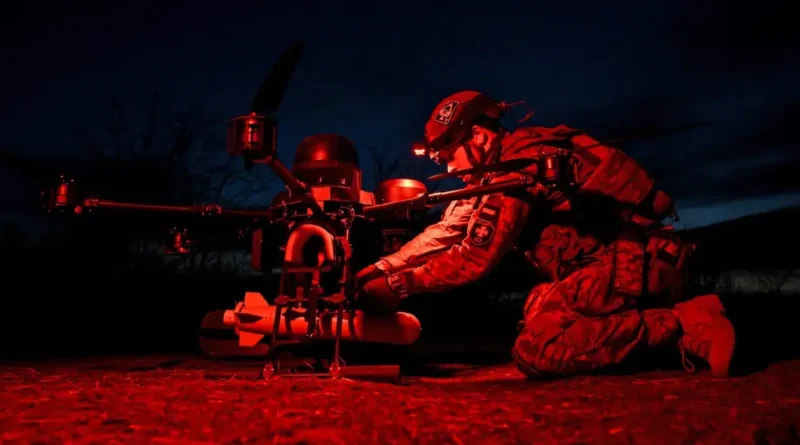
Ukraine has drones that can lock onto targets when Russia severs the connection to their operators, letting them complete their attacks
Ukraine is fighting with drones that lock onto their targets when they lose connection with their human operators.
Dmytro “Liber” Zhluktenko, a former drone operator who is now a lessons-learned analyst with Ukraine’s 413th Unmanned Systems Regiment “RAID,” told Business Insider that many of the country’s drones use what he called “target lock,” which allows drones to continue on to find and hit their targets even when their operators lose control.
It’s “quite useful,” he said, especially considering that Ukrainian operators frequently experience signal loss before they hit their targets due to Russian electronic warfare and also because of the ways many drones are designed.
The “target lock” capability is used on systems such as Perennial Autonomy’s Hornet mid-range strike drone. The drone communicates with its operator through a SpaceX-made Starlink terminal mounted onboard, Zhluktenko said. However, deep dives and aggressive maneuvers sometimes interrupt the Starlink connection, causing the antenna to lose the satellite lock, he said.
Giving drones that kind of target lock, allowing operators to “have the autonomy to do the rest of the work, is just great,” Zhluktenko said.
Ukraine isn’t fighting with fully automated weaponry. Humans remain largely in control and responsible for selecting targets. That creates challenges as Russia’s electronic warfare affects operations by disrupting GPS and cutting the command and video links connecting drones to their operators. That’s where the limited but useful autonomy comes into play.
Pavlo Bahmut/Ukrinform/NurPhoto via Getty Images
Ukraine also sees autonomy as a way for its smaller military to take on Russia, reducing the number of decisions each operator must make and potentially allowing one person to manage more systems simultaneously.
A growing number of drones in Ukraine operate with a human identifying and selecting a target, then designating it for the drone’s camera and guidance software. The drone’s technology can then adjust its course to continue tracking the target. If jamming or other interference cuts the video feed or command link, the drone can still continue toward the target the operator selected.
The sophistication of that terminal guidance varies. It may involve a pre-programmed process or a more advanced system that uses artificial intelligence. But the ability to continue operating without constant human input is increasingly important.
Zhluktenko said that some systems are “able to navigate themselves and fly by the route without human input” by matching imagery from their cameras with stored satellite maps.
But all of the currently deployed systems on the battlefield “have a human in the loop to a very significant extent,” he added.
Early forms of this kind of targeting technology aboard attack drones were observed in June 2025, when Ukrainian forces executed Operation Spiderweb. Ukraine reported that the attack, which involved sneaking drones close to the target positions in trucks, hit 41 Russian aircraft stationed at bases. Ukraine said that when some of the drones lost signal, they used AI to continue along their pre-planned route and have their warheads automatically activate upon finding their targets.
Ukraine is promoting this technology. Its defense ministry, for example, has highlighted the work of Ukrainian company F-Drones, which makes the LITAVR drone. The ministry says that the drone has an automatic terminal-guidance system that “identifies the target and autonomously guides the drone to impact.”
“During the terminal phase of flight,” the ministry said, the operator “controls only the speed, while all other functions are performed automatically.”
Ukrainian companies are also making equipment that can attach to multiple types of drones and provide similar capabilities. The company The Fourth Law makes its TFL-1 terminal-guidance module, which allows a human operator to select the drone’s target before machine vision locks onto and tracks it. That allows the drone to complete its final attack even if the operator’s connection is lost.
Mykyta Rozhkov, the chief business development officer of Ukrainian drone and weapons maker Frontline Robotics, told Business Insider that many drones in Ukraine can navigate autonomously toward targets operators have identified.
That is helpful when the signal drops, but autonomy could also help Ukraine manage a rapidly growing fleet of drones and robots. “You need some level of autonomy in order to achieve it,” he said.
Many companies see autonomy as a way for smaller militaries to field more systems without requiring an equivalent increase in personnel. Latvian drone maker Origin Robotics, which supplies Ukraine, makes the Blaze interceptor drone. The company says it uses radar-based detection and AI-powered computer vision for autonomous target acquisition and interception, while humans still confirm whether to engage.
Tanya Dzafarowa/Suspilne Ukraine/JSC “UA:PBC”/Global Images Ukraine via Getty Images
In this case, the autonomy is not intended to let the drone strike after communication is lost. The drone self-destructs if its connection is severed. CEO Agris Kipurs told Business Insider that autonomy is important for smaller militaries like Latvia’s or Ukraine’s because it allows them to effectively scale. “We don’t have the numbers in terms of infantry,” he said.
Ukraine is supporting the development of more autonomous weapons. Brave1, a Ukrainian government-backed defense technology platform and accelerator, said last year that autonomous detection and destruction of targets “is critical to preserving resources and increasing combat effectiveness.”
“The key role is played by the time between target detection and destruction,” the operation said.
The amount of autonomy in weaponry varies widely. Bohdan Sas, the president and cofounder of Ukrainian defense company Buntar Aerospace, told Business Insider that some companies have been “able to automate some simple tasks. For example, final target acquisition and final targeting is relatively easy.”
Buntar makes drones and software that use optical navigation and other tools to operate in areas affected by electronic warfare.
Sas said developers can use software such as OpenCV, a widely used open-source computer-vision library, alongside a machine-learning algorithm to “automate a small step,” allowing the drone to recognize and track a target with its camera and steer toward it.
Ukraine is pledging to further strengthen the autonomy of its weapons. Ukraine’s defense ministry said in June that a company had developed technology that automated 95% of an interceptor drone’s engagement cycle: A human operator selects a target and tells the drone to engage, while the system autonomously identifies the enemy drone, tracks it, and conducts the intercept.
Ukraine’s then-defense minister, Mykhailo Fedorov, said in March that “in modern warfare, we must defeat Russia in every technological cycle. Artificial intelligence is one of the key areas of this competition.”
“The future of warfare belongs to autonomous systems. Our task is to enhance the autonomy of drones and other combat systems so that they can detect targets more quickly, analyze the situation, and help inform decisions on the battlefield.”
For now, most Ukrainian systems appear to use narrower forms of automation, with human operators selecting targets and onboard software handling tasks such as recognition, tracking, navigation, or terminal guidance. But many in the industry predict rapid progress.
Rozhkov said Frontline expects “not fully autonomous, but pretty much autonomous operations done by robots in real battlefield conditions in 12 months.”