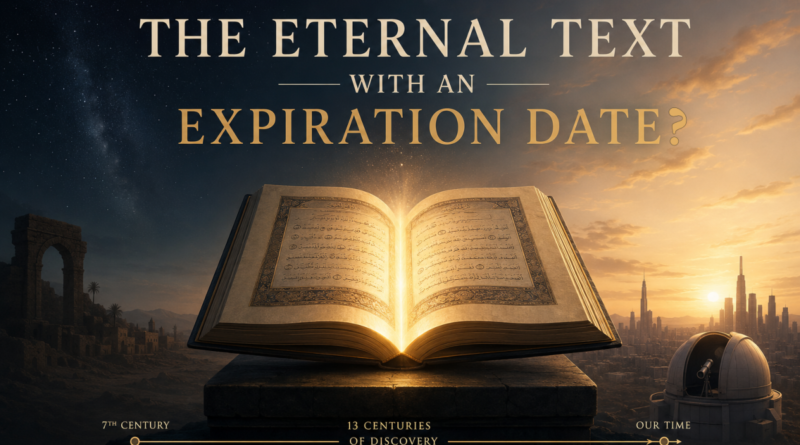
The Eternal Text with an Expiration Date?
In a previous article, we examined the 9th-century controversy that tore through Abbasid Baghdad: whether the Quran was created or uncreated. The Mu’tazilites argued that God must have preceded His own speech, and therefore the Quran was created. The traditionalists, led by Ahmad Ibn Hanbal, declared the Quran uncreated—co-eternal with God, existing before time, before the heavens and the earth, before the first human ever drew breath. Men were imprisoned, flogged, exiled, and killed over this question, and when the dust of the Mihna settled, the traditionalist position won. To this day, the uncreatedness of the Quran remains a pillar of Sunni creed. Al-Tabari declared that whoever says otherwise “is an infidel whose blood may be shed and from whom God has dissociated Himself.”
But the victors of that debate saddled themselves with a contradiction they have never resolved, and it sits at the very center of Sunni hermeneutics. Consider the two claims that traditionalist Islam asks its followers to hold simultaneously:
- The Quran is uncreated and eternal. It existed before time itself. It is not bound to any moment in history because it precedes all history.
- The Quran’s legitimate meaning is exhausted by what one specific human audience—7th-century Hijazi Arabs—understood of it, and no generation after them may extract from the text anything the first three generations did not already know.
Put these together and the result is absurd on its face: the words are eternal, but the meaning expired around 720 CE. God’s timeless, pre-existent, uncreated speech has a semantic shelf life of roughly three generations. The traditionalists claim to possess an infinite ocean, then insist that only the first bucket ever drawn from it counts as legitimate water.
This article examines that contradiction—not merely as a debater’s gotcha, but as a window into what the traditionalist project actually is: a system that sacralizes the text in theory precisely so that it can be sidelined in practice.
The Great Inversion
Recall the two camps of the 9th century. The Mu’tazilites—the rationalists, the people of kalam—held that the Quran was created. Yet it was the Mu’tazilites who treated the text as semantically alive. They rejected the authority of Hadith, took the Quran as their source of religious law, and used their God-given reason to continue extracting rulings, wisdom, and meaning from it. For them, the Quran was a text one could still think with.
The traditionalists held the opposite metaphysics and arrived at the opposite hermeneutics. The Quran is eternal, they said—and then proceeded to treat it as a closed historical document, comprehensible only through the reports of the earliest community, to be approached not with reason but with transmission. Ibn Hanbal captured the entire epistemology in a single sentence recorded by Jonathan Brown in Misquoting Muhammad: “A flawed Hadith is preferable to me than a scholar’s opinion or Qiyas.” Muslims, Ibn Hanbal reminded his students, were commanded to take their religion from on high and not rely on the flawed faculty of reason.
Here is the inversion, stated plainly: the side that called the Quran created kept it alive, and the side that called it eternal killed it. The camp that won the metaphysical argument about the Quran’s eternity is the same camp that severed the text’s living relationship with every future generation. They elevated the Quran to the throne of heaven and then locked the throne room, declaring that the only people who ever legitimately gazed upon it have been dead for thirteen centuries.
This is not an accident. It is the predictable outcome of a system in which the Quran’s authority had to be honored in name while being displaced in function. A text that is infinitely exalted but semantically frozen is the perfect scripture for a religion that actually runs on something else—in this case, on Hadith and the opinions of scholars. The eternity doctrine is the gold frame around a painting no one is permitted to look at directly.
The Doctrine of the Frozen Meaning
The traditionalist position on interpretation is not a caricature; it is stated explicitly and proudly. The principle of fahm al-salaf—the understanding of the first three generations—is treated as not merely helpful but normative and exhaustive. Ibn Taymiyyah’s influential Muqaddima fi Usul al-Tafsir argues that the Companions and their successors knew the Quran’s meanings best, and that any interpretation departing from what is transmitted from them is innovation. The Salafi movement takes its very name from this claim. The standard formulation, repeated endlessly in traditionalist literature, is that the Salaf understood the religion better than anyone who came after, that later generations can only decline from their standard, and that a meaning unknown to the first community cannot be a true meaning of the text.
Notice what this doctrine does to the eternity claim. If the Quran is God’s uncreated speech—the expression of knowledge that has no beginning and no end—then declaring its meaning exhausted by the comprehension of one audience is a statement about God’s speech, not just about interpretive method. It asserts that eternal speech contains nothing beyond what a particular 7th-century community, with its particular knowledge of the world, could recognize. It bounds the infinite by the horizon of one generation.
The traditionalist wants an eternal text with a provincial meaning. But there is no coherent way to have both. Either God’s eternal speech contains only what its first hearers grasped—in which case the word “eternal” has been deflated into a mystical honorific with no content, since the text is functionally a 7th-century document like any other—or the eternal speech contains more than its first hearers grasped, in which case discovery by later generations is not a corruption of the text’s meaning but the expected consequence of what the text is claimed to be. There is no third option. A speech without beginning, addressed to all of humanity until the end of time, that nevertheless says nothing its first audience didn’t already catch, is a contradiction wearing a creed as a disguise.
They Don’t Even Have the 7th Century
The contradiction deepens when we ask the obvious question: how does the traditionalist actually access this 7th-century understanding that supposedly exhausts the text?
Not directly. The Companions left no tafsir. The understanding of the Salaf is not a possession; it is a reconstruction, assembled two to three centuries after the fact out of materials that are, by everyone’s admission, created, human, late, and fallible. The traditionalist’s window into the 7th century consists of:
- Hadith collections compiled in the mid-to-late 9th century (Bukhari died in 870 CE, some 240 years after the prophet)
- The tafsir of al-Tabari, completed in the early 10th century
- Arabic grammar as codified by Sibawayh, a Persian writing in the late 8th century
- Lexicons like Ibn Manzur’s Lisan al-Arab, compiled in the 13th century, seven hundred years after the revelation
So the actual interpretive hierarchy of traditionalist Islam runs as follows: the uncreated, eternal speech of God is interpreted through created 9th-century reports, which are authenticated through created isnad criticism, which is itself governed by created biographical dictionaries, and the whole edifice is then frozen by the created consensus of a created scholarly class. At every single step, the uncreated is subordinated to the created. The doctrine reaches its logical terminus in the mainstream Sunni position that the Sunnah can even abrogate the Quran—that created reports, transmitted by fallible men across centuries, can delete the legal force of God’s eternal speech.
Let that hierarchy sink in. The Quran is exalted as uncreated precisely so that no one may approach it directly, and then it is governed in practice by documents that everyone agrees are created. The eternity of the text becomes an argument for its inaccessibility, and its inaccessibility becomes the warrant for the scholars’ monopoly. The Quran diagnosed this move fourteen centuries ago:
They have set up their religious leaders and scholars as lords,± instead of GOD. Others deified the Messiah, son of Mary. They were all commanded to worship only one god. There is no god except He. Be He glorified, high above having any partners. (9:31)
And here is the point that should not be missed: freezing the Quran’s meaning at the horizon of the Salaf does not empower the Salaf. They are dead. It empowers the class that claims custody of the Salaf’s understanding. “Only the first generation truly understood the Quran” cashes out, in practice, as “only we, who own the books about the first generation, may tell you what it means.” The eternity doctrine sacralizes the text; the fahm al-salaf doctrine quietly transfers its authority to the ulama.
An Eternal Text Caused by Necklaces
The contradiction is not only structural; it is embedded in the traditionalists’ primary interpretive tool. Sunni tafsir leans on the genre of asbab al-nuzul—the “occasions of revelation” reports that anchor verses to specific historical incidents. Verse X came down because Aisha lost a necklace; verse Y came down because someone asked the prophet a question; verse Z came down in response to a battlefield situation. Al-Suyuti, in al-Itqan, treats knowledge of these occasions as essential to interpretation, and the traditionalist method treats the occasion as the interpretive anchor of the verse.
Now hold that method up against the creed. An eternal, uncreated text existed before the necklace, before the question, before the battle—before Aisha, before the questioner, before the armies, before the creation of the universe itself. A speech that precedes all events by eternity cannot be caused by any of them. At most, a historical incident can be an occasion on which a portion of the pre-existent text was delivered; it cannot be the reason the text says what it says, because the text said it before the incident’s participants existed.
Yet the traditionalist method treats the occasion not merely as the delivery context but as the ceiling of meaning. The verse is about the necklace incident; the verse means what it meant in that circumstance; to read it beyond its occasion is to leave the safety of transmission. This gets the relationship exactly backwards. If the Quran is eternal, then the necklace incident is at most one instance that a timeless verse happens to cover—one point on an infinite line. The occasion illustrates the verse; it cannot define it. A traditionalist who takes his own creed seriously would have to conclude that asbab al-nuzul reports describe the first application of each verse, never its full extension. Instead, the tradition uses created circumstances to fence in uncreated speech.
Defending the Creed of No-Innovation with an Innovation
There is a further irony buried in the history of the uncreatedness doctrine itself. As the earlier article showed, the raw Hanbali position—that the Quran is uncreated in every respect, down to the recitation on the tongue and the ink on the schoolboy’s tablet—collapsed quickly into absurdity. Bukhari was exiled and nearly beaten to death merely for conceding that the recitation of the Quran is created.
The position was eventually rescued by the Ash’ari theologians through the doctrine of kalam nafsi: a distinction between God’s internal, eternal, attribute-speech and its created verbal expression in Arabic letters and sounds. Whatever one thinks of this distinction philosophically, notice what it is: a piece of speculative kalam—precisely the discipline Ibn Hanbal forbade—articulated by theologians centuries after the Salaf, using conceptual machinery (attributes, subsistence, the distinction between inner speech and expression) that no Companion ever employed or imagined. The Salaf never said anything resembling kalam nafsi. It is, by the traditionalists’ own definition, an innovation.
So the creed that anathematizes innovation and forbids philosophical theology survives only by means of an innovated philosophical theology. The traditionalist says: nothing may be believed about the Quran that the first generation did not believe—except, apparently, the elaborate post-Salaf metaphysical apparatus required to keep the uncreatedness doctrine from collapsing. The rule against novelty has a carve-out for the novelties that protect the rule.
The Scientific Miracles Hypocrisy
Nowhere is the traditionalist double standard more visible than in modern apologetics. Open any contemporary dawah presentation and you will find the genre of i’jaz ilmi—the “scientific miracles” of the Quran. The embryonic stages in 23:14. The expanding universe in 51:47. The barrier between the two seas, the orbits of the sun and moon, the formation of mountains. The argument, in every case, is the same: the Quran contains information that no 7th-century Arab could have known, and this is proof of its divine origin.
We constructed the sky with our hands, and we will continue to expand it. (51:47)
Stop and examine what this argument requires. It requires that the Quran contains meaning that the first generation could not access—reference that remained sealed until human knowledge caught up with the text centuries later. The 7th-century audience understood the Arabic of 51:47 perfectly well; they could not have known what it referred to. The verse waited thirteen centuries for Hubble.
This is precisely the premise that traditionalist hermeneutics forbids. The same scholar who tells you on Monday that no meaning unknown to the Salaf can be a true meaning of the Quran will tell you on Friday that the Quran miraculously describes cosmic expansion, a fact utterly unknown to the Salaf. The eternal, inexhaustible text is invoked when it is apologetically useful and frozen when it is juridically threatening. They want the miracle of foreknowledge without the hermeneutic that makes foreknowledge possible. But you cannot have a text that outran its first audience’s knowledge and a text whose meaning is exhausted by its first audience’s knowledge. Pick one.
Sura 112: The Counter-Creed the Tafsir Never Recognized
If the scientific miracles show the traditionalist invoking future knowledge when convenient, Sura 112 shows something more damning: a case where the transmitted tradition lost the meaning that the first audience likely grasped, and where it took modern scholarship—working with historical knowledge the mufassirun never possessed—to recover it.
[112:1] Proclaim, “He is the One and only GOD. [112:2] “The Absolute GOD. [112:3] “Never did He beget. Nor was He begotten. [112:4] “None equals Him.”
Ask the classical tafsir what occasioned this sura and you receive the standard asbab fare: the pagans of Quraysh approached the prophet and said unsub lana rabbaka—”give us the lineage of your Lord”—and the sura came down in reply. Al-Tabari and those who followed him framed the chapter as an answer to Meccan idolaters curious about God’s genealogy, and then spent their energy on lexical puzzles, most famously the word al-samad, for which the tradition accumulated a grab-bag of guesses: the one to whom all turn in need, the solid one without hollow, the one who does not eat or drink. The sheer variety of glosses is itself an admission—the transmitted tradition no longer knew what the word was doing there.
But set the sura against the Nicene Creed, the doctrinal formula hammered out at the Council of Nicaea in 325 CE and finalized at Constantinople in 381, recited in every church across the Christian Near East for three centuries before the Quran’s revelation:
“We believe in one Lord, Jesus Christ, the only-begotten Son of God, begotten of the Father before all ages; God from God, Light from Light, true God from true God; begotten, not made; of one essence with the Father (homoousios)…”
Now read Sura 112 again. Lam yalid—He did not beget—negates “the only-begotten Son, begotten of the Father.” Wa lam yulad—nor was He begotten—negates “eternally begotten before all ages.” Wa lam yakun lahu kufuwan ahad—none is equal, none is comparable to Him—negates homoousios, the claim of a second person “of one essence” with God, the very word over which Nicaea was fought. The sura is not a genealogy lesson for confused pagans. It is a point-by-point counter-creed, a surgical response to the precise technical formula of Nicene Christology—which is why scholars of the Quran’s late antique milieu, Angelika Neuwirth among them, have identified Sura 112 as a deliberate counter-text to the Nicene Creed, phrase answering phrase. Even its opening, qul huwa Allahu ahad, echoes the Shema of Deuteronomy 6:4—”Hear, O Israel: the LORD our God, the LORD is one (echad)”—situating the sura within the oldest monotheist confession while it dismantles the newest deviation from it.
Consider what this example does to the traditionalist framework, because it cuts deeper than the scientific miracles. The original 7th-century audience lived in a world saturated with these controversies—Byzantine Chalcedonians, Syriac Miaphysites, and Nestorians anathematizing one another over precisely these formulas, with Christian Arab tribes like the Ghassanids party to the disputes. The first hearers were well positioned to catch the reference. It was the later tradition—the 9th- and 10th-century mufassirun, working in Baghdad from occasion-reports and lexicons, at a remove from the credal battlefields of late antique Arabia—that lost it, reducing a precision strike on conciliar Christology to a trivia answer about pagan genealogy. The transmitted tradition failed at the one task it claims as its monopoly: preserving what the first generation understood. And the meaning was recovered only in the modern era, by scholars armed with critical editions of Syriac literature and the documentary history of the church councils—knowledge unavailable to Tabari, unimagined by Ibn Hanbal.
So the traditionalist is now trapped from both directions. New knowledge recovers meaning the tradition never had (the scientific verses), and new knowledge recovers meaning the tradition had and lost (Sura 112). Either way, the claim that the transmitted understanding exhausts the text is refuted—in the second case, by the tradition’s own demonstrated failure to transmit. A hermeneutic that cannot even preserve the 7th century has no standing to imprison the Quran inside it.
The Mathematical Structure: Evidence Held in Reserve
There is an even more concrete example of the Quran containing information that was inaccessible to its first audience by design: its mathematical structure.
Whatever one concludes about the phenomenon, one historical fact is indisputable. The first generations of Muslims had neither the concordances nor the computational tools necessary to detect the numerical patterns spanning the entire text.
Consider a few examples. The singular word “day” (yawm) occurs 365 times in the Quran—the number of days in the solar year. The singular word “month” (shahr) occurs 12 times. The word “Sabbath”, the seventh day of the week, appears seven times. Even more strikingly, if one counts the occurrences of yawm between the first and last appearance of shahr, the total is 354—the average number of days in a lunar year.
Beyond these lexical patterns lies the much larger mathematical structure centered on the Quran’s mysterious disjoined letters (al-muqatta’at) and the number nineteen.
[74:30] Over it is nineteen. [74:31] We appointed angels to be guardians of Hell, and we assigned their number (19) (1) to disturb the disbelievers, (2) to convince the Christians and Jews (that this is a divine scripture), (3) to strengthen the faith of the faithful, (4) to remove all traces of doubt from the hearts of Christians, Jews, as well as the believers, and (5) to expose those who harbor doubt in their hearts… [74:35] This is one of the great miracles.
The disjoined letters that open twenty-nine suras exhibit numerous numerical relationships based on nineteen. For example, the letter Qaf (ق) prefixes Suras 42 and 50 and occurs 57 times (19 × 3) in each chapter. The initials Ha Mim (حم) introduce Suras 40–46; counting every Ha and Mim across those seven suras yields 2,147 occurrences (19 × 113). Similar patterns extend throughout the system.
The irony is difficult to miss. The same traditionalists who insist that every legitimate meaning was exhausted in the seventh century have to deny these facets of the Quran. However, if the Quran is truly eternal, this is not an embarrassment—it is exactly what one would expect. An eternal text does not become smaller as history advances. It continues to reveal depths that previous generations lacked the means to perceive.
The Quran’s Own Testimony: Meaning That Unfolds
What makes the traditionalist position finally untenable is that the Quran itself describes its meaning as something that unfolds over time. This is not an esoteric reading smuggled in from outside; it is the text’s explicit self-description.
Start with the anchor verse. Speaking of those who reject the revelation, God says:
Indeed, they have rejected this without studying and examining it, and before understanding it. Thus did those before them disbelieve. Therefore, note the consequences for the transgressors. (10:39)
The Arabic is striking: they rejected what they could not encompass in knowledge, wa lamma ya’tihim ta’wiluhu—”and whose interpretation has not yet come to them.” The Quran states, in so many words, that its ta’wil is something that arrives later. Interpretation is described as a future event, not a completed 7th-century fact. The verse presupposes exactly what the traditionalist denies: that there is content in the text whose unlocking belongs to a later time.
The same forward orientation appears throughout:
We will show them our proofs in the horizons, and within themselves, until they realize that this is the truth. Is your Lord not sufficient, as a witness of all things? (41:53)
Future tense. Progressive disclosure. God’s signs in the cosmos (“the horizons”) and in the self will be shown—an ongoing process addressed to generations who had not yet been born, whose telescopes and instruments had not yet been built.
“And you will certainly find out in awhile.” (38:88)
Whatever argument they come up with, we provide you with the truth, and a better understanding. (25:33)
A standing promise: every new challenge is met with truth and ahsana tafsira—the best interpretation. Not “was met, once, in the 7th century.” The verb form is a continuing provision, matched to challenges as they arise. New objections in new eras call forth understanding that earlier eras never needed.
And then there is the pair of verses that should end the conversation on its own:
Say, “If the ocean were ink for the words of my Lord, the ocean would run out, before the words of my Lord run out, even if we double the ink supply.” (18:109)
If all the trees on earth were made into pens, and the ocean supplied the ink, augmented by seven more oceans, the words of GOD would not run out. GOD is Almighty, Most Wise. (31:27)
The words of God are inexhaustible. Seven oceans of ink cannot capture them. And yet the traditionalist asks us to believe that three generations of one community drained the well—that the comprehension of a single 7th-century audience exhausted what seven oceans could not write. Which claim do they actually believe? The verses describe an infinity; the creed describes a puddle.
Finally, the Quran ties access to its meaning not to temporal proximity but to sincerity and knowledge:
None can grasp it except the sincere. (56:79)
In fact, these revelations are clear in the chests of those who possess knowledge. Only the wicked will disregard our revelations. (29:49)
The gate is moral and intellectual, not chronological. Nothing in the text privileges the accident of having been born in Arabia in the 600s; what it privileges is sincerity, study, and knowledge—qualities available to every generation. That the Quran is “clear in the chests of those who possess knowledge” cuts in exactly the opposite direction from fahm al-salaf: as knowledge grows, so does what the sincere can see in the text.
Conclusion: The Fork
Strip away the details and the traditionalist faces a simple fork. If the Quran is eternal, uncreated speech—the position for which Ibn Hanbal was flogged and for which Sunni creed anathematizes dissenters—then its meaning cannot be exhausted by any single audience, and the discovery of new understanding by later generations is not a heresy but an entailment. If, on the other hand, the Quran’s meaning really is bounded by what 7th-century Arabs grasped, then “eternal” is an empty honorific, and the Mu’tazilites were right after all: the Quran is a text located in history, and the Mihna’s victims died over a word.
What the traditionalist cannot coherently do is what he in fact does: proclaim the text infinite on the page of creed and treat it as finished on the page of tafsir. He venerates an ocean and rations a bucket. He declares the speech of God without beginning or end, then hands you a 9th-century book and says the meaning ended there.
The tragedy is that the frozen text is the deserted text. A Quran whose every meaning was mined out thirteen centuries ago is a Quran no living person has any reason to study—only to recite, ornament, and route around, which is precisely what happened. The verse the tradition should fear most is not about creed at all:
The messenger said, “My Lord, my people have deserted this Quran.” (25:30)
They did not desert it by burning it. They deserted it by gilding it, raising it to the heavens, declaring it uncreated and eternal—and then never permitting it to speak again.