
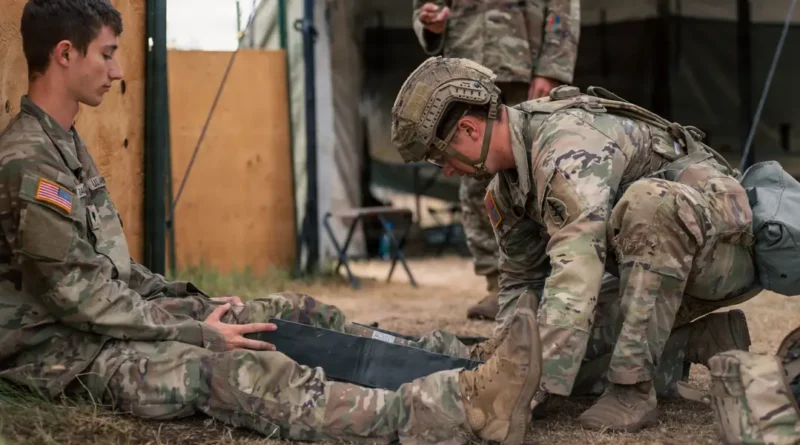
Modern war demands more of special operations medics. AI is helping the Army cram in more of what they need most in training.
As military medical personnel prepare to face complex battlefields where wounded troops may wait hours or even days for evacuationthe Army school tasked with readying special operations medics for future fights is turning to AI to pack in more lessons into their training.
The military’s preparations for large-scale combat operations and new injuriessuch as those caused by drones, are forcing military medical personnel to sharpen skills that received less attention during the wars in Iraq and Afghanistan.
Instructors at the Joint Special Operations Medical Training Center, however, can’t simply extend their already grueling training course, a premier pipeline for new military medics headed to special operations units, to accommodate more material. As is, it’s nearly nine months long.
So, instructors are leaning on AI to optimize the experience, decide what to teach more or less of, and determine where students are struggling.
The number one thing the school needs “is a way for students to learn more and learn faster,” Col. Ken Dwyer, the school’s commander, told Business Insider. “We only have so much time with them before we’re required to get them onto the force.”
US military special operation operations personnel conduct combat casualty care training at Hurlburt Field, Florida. Airman 1st Class Alexa Hunt/US Air Force
Course instructors face a unique challenge: taking students who usually have no prior medical experience and turning them into highly capable paramedics. Graduates must be able to stop catastrophic hemorrhaging, manage wounds that cannot be controlled with a tourniquetprovide a level of basic care for local civilians, and manage the health needs of potentially hundreds of troops off the battlefield, too.
(The school trains senior medics too, in its four-month Special Forces Medical Sergeant Course, where troops build on skills to master a higher degree of clinical care.)
On top of all those medical skills, students — Army medics who will serve with Rangers and Green Berets and Navy corpsmen headed to Marine reconnaissance and special operations units — must possess the tactical combat skills expected of special operators, making for a school calendar with little wiggle room.
To make better use of that time, course leaders are analyzing student performance data, including how long students take to master specific skills and how many repetitions they require, using AI-assisted analytics to pinpoint how they can make the most of their curriculum.
The goal isn’t to replace instructors, but to help leaders identify how they can shift precious classroom hours toward the skills students need most.
Feeding that granular information, requiring tedious data entry from leaders, into a calculator “gives us back a, ‘this is where our blind spots are,” said the course chief, who spoke on condition of anonymity because of privacy concerns. Such data compiled over multiple iterations of the intense course can make a big training difference, he said.
“We can shift resources and time to put the emphasis where the students need it and where their areas of weakness are,” he said.
Tourniquet training offers a simple example. The skill was a central part of battlefield medicine during the Global War on Terror, so students may arrive with more familiarity or master application faster than other forms of care, such as tourniquet removal in the field, something Ukraine is showing is necessary for prolonged casualty care when evacuation isn’t an option. Such removals, called conversions, must be carefully tracked and timed to avoid serious organ damage.
Training could focus more on conversions, or other areas of concern for medics, like infection and medication management, part of a growing field called prolonged casualty caremeant to keep wounded troops alive when advanced trauma care is out of reach.
Refining training in such minute ways allows the curriculum to evolve more quickly, the course chief explained. If data shows students are mastering one skill faster than expected, instructors can reclaim that time and devote it to newer priorities shaped by lessons emerging from Ukraine.
“We owe it to them to make sure that we’re creating systems” that show instructors “where we should be going,” the chief said. “Those are educational strides that three years ago just wouldn’t have been possible.”