Asia AI bets power record equities run for Wall Street banks
Equities trading in Asia is helping power a record-breaking run from Wall Street’s banks, with the region on course to surpass Europe as the industry’s second-largest source of revenue behind the US.
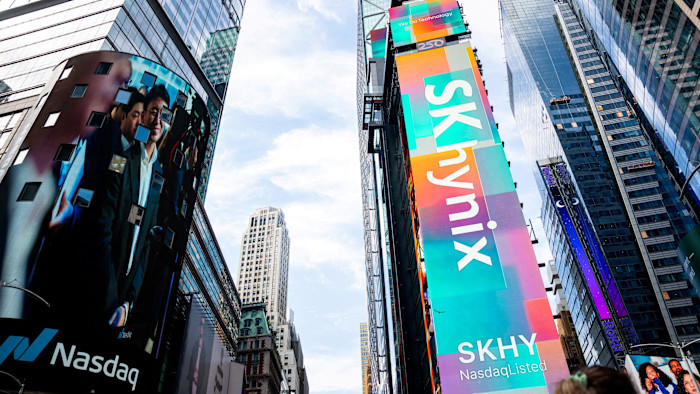
In the past 12 months, clients of large investment banks have ploughed into companies in Asia that provide critical infrastructure to the AI semiconductor industry, including South Korean SK Hynix, Taiwan’s TSMC and China’s Cambricon Technologies.
“Asia has definitely emerged as one of the big winners in the picks-and-shovels strategy of AI,” said Rachid Alaoui, head of global equities at JPMorgan Chase.
In the most recent quarter, the largest investment banks collectively reported an unprecedented $25.7bn in earnings from equities trading and called out Asia as a crucial factor in the growth.
Data from the World Federation of Exchanges, an umbrella group for exchanges around the world, shows that trading volumes across Asia through to the end of May were more than $52tn, almost matching the $53.5tn in North America.
The gains by investment banks are such that the Asia region could this year overtake Europe in terms of revenues for banks including Goldman Sachs, JPMorgan Chase and Morgan Stanley, according to people familiar with the matter. The banks declined to comment.
While the revenues are subject to market conditions in the second half of 2026 and can be inflated by the inclusion of stamp duty in transaction fees, they underscore how trades tied to AI are driving financial markets globally. They also mark a turnaround for the China business of US banks. Just a few years ago many investors were reluctant to invest in the country for fear of geopolitical tensions with the west and lacklustre economic growth.
Banks have been doubling down on their investment in Asia in recent years and the region has emerged as an important part of a revival of trading businesses at big banks, which have enjoyed a renaissance since 2020.
“Let’s call it in the last 18 to 24 months, we’ve made a material surge and pivot to really, really invest in Asia, partly just as the complexity in the region has started to rise,” said Dmitri Potishko, Goldman’s global co-head of equities.
The push is not without risk, with executives watchful of geopolitical tensions in the region flaring up and trades becoming too heavily correlated with the performance of AI investments.
“There are correlated risks that drive exposure in prime books,” said Potishko. “What happens if the AI trade goes in reverse? What happens if the quants’ position unwinds simultaneously?”
But so far, it is paying off for banks.
Denis Manelski, co-president of global markets at Bank of America, said “clients wanted exposure to the entire AI-driven investment themes” in Asia as well as the US.
“We saw strong demand for financing, cash and derivatives in Asia.”

Computer-driven quantitative funds have been among the investors that have piled into the region, pouncing on what are seen as market inefficiencies, including difficulties in shorting stocks in China in a retail-dominated market. Proprietary trading firms such as Jane Street and Citadel Securities are also rapidly growing their presence in the region.
Beijing has made a concerted effort to make its markets more investor-friendly, including cuts to transaction fees. President Donald Trump has also cooled his trade war with China, given the US reliance on the country for rare minerals.
“We used to talk about Asia, we just meant greater China,” said Morgan Stanley chief financial officer Sharon Yeshaya. “Then we started talking about Japan and India. And then more recently, we’ve been talking about Korea and Taiwan. And we really saw strength on nearly all of those on a year-over-year basis.”
Banks are still wary of the geopolitical risks in Asia, particularly in light of Moscow’s full-scale invasion of Ukraine, which triggered western sanctions on Russia and meant investors could not access financial assets in the region.
Foreign investors will often invest in Asia through swap contracts, which are trades facilitated by investment banks that give the investor the financial exposure to a security without owning the underlying asset. This allows investors such as hedge funds and other asset managers to invest in a country without having the sort of onshore infrastructure that regulators can require while also not obliging the investor to publicly disclose their position.
In these trades, the investor will go long the asset, meaning the bank then has a short position. To hedge its exposure, banks will typically purchase the underlying asset.
According to people familiar with the matter, following the sanctions handed down to Russia, investment banks including Goldman, JPMorgan and Morgan Stanley tightened terms in their trading agreements with clients around Chinese securities.
These changes made it clear that if securities the bank holds as part of a swap contract get frozen in a country, any loss will be incurred by the client holding the swap contract, not the bank, the people said. The banks declined to comment.
“Russia scared the shit out of everybody,” one trader at a large US bank said.
Following the 2008 financial crisis, banks retooled their trading businesses to focus on market-making and lending in equities through prime brokerage to hedge funds and trading firms. Some executives said lending in the Asia business could overtake the US at its current growth rate.
“If the growth trajectory we’ve seen over the last two years continues, Asia could become the largest region for the Prime business globally,” said JPMorgan’s Alaoui.
The rally has been so fierce that it has pushed banks to deploy capital away from other businesses and towards Asia.
A top executive at a US bulge-bracket bank said: “To accommodate some of our clients in Asia we have had to become less accommodative to clients elsewhere in the world.”
Additional reporting by Akila Quinio