US and Iran hold crunch talks in Switzerland
Unlock the White House Watch newsletter for free
Your guide to what Trump’s second term means for Washington, business and the world
The US and Iran began high-stakes talks on Sunday aiming to build on a shaky interim deal to reopen the Strait of Hormuz and move towards a permanent settlement to end their more than 100-day war.
The negotiations in a Swiss mountain resort were set to focus initially on the Israeli-Hizbollah conflict in Lebanon that has threatened to derail diplomatic efforts to implement the memorandum of understanding signed by the US and Iran on Wednesday.
Repeated Israeli strikes in Lebanon caused Iran to warn on Saturday that it would close the straitunderlining the tenuous state of US President Donald Trump’s push to end the war and ease the global energy crisis triggered by the conflict.
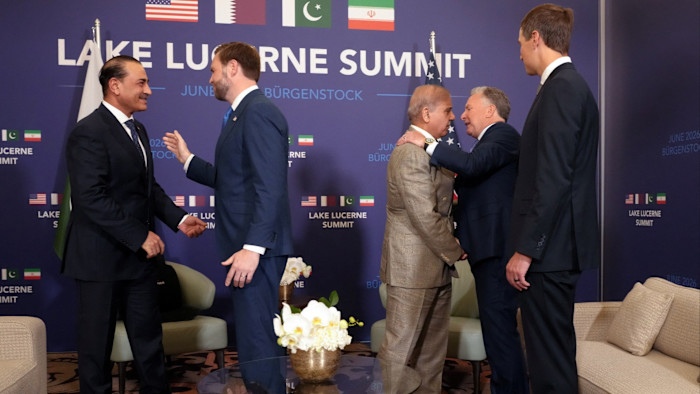
US vice-president JD Vance, who is leading the American delegation, termed the talks “historic” as the warring parties began formal direct negotiations, mediated by Qatari and Pakistani officials.
“The question before us now is how much more can we accomplish together? Can we turn over a new leaf?” Vance said. “We’ve already made great progress over just the last few hours and I expect that we’ll make additional progress in the hours to come.”
But the fraught nature of the negotiations between two parties — who harbour deep mutual distrust after almost half a century of hostility — was on display when the Iranian delegation refused to appear for a photo opportunity with their US counterparts at the start of the formal talks.
Instead, Iran’s foreign minister Abbas Araghchi walked briefly into the room, greeted Pakistani leaders and then left. The Iranian delegation led by Mohammad Bagher Ghalibaf, Iran’s top negotiator and one of its most powerful civilian wartime leaders, entered the room about 15 minutes later after the press had been asked to leave. The MoU and talks with the US have been vocally criticised by ultra-hardliners in Iran.
The meeting — the highest-level talks since negotiations in Islamabad in April that led to a temporary ceasefire — had been due to begin on Friday and to focus initially on Iran’s nuclear programme.
But the talks were delayed after Tehran refused to send a delegation because of Israeli strikes against Hizbollah, its most important proxy, in Lebanon.
Iran’s powerful Revolutionary Guards on Saturday said its forces were closing the strait as Israel and Hizbollah continued to clash despite a truce brokered by the US, Qatar and Iran a day earlier.
However, after a flurry of intense mediation efforts by Qatar and Pakistan in co-ordination with the US, Tehran announced on Saturday that it would take part. Qatari officials had warned Iran that if it did not send a delegation it was giving Israeli Prime Minister Benjamin Netanyahu a “veto on the war”, said a diplomat briefed on the talks.
The US military’s Central Command said later on Saturday that commercial shipping through the strait — which Iran had in effect closed throughout the war — had increased.
Trump has made reopening the strait — through which about a fifth of the world’s oil and gas normally passes — a priority as he seeks to ease a global energy crisis that has pushed up prices at American petrol pumps ahead of November’s midterm elections.
The US president and Vance have both criticised Netanyahu and members of his far-right government over the past week as they seek to contain the fighting in Lebanon.
But on Sunday, Trump threatened Iran if it did not do more to rein in Hizbollah.
“Iran must immediately stop their highly paid PROXIES in Lebanon from causing trouble,” he posted on his Truth Social Platform. “If they don’t, we’ll hit Iran very hard again, just like we did last week, only harder!!!”
The talks on Sunday come after the US and Iran signed the MoU last week to extend an April 8 ceasefire by 60 days, during which Iran is supposed to reopen the strait and not charge ships a fee for transiting the waterway.
Trump has already ordered the US navy to lift its blockade of Iranian ports.
A diplomat briefed on the talks said mediators would initially discuss a “mechanism to track violations and keep the peace in Lebanon”. They added that one challenge was not being able to know who fired first there.
The parties are also expected to discuss the status of the Strait of Hormuz and the nuclear programme. US envoys Steve Witkoff and Jared Kushner, Trump’s son-in-law, were part of the US delegation.
The first of the MoU’s 14 points had declared an immediate and permanent halt to military operations on all fronts, including in Lebanon. Yet several ceasefires since April have failed to end the fighting between Israel and Hizbollah.
The nuclear talks are expected to stretch out over weeks as the parties negotiate the fate of Iran’s enriched uranium and its main nuclear sites, which were severely damaged by US bunker bombs last year.
The MoU states that the parties would find a “mutually agreed” mechanism to handle the enriched uranium.
Iran has more than 9,000kg of the material stockpiled, including 440kg at levels close to weapons-grade that Trump previously demanded Tehran hand over to the US.
Additional reporting by Bita Ghaffari in Tehran