In Venezuela, a 91-Year-Old Weaver Sticks to Traditions
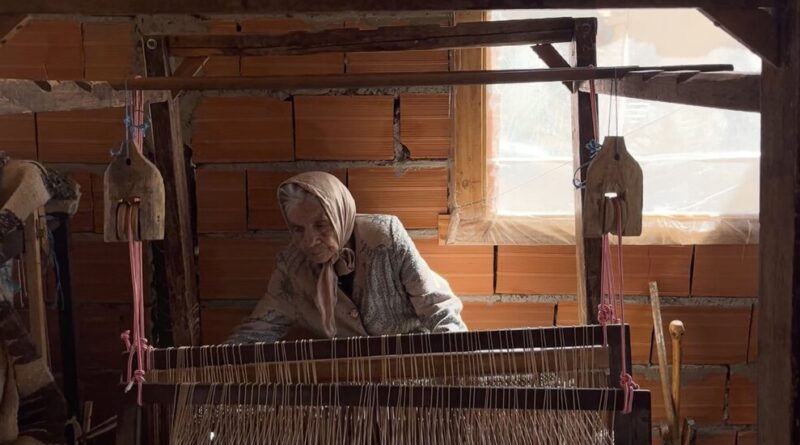
As she sat at her loom on the rooftop of her home in Mucuchies, a town high in the Venezuelan Andes, Margarita Mora, recalled the morning when, at 5, she delivered some wool her mother had spun to a local weaver in nearby Mitivivó. It was her first encounter with the very loom she would use for decades to come.
“This loom has made me very happy,” she said during an interview at her home in 2024. “When I learned to weave, I was able to buy my own clothes and shoes.”
It was also how she discovered the craft that she has dedicated her life to. All those decades ago, Mitivivó was a remote settlement with just a few families, set where the mountains met the sky. It was here that she began selling her weavings.
In most parts of the world, electric machines have replaced ancient weaving techniques, but Mora, who is 91 and tiny, wearing head scarves around her weathered face, has clung to a mix of ancestral Indigenous and Spanish traditions.
Her weavings have gained her a modest level of fame in Venezuela. For years, she was an instructor at the Moconoque School of Trade, Arts and Crafts, a nonprofit with the mission of preserving and promoting traditional crafts. In 2008, her face adorned a huge billboard on the facade of a convention center hosting an art exposition in the city of Mérida, southwest of Mucuchies, along with two other weavers and former president Hugo Chávez. She has also received multiple honorary degrees.
Mora’s first group show, with other weavers from the region, was in 1979 in Caracas, though only recently has her work been shown within the context of contemporary art. This shift comes as weaving has been increasingly featured in major institutions, such as the Art Institute of Chicago and the National Gallery of Art in Washington.
With a pull of the reed, a comb-like frame, she drives the horizontal threads tight against the woven fabric to create a dense textile, which becomes a tapestry, a blanket, a rug or other product. The patterns she creates are geometric and abstract, featuring motifs — hands, butterflies, scissors and axes — from her daily life.
Lynne Cooke, a former senior curator of Modern and Contemporary Art at the National Gallery of Art in Washington, believes Mora “has a very special gift.”
In a recent interview, Cooke said that Mora’s designs “subtly diverge from repetitive geometric patterning.” This is achieved, she said, through “strong tonal contrasts between the dark and light wools she sources locally.”
For years, Mora farmed merino and criollo sheep; now she buys sacks of wool from farmers in the surrounding area, and stores it on her roof. (If she has a large workload, she buys spun wool from her cousin.) She cards the wool by hand, untangling it and aligning fibers in preparation for spinning.
Creating a large piece is a two- or three-month process that includes washing, dyeing, spinning and weaving. Mora cannot rely on consistent access to electricity and running water, so the process is entirely manual and heavily dependent on the weather; if it rains too much after she washes the wool, the fibers won’t dry.
“Margarita leaves a legacy of skill and wisdom in the application of essential materials,” said the British-Venezuelan architect Jimmy Alcock, whose countryside house in Mitivivó is filled with rugs, blankets and upholstered furniture by Mora.
Mora has passed on her knowledge to the next generations of her family, who have built a studio on her Mucuchies rooftop, complete with eight looms. “Passing down a legacy is very rewarding,” she said.
Her daughter Asunción Rangel, 53, who was in charge of scouring, drying and carding the wool for her mother, is now weaving. Two of Mora’s six grandchildren, Daniel Castillo, 23, and Fabián Rangel, 22, also weave.
“As long as I’m in it,” Mora said, referring to weaving, “I’m happy. It hasn’t made me rich, but it has kept me going all my life.”