Adam Silver Talks Expansion, Europe, Tanking Before NBA Finals
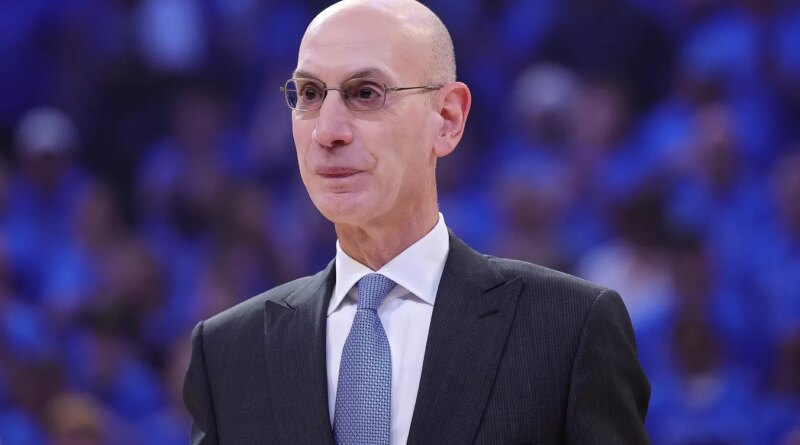
OKLAHOMA CITY, OKLAHOMA – MAY 18: NBA Commissioner Adam Silver looks on after the most valuable player trophy presentation before Game One of the NBA Western Conference Finals between the Oklahoma City Thunder and San Antonio Spurs at Paycom Center on May 18, 2026 in Oklahoma City, Oklahoma. NOTE TO USER: User expressly acknowledges and agrees that, by downloading and or using this photograph, User is consenting to the terms and conditions of the Getty Images License Agreement. (Photo by Alex Slitz/Getty Images)
Getty Images
Before the New York Knicks and San Antonio Spurs tipped off from the Frost Bank Center, NBA Commissioner Adam Silver addressed media around a variety of big topics for the league as it’s just weeks away from the offseason.
Among the hottest topics was expansion for the NBA. Both in terms of the forthcoming NBA Europe and the potential clubs being added stateside.
Europe, Expansion
In Europe, Silver stated the plan is 16 teams; 12 permanent members plus four remaining spots. “Any” club in Europe can play in those remaining slots – effectively creating a modified promotion/relegation system where the NBA’s European league would be the big prize for all clubs across the continent.
The structure isn’t exactly aiming to replace the existing Euroleague, which has 16 long-term members and four flexible spots. That said, Silver remarked that while the NBA would like to integrate its operations with Euroleague and discussions are ongoing, it will be moving forward either way.
As far as domestic expansion, those discussions are ongoing as well. With the focus still centered around Seattle and Las Vegas.
Silver reinforced that it’s “not a foregone conclusion that (the NBA) will expand either in one city or both cities,” however.
The fact that neither city has just one potential ownership group adds more factors to juggle as well. Silver did say that the NBA’s Board anticipates making a decision there by the end of 2026.
There is the possibility that the NBA doesn’t expand at all. Yet, given the potential entry fees, opportunity to enhance the NBA Cup (creating a simpler 32-team tournament) and of course, adding more valuable regular season game inventory, it seems unlikely the league would vote against expansion.
NEW YORK, NEW YORK – JUNE 25: An overall view of the draft board following the first round of the 2025 NBA Draft at Barclays Center on June 25, 2025 in the Brooklyn borough of New York City. NOTE TO USER: User expressly acknowledges and agrees that, by downloading and/or using this photograph, user is consenting to the terms and conditions of the Getty Images License Agreement. (Photo by Sarah Stier/Getty Images)
Getty Images
Fixing Tanking
“I think maybe what surprised us all a little bit is how quickly it became acceptable behavior in this league,” said Silver, “… it used to be limited, frankly, to a small group of teams.”
The fact that it was no longer a limited group (Silver said it seemed like a third of the league was engaging in tanking this year), and appeared to be spurred by a clear incentive to fall to the bottom of the standings.
That was ultimately enough for Silver, who said this season told the NBA that immediate action was needed to address the lack of competitive basketball.
He credited the 3-2-1 lottery system with giving teams a new incentive to win all of their games. But was also quick to point out that this new system doesn’t prevent continually poor teams from being able to rebuild through the draft.
Teams with bottom-10 records will still have a 70% chance (combined) of getting a top-10 pick, as Silver himself pointed out.
The emphasis was – for the first time in league history – removing the incentive for teams to perform poorly (especially on a repeated basis). And if it doesn’t work, this is a three-year trial.
How It All Ties Into Parity
The draft is part of how the league continues to achieve parity at a historic rate. But it’s not the only way to build a title contender. And Silver thinks teams will now be drafting deeper.
No matter which team wins this year’s Finals, the NBA will name its eighth different champion in as many years. And Silver highlights that while there was once a notion that small markets needed the draft to compete, digital media has changed that idea.
“It would be hard to argue that Victor Wembanyama is not getting the global attention he deserves because he’s playing in a small market, San Antonio,” said Silver.
Last year’s Finals were also between two perceptively small-market teams in Indiana and Oklahoma City, and both teams acquired talent to get there.
The Pacers traded for Tyrese Halburton, while the Thunder dealt for Shai Gilgeous-Alexander. While the Spurs are primarily homegrown, they were also able to acquire De’Aron Fox via trade last year and sign Luke Kornet in free agency last offseason.
As team construction continues to evolve under the collective bargaining agreements limitations and now tanking reforms as well, the NBA (at least at the top) appears to be embracing just how different it could make the league look over time.
That could all be crucial with expansion on the horizon, too.
While previous machinations around expansion teams and the draft may have made it harder to build a quick contender, the NBA can look at the NHL’s quick success in Las Vegas as a way for new teams to benefit the league by succeeding quickly and consistently – whether through the draft, trades or free agency.