As Deaths From U.S. Boat Strikes Pass 200, Locals Tally an Even Greater Cost
More than 200 people have now been killed in a bombing campaign by the U.S. military against people it has accused of smuggling drugs in the waters off South America, after a string of deadly attacks over the last week.
The military said on Saturday that three men had been killed in the eastern Pacific during a strike ordered by Gen. Francis L. Donovan, the head of the Southern Command, against a boat that was “engaged in narco-trafficking operations.” Their deaths bring the total killed to at least 202, in more than 60 strikes.
The strikes have been shrouded in secrecy. Few bodies of those killed have been recovered, and scant physical evidence exists of debris or the drugs the Trump administration claims the boats were transporting.
A wide range of legal experts say the strikes are illegal because the military is prohibited from deliberately targeting civilians, even if they are believed to have committed a crime, unless they pose an immediate threat. Experts also say there is no evidence that the strikes have had any impact on the amount of cocaine reaching the United States from South America.
The death toll, however, only accounts for one dimension of the consequences of the lethal campaign.
Coastal communities in Colombia and Ecuador, where most of the boats are thought to have begun their journeys, are counting the losses not just in relatives who never returned, but in how the attacks have upended the lives of those who make their living from the ocean and now fear it.
Residents described entire communities abandoning fishing because the small “lanchas,” or speedboats, used by traffickers and fishers are often indistinguishable.
“Fishermen endure the forces of nature: wind, rain and sun. But they also face pirates, and on top of that, now there is this bombing thing,” said one Ecuadorean woman from a fishing family in San Mateo, a seaside town of 5,000. Like many in these coastal Ecuadorean villages, she asked not to have her name published for fear of retribution from the government, which has actively supported the bombing campaign. The Ecuadorean government did not respond to requests for comment.
“We live in fear of these strikes,” she said, “and because of that, many people have stopped going out to fish.”
In Ecuador and Colombia, residents described being caught between forces beyond their control: an emboldened Trump administration that has dismissed accusations of wrongdoing while offering little proof to back up its claims, and drug traffickers who often prey on fishermen, commandeering their boats to use for their own purposes.
The lines between fishermen and traffickers can blur, too, some said. In low seasons, or simply as a way to make more than fishing’s meager income provides, some fishermen take occasional trafficking jobs to get by.
Unlike Ecuador’s right-leaning government, Colombia’s leftist president, Gustavo Petro, has sharply criticized the strikes, calling them “murder” and claiming, in the case of one strike last October, that a Colombian fisherman had been killed. After that strike, Mr. Petro suspended intelligence sharing with the U.S. military for the purposes of the strikes.
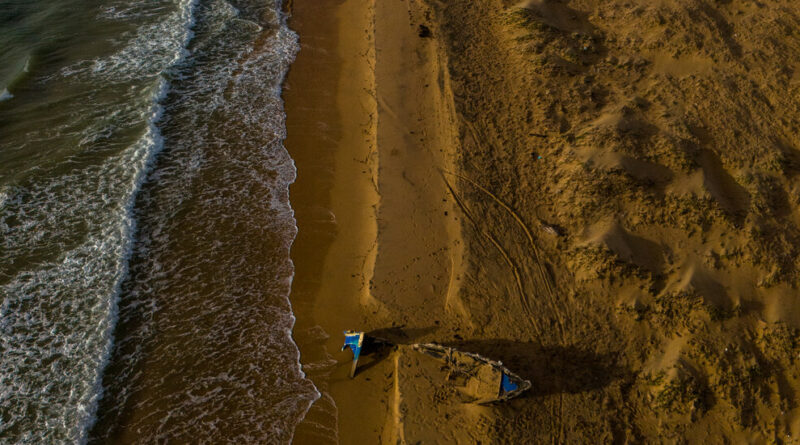
On Colombia’s Guajira peninsula, where The New York Times found the first physical evidence of one of the strikes last December, nearly all the men had left the towns of Puerto López and Siapana, each just a few miles from where a bombed boat and two bodies of its crew members washed ashore.
Aristótele Palmar García, a police inspector in Siapana, said the area had become a ghost town.
“Youth who made their living fishing, you know, selling, buying, they’ve gone to the city now, driving motorcycle taxis, that kind of thing,” Mr. García said. “I ask them how it’s going for them and they tell me, ‘To be honest, I’m about to throw in the towel.’”
Colombia’s state-run forensic agency said in an emailed statement that they still had the bodies of the two people that washed ashore in December in their custody, but that they had not been able to “establish the identities.”
The strikes reached their peak last December, with 14 that month. But the pace has recently begun increasing again, and the period between April 11 and May 8 saw a strike nearly every three days.
During that time period, the military increased the number of secret fixed-wing attack aircraft and armed MQ-9 Reaper drones operating from bases in El Salvador and Puerto Rico, allowing the military to accelerate the strikes.
Before the increase in aircraft, a suspected drug boat might have had a 50 percent chance of evading the military, a U.S. military official told The Times in an interview. Now that is down to about 25 percent, the official said.
Neither the military nor the administration has disclosed any information about the strikes except for social media posts that contain grainy videos of the strikes themselves.
In November, The Times examined video of more than 40 strikes and consulted military aviators and weapons experts, and found that the U.S. military used both drones and manned aircraft, contrasting with traditional stop-and-board operations by the U.S. Coast Guard.
Fishermen in Ecuador said they had feared harassment in the past by the U.S. military, as well as from their own, patrolling nearby waters, but that the possibility of being bombed by an unmanned drone was particularly unnerving.
“We don’t want anyone to fish anymore,” said Johnny Valencia, 59, a lifelong fisherman from Jaramijó, a few miles north of San Mateo. Now he picks up plastic bottles that wash up on the beach and sells them to recyclers, earning even less than he did fishing.
“We eat once a day, twice a day,” he said, “or sometimes go to bed without even having a cup of coffee.”
Simon Posadaand Eric Schmitt contributed reporting.