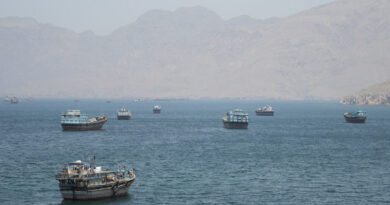
US-Iran tit-for-tat strikes over Hormuz expose risks of prolonged standoff
WASHINGTON — The Pentagon’s Middle East command on Tuesday denied a report that the US Navy had resumed guiding commercial ships through the Strait of Hormuz, saying the maritime operation paused by President Donald Trump last month has not yet restarted.
“US forces are not currently escorting commercial shipping through the Strait of Hormuz,” Navy Capt. Timothy Hawkins told Al-Monitor, saying that a report in The Wall Street Journal that the US Navy had helped a Greek tanker navigate the waterway was “not true.”
The denial by Hawkins followed an exchange of fire between the US and Iranian militaries within the strait and on Iran’s southern coast overnight on Monday. The flare-up threatened to disrupt down-to-the-wire ceasefire negotiations between the Trump administration and Iran’s leaders toward an agreement that White House officials hope will result in Tehran reopening the strait.
Overnight on Monday, the US Air Force carried out multiple strikes near the Islamic Revolutionary Guard Corps Navy’s main base at the southern port of Bandar Abbas. US aircraft first sank IRGC boats that a US official alleged were attempting to lay mines in the strait. American warplanes later struck suspected Iranian missile launch sites after Iran’s forces attempted to target US vessels in the waterway in response, the US official said.
The mutual blows on Monday came as Iranian negotiators arrived in Qatar. Pakistan’s Prime Minister Shehbaz Sharif and Army Gen. Asim Munir also met in Beijing the same day with China’s President Xi Jinping in an apparent attempt to break the impasse.
Hormuz flashpoint
US military officials on Monday denied their side’s strikes violated the ceasefire, saying the actions were taken in self-defense.
“US Central Command continues to defend our forces while using restraint during the ongoing cease-fire,” Hawkins said in a statement following the incident.
In public comments, Pentagon officials have previously dismissed such intermittent exchanges of fire as the result of the IRGC’s fractured command structure. Although Trump has repeatedly characterized Iran’s military as having been destroyed by the US air and naval campaign, senior military officials have cautioned that Iran may still be capable of launching small-scale attacks in the region intermittently.
Earlier this month, Trump abruptly reversed a US Navy escort mission announced just a day prior by the Pentagon. Defense officials described the mission, dubbed Project Freedom, as an effort to protect commercial ships seeking to transit the strait in a bid to undermine Tehran’s grip on the economically vital waterway. Trump aborted the mission under pressure from Saudi Arabia and other Gulf states after Iran targeted energy infrastructure in the United Arab Emirates in retaliation.
Another US official, speaking on condition of anonymity, said recent assistance to ships attempting to transit the strait did not amount to a resumption of the Navy’s mission. The official added that further requests for help were likely as crews aboard vessels stranded at sea for weeks due to the impasse continued trying to navigate the waterway.
Deal still elusive
A proposal to lift the US blockade of Iran’s ports in exchange for opening the Strait of Hormuz during a 60-day ceasefire extension is currently being negotiated between the White House and Iranian leaders, Axios reported on Saturday. The global price of Brent crude briefly fell below $100 per barrel over the weekend amid hopes that negotiations facilitated by Pakistan, Qatar and Egypt could produce a breakthrough.
Yet the exchange of strikes between the US and Iran on Monday offered a glimpse of a potentially prolonged status quo for American military forces and commercial shipping companies should the talks yield little further progress.
Iran insists it will not relinquish its stockpile of enriched uranium, while the US maintains that Tehran must do so, one way or another.
Iran’s Foreign Ministry spokesperson Esmaeil Baghaei on Monday cited progress between the two sides on the broad issues but threw cold water on claims that a final agreement was at hand. “To say this means the signing of an agreement is imminent — no one can make such a claim,” Baghaei said.
Trump echoed that in a post on Truth Social on Monday, saying he ordered US negotiators “not to rush” to reach an agreement, adding that “both sides must take their time and get it right.”
US Secretary of State Marco Rubio similarly hedged during a gaggle with reporters while traveling in India on Monday: “I think it’s a lot of talking back and forth going on about specific language in the initial document.”
Trump is “going to make a good deal or no deal,” Rubio added. “But that may take a little while,” he said. “I mean, a few more days.”