Days After Hosting Trump, Xi Deepens Ties With Putin
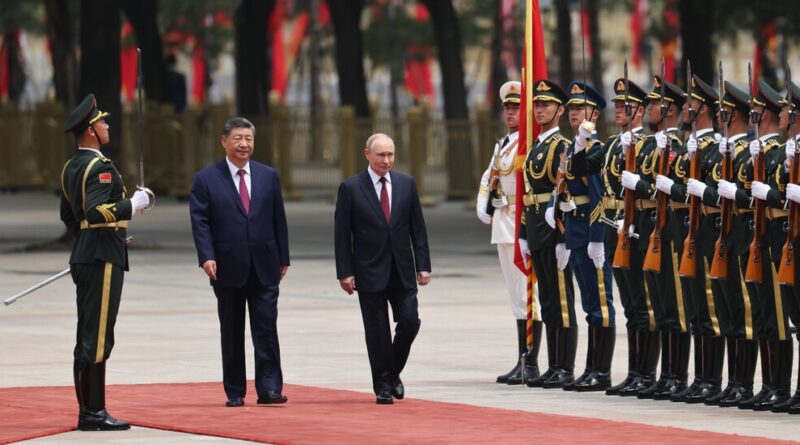
Less than a week after holding talks with President Trump, China’s top leader, Xi Jinping, met with President Vladimir V. Putin of Russia in Beijing on Wednesday, casting the two countries’ relationship as a stabilizing force in a world thrown into tumult by the United States.
“The tide of unilateral hegemony is running rampant,” Mr. Xi said to Mr. Putin, according to Chinese state media, in an oblique reference to the United States, which this year launched a war in Iran and violently seized the leader of Venezuela.
Speaking to Mr. Putin inside the Great Hall of the People, Mr. Xi called for a “complete cessation of hostilities” in the Middle East, warning that it would be “unacceptable” if fighting renewed. The Trump administration has been considering relaunching strikes, which have been paused since a cease-fire was announced last month, to force Iran to reopen the Strait of Hormuz.
Mr. Xi acknowledged the pain the crisis is inflicting on China, which relies on the strategic waterway for about 40 percent of its oil imports. There is also growing concern that Iran’s ongoing shutdown of the strait could devastate global trade, the chief engine of China’s economy.
“An early end to the conflict would help reduce disruptions to energy supply stability, the smooth operation of industrial and supply chains, and international trade order,” Mr. Xi said.
The two countries are expected to strengthen bilateral ties and sign economic and trade deals during Mr. Putin’s two-day visit. Mr. Xi said on Wednesday that “China-Russia relations have entered a new phase of more active engagement and faster development.”
But beneath that show of solidarity lies an uneven relationship. Russia has become increasingly dependent on China since launching an invasion of Ukraine four years ago that has turned into a costly stalemate, as Russian soldiers struggle to gain ground and the country’s economy falters.
Russia also relies heavily on China for dual-use technologies — civilian capabilities that can be applied to the battlefield. Mr. Putin will want to ensure that China maintains that supply.
At the same time, the oil shortage caused by the war in Iran has only enhanced Russia’s position as an energy supplier to China. Mr. Putin, who is traveling with Russian energy executives, has been urging China for years to agree to open a major gas pipeline between the two countries, and will likely renew those calls during the meeting.
Known as Power of Siberia 2, the pipeline would link Siberian extraction sites with northwest China through Mongolia. Beijing is concerned the pipeline would make China too dependent on one nation for energy supplies.
Russia could also dangle promises to share military technology knowledge with China, though the two countries would almost certainly not disclose such deals.
By meeting so soon after Mr. Trump’s visit, Mr. Xi and Mr. Putin are signaling their commitment to serving as a counterweight to the West. Mr. Xi on Wednesday cast China and Russia as model nations defending “international fairness and justice” and he hailed their close ties “despite countless trials and tribulations.”
Even as Mr. Xi deepens ties with Mr. Putin, he has invested heavily in courting Mr. Trump, whose tariffs, technology restrictions and support for Taiwan can hurt Beijing’s interests. The Chinese reception of both Mr. Trump and Mr. Putin reflected the balancing act Mr. Xi is striking between the two leaders.
Mr. Putin’s red carpet welcome was similar to Mr. Trump’s, featuring an honor guard inspection, a 21-gun salute and a group of cheering children.
While Mr. Trump had been greeted at the airport by Han Zheng, China’s vice president, Mr. Putin was met by China’s top diplomat, Wang Yi. Yun Sun, director of the China program at the Stimson Center in Washington, said that in her view, Mr. Han was the more senior official, but Wang Yi played a more active role in foreign policymaking.
During last week’s summit with Mr. Trump, Mr. Xi was friendly, despite the frequent tensions between the United States and China. Mr. Xi took Mr. Trump inside the secretive Chinese leadership compound in Beijing known as Zhongnanhai on Friday and seemed to signal that he was being granted rare access.
Mr. Trump asked Mr. Xi if he had hosted other world leaders there.
“Very rarely,” Mr. Xi said. “For example, Putin has been here.”
Berry Wang contributed research.