As a Weakened Putin Follows Trump to Beijing, Iran War Offers an Opening
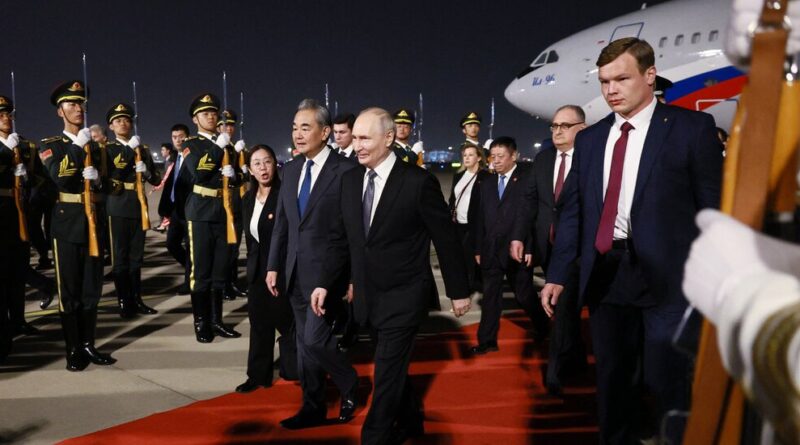
President Vladimir V. Putin of Russia arrived in Beijing on Tuesday for a state visit in a position of relative weakness.
His army is struggling to move in Ukraine. His seat of power, Moscow, has been increasingly vulnerable to Ukrainian drones. Russia’s economy is under severe strain. More Russians are growing tired of what increasingly looks like a fruitless and endless war.
Even in better times for Moscow, its relationship with Beijing has been defined by economic imbalance. “China has massive leverage and can dictate exactly what it wants from this menu of bilateral cooperation,” said Aleksandr Gabuev, the director of the Carnegie Russia Eurasia Center in Berlin.
Still, Russia is not content being relegated to junior partner to China. Its nuclear arsenal, far larger than Beijing’s, could make it an important ally in any superpower conflict, including over Taiwan. The invasion of Ukraine has positioned Moscow as a leader of an emerging non-Western world order supported by Beijing.
And then there is the opening provided by the war against Iran waged by the United States and Israel.
Five days after an architect of that conflict, President Trump, left Beijing at the end of his own state visit, Mr. Putin will join the Chinese leader, Xi Jinping, for a day of meetings on Wednesday.
The upheaval that Mr. Trump has caused in the Persian Gulf has disrupted energy supplies to China, and Russia has promoted itself as a reliable alternative. Russian officials hope to leverage the Middle East crisis to deepen energy ties with Beijing, including by moving ahead with a stalled pipeline project.
Ivan Timofeev, the director general of the Russian International Affairs Council, a think tank co-founded by the country’s foreign ministry, said the Middle East conflict showed how Russia could “mitigate for China the risks associated with logistics and the Persian Gulf.”
“Russia retains a crucial strategic role here for China in the event of such escalations,” Mr. Timofeev said on Friday during a news conference in Moscow.
By hosting Mr. Putin just days after Mr. Trump’s visit, Mr. Xi is tending to his relationship with his most important strategic partner and casting China as an indispensable global power.
Since December, Mr. Xi has welcomed to Beijing the leaders of France, Canada, Britain, Germany and the United States. In his summit with Mr. Trump, Mr. Xi argued that China and the United States were now peer powers and that they should avoid prioritizing competition.
Mr. Putin has been working to position himself advantageously between Mr. Trump and Mr. Xi.
The Russian leader has tried to cultivate Mr. Trump, seeking his help in securing a favorable resolution to the invasion of Ukraine and reaping the benefits of renewed business relations after the war.
Mr. Putin’s ties to Mr. Xi, however, run far deeper. The Russian leader has worked to develop a well-documented bond with his Chinese counterpart, calling him his “dear friend” and “best bosom friend.”
Mr. Xi is expected to reaffirm that closeness on Wednesday.
“Both sides will seize this opportunity to continue to promote the development of China-Russia relations to a deeper and higher level, injecting more stability and positive energy into the world,” a Chinese Foreign Ministry spokesman, Guo Jiakun, said on Monday.
Mr. Putin struck a similar note in an address published by the Kremlin on Tuesday ahead of the visit. “The close strategic relationship between Russia and China plays a major, stabilizing role globally,” he said, adding, “Without allying against anyone, we seek peace and universal prosperity.”
In Mr. Putin, Mr. Xi sees a like-minded leader frustrated by American dominance of the global order, said Julian Gewirtz, a senior director for China and Taiwan affairs at the National Security Council in the Biden administration.
While Mr. Trump lavished praise on the Chinese leader during his visit to Beijing, “Xi’s embrace of Putin this week should be a reminder that Beijing’s closest international partners are connected by their shared emphasis on resistance to the United States,” Mr. Gewirtz said.
Russia and China declared a “no limits” strategic partnership in early 2022, weeks before Moscow invaded Ukraine.
The economic asymmetry in the relationship is glaring. Beijing supplies more than a third of Russia’s imports and buys more than a quarter of Moscow’s exports, while Russia accounts for only about 4 percent of China’s international trade, a share smaller than Vietnam’s.
Although Russia’s economic dependence — including for parts to power its war machine — constrains its actions toward China, the Kremlin has gone its own way at times.
While Western officials believe that Mr. Xi has been urging Mr. Putin not to use nuclear arms in Ukraine, Russia moved such weapons into neighboring Belarus in 2023, and Russian forces are currently holding nuclear exercises in Belarus even as Mr. Putin visits Beijing.
But the advantages of a partnership with Moscow are clear to China, especially in comparison to the United States.
“Russia remains a predictable partner, whereas the United States is not,” said Andrei Kortunov, an expert on international affairs with the Kremlin-linked Valdai Discussion Club. He added that Mr. Putin had been visiting China regularly, while Mr. Trump’s last visit occurred in 2017.
As the Chinese and Russian leaders have grown closer, so have their countries.
Last year, both began to allow their citizens to conduct visa-free travel. Hundreds of thousands of Russians visited the Chinese island of Hainan in 2025, according to the Association of Russian Tour Operators, and the numbers have continued growing this year.
In Moscow, schools with Mandarin on the curriculum have been oversubscribed. One Russian governor has taken pride in the fact that his children can recite poems in Chinese dedicated to Russian-Chinese friendship. Highways in Moscow and other Russian cities are now filled with Chinese-made cars. Chinese restaurants pepper the streets.
“The bilateral relation continues to thrive, and Russians are still very positive and curious about China,” Kirill V. Babaev, the head of the Institute of China and Contemporary Asia at the Russian Academy of Sciences, said in response to written questions.
“Surprisingly,” he added, “the conflict in the Middle East has made China even closer for Russians who turned to Chinese resorts instead of the Middle East.”
Mr. Babaev also pointed out that Chinese and Russian companies had found ways to conduct payments that bypass Western sanctions. “A transaction from a sanctioned Russian bank to an account in China now takes less than half an hour,” he said, adding that in 2024 “it could take weeks.”
While the conflict in the Middle East has seemingly reversed Russia’s economic fortunes, even if temporarily, it has more fundamentally turned Moscow into an increasingly indispensable energy supplier for China and other countries.
For years, Russia has been trying to push China to go forward with a major new gas pipeline, known as Power of Siberia 2, that would link its Siberian extraction sites with China’s northwest through Mongolia. But Beijing has been hesitant, trying to push for lower energy prices and fearing that the pipeline would deepen its dependence on one supplier too much.
The energy shock from the Iran conflict may have upended that dynamic, underscoring the importance for China, the world’s largest importer of natural gas, to diversify its supply options beyond the Middle East.
“The war in the Persian Gulf is a new factor — it has influenced Chinese planning and the signals we are receiving from our Chinese colleagues,” said Vasily Kashin, the director of the Center for Comprehensive European and International Studies at the Higher School of Economics in Moscow.
“As I see it, the chances of concluding a deal on Power of Siberia 2 will continue to grow for now.”
Catie Edmondson contributed reporting from Seoul.