Iraqi militia leader in US custody after arrest: What to know
The US government said on Monday it had arrested a senior member of an Iran-backed Iraqi militia, accusing him of plotting and carrying out attacks across Europe and in the United States.
What happened: The US Justice Department said Mohammad Baqer Saad Dawood Al-Saadi was charged with six terrorism-related offenses and was involved in nearly 20 attacks and attempted attacks. He was arrested in an unspecified foreign country, transferred to US custody, and brought to the United States, where he appeared in a New York court on Friday, the department said in a statement.
US media outlets including CNN and ABC reported that Saadi was arrested in Turkey.
The Justice Department described Saadi, 32, as a senior member of Kataib Hezbollah, one of the most prominent Iran-backed militias in Iraq, which is directly supported by the Islamic Revolutionary Guard Corps (IRGC). He and his associates allegedly planned, coordinated, and claimed responsibility for at least 18 terrorist attacks in Europe and two in Canada in recent months, including the attempted bombing of a Bank of New York Mellon branch in the Netherlands.
The department said Saadi acted in the name of Harakat Ashab al-Yamin al-Islamiya (HAYI), a mysterious pro-Iran group that has claimed dozens of attacks in Europe since the start of the Iran war, many of them targeting the Jewish community on the continent. The department described HAYI as a “component” of Kataib Hezbollah.
Saadi allegedly plotted in April and May to target Jewish institutions in New York, California and Arizona. He spoke to an undercover law enforcement officer about these plans, the department said.
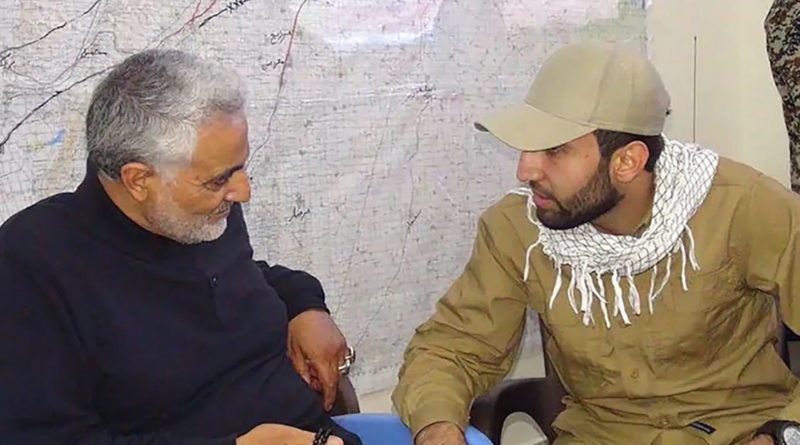
The US Attorney’s Office for the Southern District of New York posted images from Saadi’s social media showing him with slain IRGC Quds Force commander Qassem Soleimani.
Alleged Terrorist Arrested: “For years, Al-Saadi sought to disrupt American society through intimidation and violence. In a righteous and just contrast, his prosecution will highlight the best of our country,” said U.S. Attorney Jay Clayton. @TheJusticeDept @FBI @FBIWFO… pic.twitter.com/yl272z7Vyx
— US Attorney SDNY (@SDNYnews) May 15, 2026
Soleimani was killed in a US drone strike in Baghdad in January 2020. He was widely considered one of Iran’s leading military strategists.
Telegram channels affiliated with Kataib Hezbollah and other Iran-backed militias did not report any comment from the group. Al-Monitor’s efforts to reach a lawyer for Saadi were unsuccessful.
Why it matters: HAYI has drawn the attention of authorities across Europe in recent months and claimed responsibility for a stabbing attack on two Jewish men in London in late April. A Somali-born British citizen was arrested in connection with the attack and is due in court next week, according to the BBC.
Dutch authorities said in March they would probe alleged Iranian links to explosions targeting Jewish institutions in the country.
The Iranian embassy in London said earlier this month that it denies any role in antisemitic violence in the United Kingdom.
The Trump administration is placing increasing pressure on Iraq to rein in Iran-backed armed groups in the country. Since April, the US government program Rewards for Justice — which offers rewards for information leading to the capture of wanted individuals — has announced rewards of up to $10 million each for information on four pro-Iran militia leaders.
Iraqi Prime Minister Ali al-Zaidi took office on Thursday and pledged to place all weapons in the “hand of the state.” Zaidi has received public backing from both the US and Iran.
The militias have claimed hundreds of attacks on US forces in Iraq since the war with Iran began, leading to American airstrikes on their positions. A number of Iran-backed groups, including Kataib Hezbollah, are part of the semi-official Popular Mobilization Units (PMU). The PMU formed in 2014 to fight the Islamic State and was technically integrated into the armed forces two years later, but its components operate with considerable autonomy.