Hantavirus Doesn’t Spread Easily, but Officials May Be Downplaying Risks
Close, sustained contact.
That, health officials have repeatedly said, is the only way that the Andes hantavirus, which caused an outbreak on a cruise ship and has gripped the world’s attention, spreads among people.
“You have to be in close contact with someone who has a lot of symptoms,” Dr. Jay Bhattacharya, acting director of the Centers for Disease Control and Prevention, said in an interview on Fox News.
But scientists who have studied hantaviruses for decades are far less certain about how the virus might behave.
They agree with health officials that the Andes virus is not particularly contagious and is unlikely to spur a bigger outbreak. But they said research has shown that under certain circumstances, the virus can be transmitted without direct contact.
“It’s important to be honest scientifically and communicate that, because otherwise you lose credibility,” said Steven Bradfute, a viral immunologist and hantavirus expert at the University of New Mexico.
In an interview, Dr. Tedros Ghebreyesus, director general of the World Health Organization, acknowledged that officials have emphasized close contact as the way the virus spreads to avoid panicking people over rarer possibilities.
“It’s very difficult to explain to people saying, ‘OK, this is the exception, this is the norm,’” he said. “When you say the exception, they might still think that that’s something frequently happening as well.”
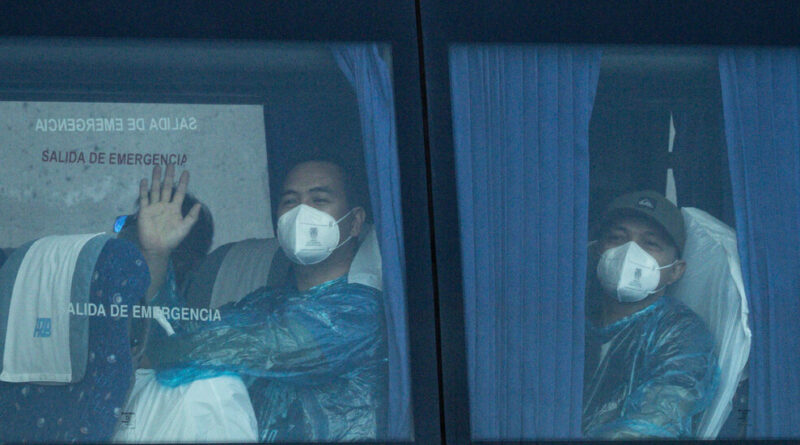
The hantavirus outbreak that began on the Dutch cruise ship MV Hondius last month has thus far sickened at least nine people and killed three. Many of the roughly 150 passengers, including 18 in the United States, are being closely monitored in quarantine. The remaining were given a set of instructions to avoid spreading the virus to others including: take your temperature daily, don’t fly commercial and try to use your own bathroom.
On CNN’s State of the Union on Sunday, Dr. Bhattacharya could not recall when some passengers who disembarked on April 24 in St. Helena, an island in the Atlantic Ocean, had arrived on American soil. None had symptoms at the time of their travel, he said, so officials had not seen a need to alert the public or trace contacts.
“The virus doesn’t spread unless somebody has active symptoms,” he said.
That, too, is not certain, although some scientists believe people may be most contagious just as they are developing symptoms.
Some labs have studied hantaviruses for decades, but there is still much that’s not known about them because they grow slowly and are difficult to analyze genetically.
Hantaviruses are naturally found in rodents. The Andes virus, found primarily in Argentina, where the cruise ship began its journey, is the only hantavirus species known to spread among people. But scientists were slow to acknowledge that possibility.
“It was very difficult to convince people of that, even here in Argentina,” said Valeria Martinez, a virologist at the National Institute of Infectious Diseases in Buenos Aires.
In the largest outbreak characterized so far, in Epuyén, Argentina, Dr. Martinez and her colleagues carefully traced transmission patterns among 34 cases and 11 deaths between November 2018 and February 2019.
The study confirmed that the virus does not spread easily: None of 82 health workers who cared for patients became infected, even though many of them did not wear protective gear.
But the researchers also identified what they called “super-spreading events,” in which a single person spread the virus to several others. The outbreak began after a man who became infected from rodents developed a fever, and attended a birthday party with 100 guests.
“He was there only 90 minutes because he was feeling ill,” Dr. Martinez said.
Within three weeks of the event, five people at the party had become ill. One of those five soon died, and his wife most likely passed the virus to another 10 people at his wake. In all, six of 34 cases in the outbreak had no direct contact with those who were ill, and one seems to have become infected after simply saying hello as they crossed paths.
“That’s not close contact, and it’s also not prolonged contact,” said Joseph G. Allen, director of the Healthy Buildings program at the Harvard T.H. Chan School of Public Health.
Studies so far suggest that the disease is most contagious when people are carrying a lot of virus, perhaps just as they are starting to feel sick. But there have also been too few outbreaks large enough to be sure of that.
“We have so little data that it’s really hard to say anything concrete or definitive,” said Kartik Chandran, a virologist at the Albert Einstein College of Medicine.
Still, the fact that there have been very few cases should in and of itself reassure people that the virus is not very contagious, he and other experts said. After weeks of being cloistered together on the ship, only 11 of the roughly 150 passengers became infected, Dr. Tedros noted. “You can see how the virus actually is not really as efficient as Covid,” he said.
One person in the Argentina outbreak became ill after sharing a hospital room with a hantavirus patient, but again, had no physical contact.
Hantavirus typically infects people when they breathe in virus particles aerosolized from rodent droppings. That fact, some experts believe, leaves open the possibility that person-to-person transmission could possibly occur through the air too.
“I don’t understand why we are so reluctant to acknowledge the inhalation route when we’re talking about person-to-person transmission,” said Linsey Marr, an expert in airborne transport of viruses at Virginia Tech.
“Airborne transmission is certainly the simplest explanation in those cases,” she said of the Argentinians who had no direct contact with patients.
Dr. Tedros of the W.H.O. said his organization had not referred to the findings about the birthday party spread because they have not been replicated by other studies and because close contact is the most common way the virus spreads.
But Gustavo Palacios, a virologist at the Icahn School of Medicine at Mount Sinai and an author on the paper, disagreed with that stance.
“Our paper is important because it helps define the outer boundary of what Andes virus can do under favorable transmission conditions,” he said. “Most events will not look like that, but public-health guidance still has to account for that possibility.”
In the United States, the C.D.C. did not issue any guidance or statements on the hantavirus outbreak until late on Friday, and did not hold a news briefing till Saturday, nearly a month after the first passenger died. It still describes transmission as requiring close or intimate contact.
The C.D.C. appears to have designated an arbitrary measure of closeness, acknowledging the threshold as “not absolute.” It has cited being at a distance of less than six feet for longer than 15 minutes, out of the Covid playbook, as an indication of risk.
In public, some U.S. health officials have shown uncertain command of the facts of the current outbreak. Speaking about the first two people who died from the virus on the Fox News interview, Dr. Bhattacharya incorrectly said the couple had been in their 80s (they were 70 and 69) and added, “People who were very close to them, the roommates, a doctor who was caring for them, they’re the ones who got symptomatic.”
He was wrong about the details. C.D.C. scientists were not on the ship to investigate the outbreak, but W.H.O. officials who led the investigation are still working out how other passengers became infected.
The third person who died, an 80-year-old German woman, was not a roommate of the first two or even on the same deck. But she may have shared meals or been in other spaces with them, said Dr. Maria Van Kerkhove, the W.H.O.’s director of epidemic and pandemic preparedness.
Andrew Nixon, a spokesman for the Department of Health and Human Services, which oversees the C.D.C., said federal agencies have “been fully engaged from the outset.”
He did not respond to questions about the scientific basis for the six-foot guidance or about Dr. Bhattacharya’s errors.
“Attempts to second-guess this response overlook the ongoing work being done to protect the health and well-being of American citizens,” he said.
The W.H.O. does not include the six-foot distance in its guidance and its description of the outbreak acknowledges the scarcity of data, including on transmission.
“We are learning, and we will continue to learn, I think, for quite some time,” Dr. Van Kerkhove said. “The book is not written.”