Alberta Separation Petition Is Dealt a Court Blow
A judge in Alberta on Wednesday delivered a blow to activists’ efforts to hold a referendum on the Western Canadian province’s split from the country, siding with an Indigenous group that argued the government has an obligation to consult with it as their rights would be directly affected by secession.
The ruling of the Court of King’s Bench of Alberta sided with the Indigenous group, the Athabasca Chipewyan First Nation, in its lawsuit against the provincial government.
The group argued that the secession of Alberta from Canada would introduce new international borders, violating its rights under long-established treaties.
The group maintained that the government was obliged to consult it before allowing activists to collect signatures to force a vote.
The court ruling, which the pro-separation activists and the province’s leadership said they will appeal in a higher court, is a significant obstacle to the effort of a growing minority in Alberta to split the landlocked oil-rich province from Canada.
What had once been a small, fringe movement pushing for separation on cultural and economic grounds has in recent years grown to a more mainstream movement that polls suggest is supported by about 30 percent of Alberta’s population.
Pro-independence activists say that an independent Alberta would be better off on its own because the federal government of Canada is biased against their conservative values and has put environmental regulations and overly punitive taxation on them and the province’s main resource, oil. The government, under prime minister Mark Carney, has in recent months made some efforts to allay those concerns by supporting the building of a new pipeline from Alberta to the Western coast of Canada to sell oil to Asian markets.
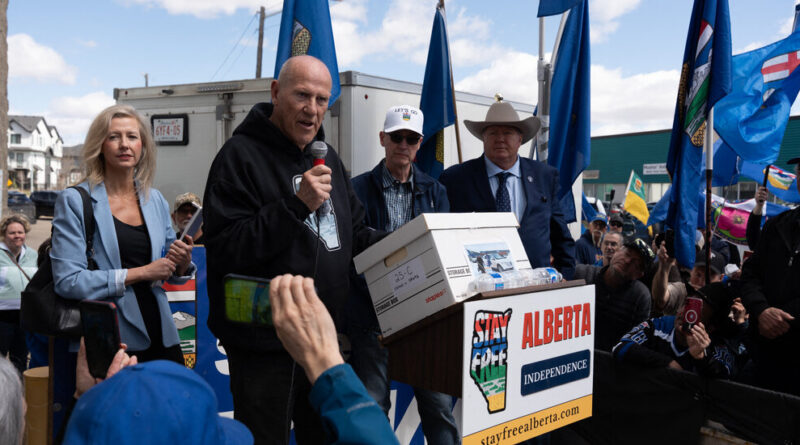
Earlier this month, Stay Free Alberta, a pro-separatist group that had been energetically canvassing, submitted a petition with more than 300,000 signatures to Elections Alberta, the province’s electoral body.
The signatures would need to be counted and validated by Elections Alberta, but were well over the threshold required to trigger the referendum, which had been slated for the fall. The counting process had not begun because of the court case.
In her ruling on Wednesday, Judge Shaina Leonard said that “as a matter of logic and common sense, there can be no doubt that Alberta’s secession from Canada will have an impact on Treaties 7 and 8,” referring to the treaties relevant to the Athabasca Chipewyan First Nation.
Mitch Sylvestre, a leader of the Stay Free Alberta pro-independence movement that submitted the petition, said that it was appealing the ruling.
“This is not a setback for us, it’s exactly what we were expecting,” he said by phone on Wednesday.
Danielle Smith, the premier of Alberta, said in a televised news conference that her government would appeal the decision. “We think there’s been an error in law,” she said. “We think it’s undemocratic.”