Eurovision Song Contest gets off to a tense start, overshadowed by Gaza
By Francois Murphy
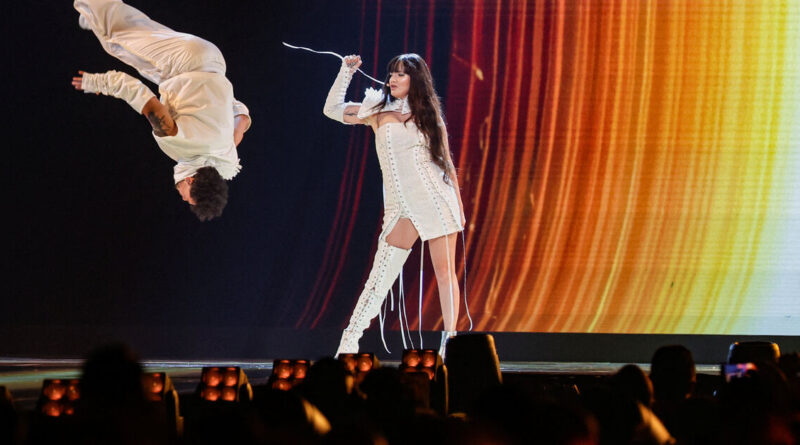
VIENNA, May 12 (Reuters) – The Eurovision Song Contest gets off to a tense start in Vienna on Tuesday with a protest due to be held hours before the first semi-final featuring Israel, whose attendance prompted five countries to boycott over the Gaza war.
The contest, traditionally a good-natured celebration of pop music and high camp now in its 70th year, has become mired in crisis over Israel’s military offensive in Gaza in response to the Hamas-led attack of October 7, 2023.
The public broadcasters of five countries – Spain, the Netherlands, Ireland, Iceland and Slovenia – are boycotting this year’s event, making it the smallest since 2003 with 35 entries. That will also most likely reduce viewership from last year’s estimated 166 million, more than the Super Bowl’s 128 million.
‘WE WILL NOT BE TERRORISED’
A first protest, expected to draw an estimated 500 people, was planned for Tuesday afternoon and the tension in the city was palpable ahead of the semi-final scheduled for 9 p.m. (1900 GMT).
“We won’t let ourselves be terrorised into silence,” Vienna Mayor Michael Ludwig of the Social Democrats said on Friday in an angry response to a small group of pro-Palestinian protesters who blew whistles at a concert he was speaking at.
“Unfortunately we will need large security measures because of people like you, for example. That will incur great expense, but we will nevertheless hold a festival of togetherness, I can promise you that,” he said.
The joint head of Amnesty International Austria, Shoura Hashemi, said on X Ludwig should apologise for his “unbearable, false, divisive” remarks aimed at peaceful protesters.
Austrian officialdom is strongly supportive of Israel, and pro-Palestinian protests are small. A handful of protests are planned this week, with attendance estimated at up to 3,000.
IRELAND SAID ATTENDANCE WOULD BE ‘UNCONSCIONABLE’
Police also say there could be spontaneous protests, particularly on Saturday, the day of the final. A cold snap, with rain and temperatures not due to exceed 18 degrees Celsius (64 degrees Fahrenheit) all week, could help keep numbers down.
Irish broadcaster RTE referred back to its statement in December that it would be “unconscionable” to take part.
Israel often alleges a global smear campaign against it.
At least 1,200 people were killed in the October 7 attack, most of them civilians. Israel responded by launching an assault on the enclave that killed more than 72,000 Palestinians, mostly civilians, and left much of Gaza in ruins.
Israel’s contestant last year was Yuval Raphael, a survivor of the attack, who came second thanks to a massive public vote.
Its contestant this year, Noam Bettam, has no obvious political connotation but did receive a formal warning on Saturday for posting videos instructing the public to vote for him 10 times, the maximum allowed.
Contest Director Martin Green told Reuters he hoped those boycotting would return.
“They are members of our family, right? We miss them,” he said, adding: “We remain in dialogue to see if we can find pathways for them back.”
(Editing by Alexandra Hudson)