The Iran War and Angry Voters
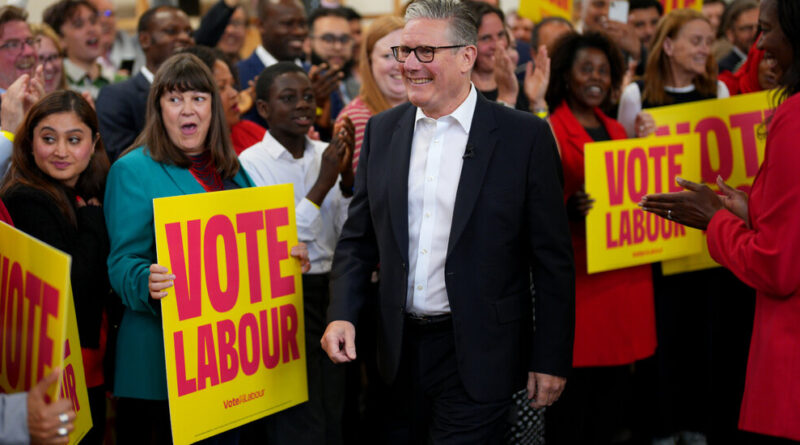
Much of Britain goes to the polls today. There are local elections in England, and parliamentary elections in Wales and Scotland. They are a big test for the government of Prime Minister Keir Starmer, whose Labour Party is bracing for crushing losses. If pollsters are right, the right-wing populist Reform U.K. party will win the highest overall vote share.
There are many reasons Europe’s political center is so unpopular. Starmer’s counterparts in Germany and France are also polling at historic lows. But the war in Iran isn’t helping. Today I write about how the economic crisis sparked by the war is accelerating the rise of the nationalist right across Europe.
How the Iran war is boosting Europe’s far right
Last week I was in Germany, where I met with officials, journalists and a leader of the far-right Alternative for Germany party. I was struck by how much the conversation had shifted from just a few months ago, when I was last there. People not only expect the AfD to win an outright majority in state elections in September — they openly discuss the possibility of the AfD running, or at least joining, the federal government after the next national election.
The AfD is now the strongest party in opinion polls. Recent surveys show that it would win between 26 and 28 percent of the vote if elections were held today. That puts it ahead of Chancellor Friedrich Merz’s center-right Christian Democrats, at 22 to 24 percent, and at nearly twice the level of the Social Democrats, his coalition partner.
The far right has been on the rise for years. And Merz’s government has failed to deliver on many fronts, from infrastructure to economic growth, accelerating that rise. But what’s striking is that the AfD’s most recent surge in the polls — and the latest decline of the center-right and center-left — coincide with the economic fallout from the war in Iran.
That’s emblematic of a wider phenomenon. Since the U.S. and Israel attacked Iran, incumbent governments around the world have been facing voters who are angry about the economic pain the war has inflicted. But in Europe in particular, where the most prominent opposition increasingly comes from right-wing populist parties, that has meant a near-continent-wide boost for the far right.
‘Crisis entrepreneurship’
The war has battered economies around the world. Protests over rising energy costs have rocked capitals from Dublin to Nairobi to Manila.
But Europe is noteworthy because populist parties across the continent have a well-honed playbook for capitalizing on just this sort of voter frustration. And they’re turning to it now.
I spoke to Mark Leonard, director of the European Council on Foreign Relations, who has interviewed far-right leaders for his new book, “Surviving Chaos.” He told me how the so-called new right in Europe thrives in the midst of crisis.
Right-wing populist parties use crises like the war, Leonard said, “to build their own legitimacy by showing that the mainstream parties are overwhelmed by them and unable to control the country’s destiny.” Then, they argue that the government response to the crisis highlights how these mainstream parties are not on the side of the people.
The AfD offers perhaps the starkest examples of this kind of “crisis entrepreneurship,” Leonard said. Born out of Europe’s debt crisis in the early 2010s as an anti-euro party, it used the migrant crisis of the mid-2010s to reinvent itself as an anti-immigrant party. It then tapped into anti-vaccine sentiment during the pandemic to present itself as the party of freedom.
In every one of these crises, Leonard said, the AfD argued that mainstream parties were on the side of foreigners or elites: They wanted to bail out Greeks, or let in refugees, or deprive Germans of basic freedoms.
The energy crisis resulting from the war is another opportunity for the AfD, Leonard said. It may show that not only are mainstream parties unequipped to manage a complicated world, but once again, with their efforts to, say, ban nuclear power and reduce fossil fuel reliance, they’re out of touch.
For parties like the AfD, Leonard said, an event like the war is “kind of manna from heaven.”
Solving the Trump problem
Starmer, who has been unpopular for a long time, was never going to have a good election.
But in January, before the war, he gave a speech about how Britain had turned a corner. Growth was projected to be 1.3 percent this year and an interest rate cut seemed imminent. Now, in the face of rising inflation, that cut has been shelved and the economy is barely expected to grow at all. With Britain predicted to take the biggest hit of any major economy as a result of the war, polls show Labour could lose three-quarters of its current seats.
In Germany, no far-right party has held power at the state or federal level since the end of World War II. But polls show the AfD could win an outright majority in the eastern state of Saxony-Anhalt this fall. That would render the firewall — the longtime consensus among other parties never to go into coalition with the far right — irrelevant.
Britain and Germany are not set to hold national elections until 2029, provided their weakened governments last that long. The next big European country to hold a national election where the far right might triumph is France in April next year.
When Trump was re-elected, Europe’s nationalist right celebrated. But his tariffs and threats to invade Greenland increasingly made him a liability with voters. The Trump boost became a Trump problem.
Ironically, perhaps, the war in Iran — which is as unpopular in Europe as anything the president has ever done — is helping far-right parties to solve that problem now.
For more: A sense of disaffection and frustration is rampant across Britain, opinion polls suggest. It will likely fuel an electoral disaster for Starmer’s party. Here’s what to know about the elections.
Conflicting messages on the state of Iran negotiations
Iran and the U.S. offered contradictory and rapidly changing assessments on the state of the war and peace talks yesterday.
Trump, hours after threatening more attacks on Iran, said in remarks from the Oval Office that the U.S. had “very good talks” with Iran in the last 24 hours. “We’re in good shape, and now we’re doing well, and we have to get what we have to get,” he said.
Iran gave a different take. Its Foreign Ministry spokesman said yesterday that the government was reviewing an American plan to end the war and would give its response to Pakistan, which is mediating talks. Earlier in the day, another official dismissed a reported proposal to end the war as “more a list of American wishes than a reality.”
For more: For Iran, lifting the U.S. military blockade of its ports and relieving pressure on its economy is one of the main incentives to seek a deal, my colleague Farnaz Fassihi writes. The country is running out of space to store its oil.
Israel applies the Gaza model in Lebanon
An analysis of satellite images, photos and videos verified by The Times shows the scope of Israel’s campaign in southern Lebanon. Widespread demolitions have flattened expanses in at least two dozen towns and villages near the border, with damage to government offices, schools, hospitals and mosques.
Israel says its operations are aimed at dismantling Hezbollah’s military infrastructure. Videos show that Israeli soldiers are using the same tactics in Lebanon that they employed in Gaza, including controlled demolitions. Take a look.
Football: Paris Saint-Germain defeated Bayern Munich to set up a Champions League final against Arsenal. Read the highlights.
QUESTION OF THE DAY
That’s what Aiden, an 8-year-old from California, asked the Artemis II astronauts, who were guests on “The Daily” podcast this week. The crew members shared their reflections about what it feels like to be so far from Earth, and much more.
MORNING READ
An inheritance dispute in the family that runs LG is pulling back the curtain on chaebols, the massive conglomerates that dominate South Korea’s economy.
The widow and daughter of the former LG chairman filed a criminal complaint in 2024 that said they were made unwitting participants in an illegal ownership structure that reduced their rightful inheritance and favored a male heir. They also say the chairman’s wealth was far greater than publicly disclosed. Read about the secret recordings at the heart of their claim.
World Cup or bust
It’ll be tough for Argentina fans at the World Cup this year. Supporters have always flocked to the tournament in the tens of thousands. But this year, for the first time, FIFA has adopted dynamic pricing.
Argentina’s struggling economy often forces people to work two or even three jobs to make ends meet. And the new pricing system, similar to the way airline and concert tickets are sold, means tickets to see the most popular teams have spiked to staggering levels. Individual tickets for Argentina games now top $800, double the price of equivalent tickets for other teams in their group.
“It’s like they are trying to make some business with our passion,” one fan said. Still, some are selling their cars, maxing out credit cards and sleeping 10 to a room, just so they can go. Read more about the most expensive World Cup ever.
Cremini mushrooms, chickpeas and bulgur wheat mimic the texture of ground meat in this vegetarian twist on Swedish meatballs. Seasoned generously with allspice and nutmeg and blanketed in a velvety mushroom gravy, they are excellent over egg noodles or mashed potatoes.