
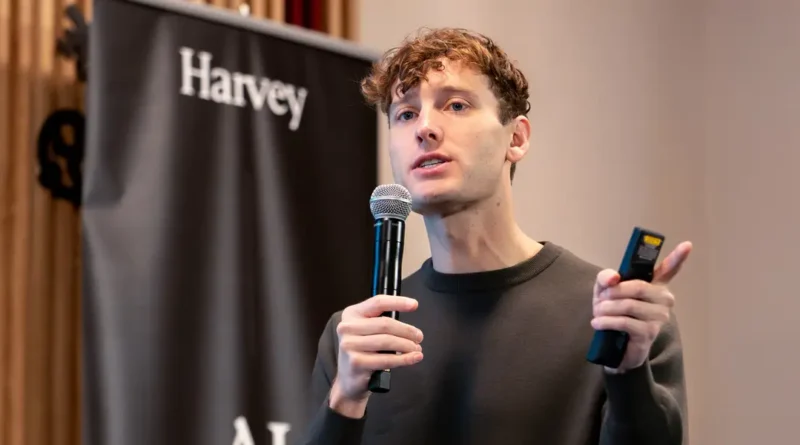
Harvey's CEO says AI agents are picking up more legal work, and that will change how firms staff lawyers
Lawyers have always been professional delegators.
Partners give work to associates who hand down tasks to junior lawyers and paralegals. Winston Weinberg, the CEO of Harvey, thinks artificial intelligence agents are about to become the next link in that chain of command.
That is the idea behind Harvey’s latest product push. The $11 billion legal software startup made its name with software that lets lawyers chat with documents and ask legal research questions. Now, Harvey is moving deeper into agents — software that uses AI to perform tasks on behalf of users.
The company tells Business Insider exclusively it now has 500 agents live in its software, covering legal workflows across major practice areas. Harvey also redesigned its tool called Agent Builder that lets lawyers customize their own agents without writing a line of code.
Weinberg said agent usage is already “exploding” among customers, despite the company still being in the early days of teaching firms how to use them. Harvey said its users run more than 700,000 agent-powered tasks a day, and that hours spent in Harvey’s software per user each month have risen 75% over the past four months, an increase the company largely attributes to agent adoption.
Agents have already transformed what it’s like to be a coder. Instead of writing code themselves, many software engineers are directing agents that can write code, test it, and iterate.
Harvey is among the startups building the tools to carry that transformation into legal. Founded in 2022, the company was one of the first to show the profession what software powered by large language models could do for legal research and drafting. Today, Harvey says its software is used by more than 100,000 lawyers across 1,500 law firms and enterprises.
Harvey’s rise has also stoked debate over what happens to a business that bills by the hour when software starts saving so much time. Tools like Harvey also raise questions about what becomes of junior lawyers whose early careers depend on the very grunt work agents are built to handle.
Harvey’s prebuilt agents are designed to pursue specific goals — think drafting a memo, preparing for negotiations, or running diligence on a merger — with lawyers reviewing and guiding the work along the way. Lawyers spend more time upfront defining the task and giving instructions for agents to follow.
“It’s going to go out and do that task and it might take 20 minutes,” Weinberg said, “but it will automate something that would normally take 10 hours, 20 hours.”
Harvey charges customers a subscription fee to use its software, including agents and its build-your-own-agent feature. Its closest competitor, Legora, is also developing agents that can perform legal tasks from start to finish, and recently acquired a startup focused on building those systems.
Weinberg said the shift to agents that can take on more complex tasks makes human oversight more important, not less. If an agent is reviewing a million documents and producing a hundred-page report, he said, the software needs “an incredible amount of verification processes” built in.
Harvey is working on standardized tests, often called “evaluations,” to measure how well its agents perform across specific tasks. It is also building quality-control agents that check other agents’ work.
The question is what that leaves for corporate lawyers to do. Weinberg does not think agents will wipe out legal roles, but he does think they will change how legal work is staffed.
His view is that firms will put fewer lawyers on each matter as work is offloaded to agents. At the same time, he expects firms to be able to take on more business overall as companies create more products, contracts, and complexity with artificial intelligence in play.
“My sense is you might need less lawyers than you do today on each matter, but you’re going to have way more matters,” Weinberg said.
The pie may grow. Harvey wants its agents to take a slice.
Have a tip? Contact this reporter via email at mrussell@businessinsider.com or Signal at @MeliaRussell.01. Use a personal email address and a non-work device; here’s our guide to sharing information securely.