Analysis-Drone diplomacy wins Ukraine valuable allies, but now it must deliver
By Daniel Flynn
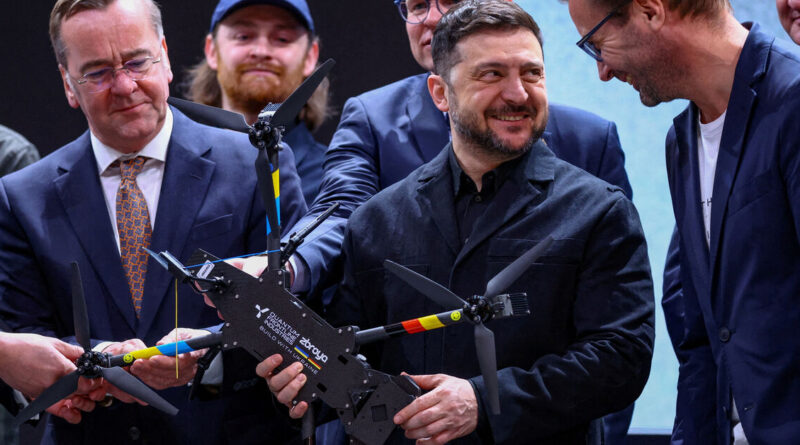
KYIV, April 28 (Reuters) – President Volodymyr Zelenskiy has leveraged Ukraine’s expertise in drone warfare into a series of successful diplomatic deals during visits to the Middle East and Europe, showcasing how Kyiv is using military prowess to boost its diplomatic clout.
This month alone, Ukraine has signed defence and drone deals in Germany, Norway and the Netherlands, following long-term security partnerships with Saudi Arabia, Qatar and the United Arab Emirates in late March.
Zelenskiy has in recent weeks also agreed security cooperation with Turkey and Syria, and signed agreements at the weekend with Azerbaijani President Ilham Aliyev on defence and energy.
Since Russia’s invasion in 2022, Zelenskiy has sought to strengthen Kyiv’s alliances, both with Western allies and with countries of the “global south”, to restrict Russia’s diplomatic sway.
The Iran war has confirmed how central drones are to modern warfare and handed Zelenskiy a diplomatic bargaining chip at a time when U.S. support for Kyiv appears unreliable, analysts say.
Since Russia invaded, Ukraine has invented cheap and highly effective ways to counter drone attacks instead of relying only on state-of-the-art defensive missile systems such as the costly U.S. Patriot, used by the U.S. in the Gulf.
Ukraine has also developed long-range attack drone capabilities to hit Russian energy infrastructure.
“Zelenskiy is really trying hard to show that Ukraine is an asset and not a liability and that it has an answer to the changing nature of war,” said Orysia Lutsevych, head of the Ukraine Forum at Chatham House, a London-based think tank. “Ukraine now needs to organize itself to actually deliver.”
UKRAINE’S EXPORT CONTROLS HAMPER DEALS
Ukraine’s drone manufacturers say they have significant spare capacity, but the government has approved only a handful of defence export licenses.
Ukraine has begun drone manufacturing overseas, including in Germany and Britain, but that production is earmarked for its own military needs.
“In Ukraine, the choke point is the export control: basically it’s an export ban,” Lutsevych said, adding that Ukraine needed to streamline the rules. “It needs to find a balance between its war needs and exports.”
Another challenge for Ukraine is that its success has mostly been in developing effective systems – such as coordinated layers of interceptor drones, machine guns and jamming devices for drone defence – rather than cutting-edge technology.
As a shop window for these techniques, Ukraine has deployed about 200 experts to the Gulf to help defend against Iran’s Shahed long-range drones.
Kurt Volker, a former U.S. NATO ambassador and Ukraine envoy during President Donald Trump’s first administration, said Kyiv was rightly cautious about sharing its wartime systems too widely.
“Much of what the Ukrainians have done is develop process and mentality,” Volker said, adding Ukraine was concerned about Russia learning how its systems operate. “What any business would do is protect your IP for as long as possible. That’s what makes it valuable. So of course they’re doing that.”
RELIANT ON HUMAN OPERATORS
Ukraine’s low-cost air defences rely on the training and skill of the operators of its interceptor drones, said Fabian Hoffmann, a senior researcher at the Norwegian Defence University College.
That has been highly effective against propeller drones, such as Russia’s Geran-2, but the gradual introduction of jet-powered models that can fly at 400 km (250 miles) an hour are making it harder for human operators.
“Ukraine has been moving towards autonomously guided interceptor drones but, so far, the operators have done a lot of the heavy lifting,” Hoffmann said, adding that European companies such as Tytan in Germany and Frankenburg in Estonia were developing autonomous systems that might erode Ukraine’s advantage.
Military exports would bring economic benefits to Ukraine, experts say. About 400,000 people already work in Ukraine’s defence industry, according to UCDI, a manufacturers’ association. A better-capitalized defence sector could also reduce reliance on Western financial and military support, and fuel economic growth after an eventual ceasefire.
Zelenskiy hopes drone diplomacy can help secure energy supply deals with Middle Eastern states and markets for Ukraine’s agricultural produce.
He also wants to strengthen Ukraine’s missile defences. The U.S.-Israel war with Iran has raised concerns in Ukraine that supplies of Patriot systems – used to bring down Russian ballistic missiles – could dry up as Washington prioritizes its own needs.
Ukraine’s $4-billion defence pact with Germany this month included supplies of Patriots and pledges of cooperation to create a European ballistic missile defence. Zelenskiy has said Ukraine needs its own anti-ballistic missile defences within a year.
Hoffmann said the challenges of building an interceptor capable of downing modern maneuvering ballistic missiles was enormous: the Patriot PAC-3, with a success rate of perhaps 60%, was the fruit of decades of work, he said.
Underlying Ukraine’s push, analysts say, is concern over Washington’s reliability as a partner.
“He (Zelenskiy) understands that America stopped being an ally,” Lutsevych said. “The Ukrainians also understand that they need to walk a fine line by keeping America on side as long as possible.”
(Editing by Timothy Heritage)