China’s Economy Starts to Show Cracks From Iran War
Rising oil and natural gas prices from the war in Iran are beginning to weigh on the Chinese economy, further slowing already anemic consumer spending and hurting critical export sectors.
Car sales fell in March and plunged further in April. Restaurants and hotels are seeing fewer customers as households turn cautious. In southern China, thousands of toy factory workers protested last week after their employer collapsed under rising plastic costs and ongoing tariffs in the United States.
The emerging signs of strain underscore how even China, with vast strategic oil reserves and massive investments in renewable energy, is not immune to the forces pressuring economies worldwide.
For many weeks, China had appeared to weather the fallout from the war, a view reinforced by fairly strong economic data through March. But with the war in its ninth week with no clear end, cracks are beginning to show.
“The economy is decelerating,” said Alicia García-Herrero, chief economist for Asia Pacific at Natixis, a French financial firm. China may struggle to meet this year’s growth target of 4.5 percent or more, she added.
One of the clearest signs of emerging weakness is in car sales and production, often considered early indicators of trouble. Cars are the second-largest purchase for many Chinese households after apartments, and the industry drives demand for steel, glass and other materials.
China’s retail car sales plunged 26 percent in the first 19 days of April from a year earlier, according to the China Passenger Car Association. While part of the drop reflects weaker electric-vehicle sales after tax incentives expired in December, gasoline-powered cars fared worse, falling by nearly 40 percent.
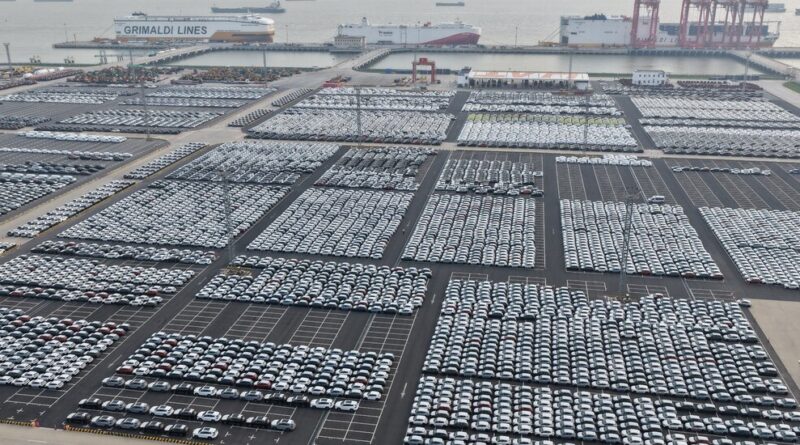
Falling sales have left dealership lots crowded with unsold cars, triggering production cutbacks. Chinese car factories made 27 percent fewer cars in the first two weeks of April than a year earlier, a sharp pullback even as exports rise.
At first glance, the economy still looks resilient. But a closer look suggests underlying weakness.
This month, China said that its economy grew at an annualized rate of 5.3 percent during the first three months of this year. But most of the strength was in January and February.
Retail sales decelerated in March, rising just 1.7 percent from a year ago. The China Federation of Logistics and Purchasing said inventories of unsold goods continued to build. Michael Pettis, a Peking University economist, said rising inventories could drag on future growth.
On Monday, industrial profits data showed continued strength through March, offering a possible buffer against a downturn. But much of that gain came from chemical and energy firms cashing in on a one-time windfall from higher oil and gas prices after stockpiling cheaply before the war.
China’s strategic oil reserves and huge refineries leave it far less exposed than its Asian neighbors. China has also shielded consumers from the full brunt of rising fuel costs, permitting its state-controlled oil companies to pass along only half of any increase in oil prices.
The picture is grimmer in the toy industry.
Thousands of workers who lost their jobs took to the streets last week in southern China, staging daily protests to demand back pay and compensation from several toy factories that abruptly closed on April 20.
The closures came as costs for plastic, which is made from oil and natural gas, surged after traffic slowed through the Strait of Hormuz, the waterway connecting the Persian Gulf to energy buyers around the world. China’s toy industry was already under pressure from rising costs, foreign competition and President Trump’s tariffs.
The shuttered factories are in Yulin City, a low-wage toy manufacturing hub about 260 miles west of Hong Kong.
Workers draped banners across factory gates with slogans like, “Give me back my blood and sweat money.” In videos, protesters mill quietly while police officers in blue uniforms and reflective vests stand nearby.
Numerous short videos of the protests have circulated online in China. While displays of public unrest are usually censored, these clips have remained, possibly because the protests are peaceful and Beijing has urged companies to meet their obligations to workers.
Repeated calls on Friday and Monday to government and Communist Party offices in Yulin City went unanswered. The closed factories belong to Hong Kong-based Wah Shing Toys, which did not respond to phone calls and an email for comment.
The company’s Yulin subsidiary issued a statement to workers that quickly spread online, saying it was closing factories and filing for bankruptcy because of tough conditions abroad. The statement cited “escalating trade friction between China and the U.S. in recent years,” and a challenging overseas business environment, noting that unpaid bills from foreign customers had hurt its cash flow.
Soaring plastic prices have become a problem for China’s toy industry, including for another cluster of manufacturers in Shantou, a city located 190 miles northeast of Hong Kong, which produces a third of the world’s toys.
Ten days after the war started on Feb. 28, the Shantou Chenghai Toy Association warned of “hoarding and panic,” as plastic prices skyrocketed.
Murphy Zhao and Ruoxin Zhang contributed reporting and research.