8 Memorable Moments From Past British Royal Visits to the U.S.
King Charles III and Queen Camilla’s visit to Washington comes as the relationship between Britain and the United States is in turmoil, with President Trump having repeatedly lobbed insults at Prime Minister Keir Starmer over his refusal to join the Iran war.
But the role of the British monarchy, which is officially apolitical, has often been to distract from the messiness of everyday politics and, through ritual and ceremony, point to something more enduring.
Here are a few pivotal moments in previous British royal visits to the United States.
1. Hot dogs and bridge-building
The trip came some 160 years after the Declaration of Independence and had a specific aim. With Hitler’s aggressive territorial ambitions becoming clear and war in Europe looming, Britain needed to strengthen ties with an increasingly powerful, but officially neutral, America.
The king and his wife, Queen Elizabeth (later known as the Queen Mother), were served hot dogscranberry jelly and strawberry shortcake at a picnic at President Franklin D. Roosevelt’s family retreat, Top Cottage, near Hyde Park, N.Y.
“It was ascertained that the King not only came back for more hot-dog sandwiches but drank beer with them,” a New York Times reporter wrote at the time.
The king recorded in his notes that he had raised the topic of the approaching war with Mr. Roosevelt. “On mentioning the Neutrality Act the President gave us hopes that something could be done to make it less difficult for the USA to help us,” George wrote.
The trip represented a brief moment of optimism in an increasingly bleak political landscape. Within three months, Hitler would invade Poland and World War II would begin. The United States did not enter the war until after Pearl Harbor was attacked in December 1941, although Mr. Roosevelt began to provide some military aid to Britain in 1940.
A 25-year-old Princess Elizabeth arrived in Washington with her husband, Prince Philip, in October 1951 after a trip to Canada. The princess made a very positive impression on the Trumans, including on the president’s daughter, Margaret Truman, who was among those meeting Elizabeth and Philip at the airport.
“I am sincerely sorry that you can’t go from one end of the country to the other, as you did in Canada,” President Truman told Elizabeth in his welcome speech“and let everybody in the country have a chance to get acquainted with you, because Margaret tells me that whenever anyone becomes acquainted with you, they immediately fall in love with you.”
The next year, King George died at 52, and Elizabeth became queen.
3. Suez and scones
Elizabeth’s first visit to the United States as monarch was in 1957, and helped restore good relations after the disastrous Suez Crisiswhich had severely damaged Britain’s reputation on the world stage.
With President Dwight E. Eisenhower as host, the queen and Philip stayed at the White House in the same suites as Elizabeth’s parents had in 1939. In welcoming them, the president underlined the endurance of the U.S.-U.K. friendship in spite of the disagreement over Suez, saying, “Those ties have grown up in periods of tranquillity and peace.”
Two years later the Eisenhowers followed up with a visit to Balmoral, the royal home in the Scottish Highlands. In a striking example of the many forms that royal diplomacy can take, Queen Elizabeth went on to share a recipe in a 1960 handwritten letter:
“Dear Mr President,
Seeing a picture of you in today’s newspaper standing in front of a barbecue grilling quail, reminded me that I had never sent you the recipe of the drop scones which I promised you at Balmoral.
I now hasten to do so, and I do hope you will find them successful…”
You can find the recipe here.
4. The kids are all right
In 1970, a new generation took on the task of burnishing Anglo-American relations. Charles, then the 21-year-old Prince of Wales, and his sister, Princess Anne, visited Washington for what The Times called “an informal but strenuous two‐day visit.”
The Times’s reporter, Christopher Lydon, made clear that the trip was more laid back, and probably more fun, than the state visits carried out by the monarch:
“The royal visitors’ real hosts are the President’s daughters, Tricia and Julie, and Julie’s husband, David Eisenhower, who together have planned a round of games, sightseeing and parties at which people over 30 will be seen rarely, if at all.”
5. A long way from 1776
Two hundred years after America declared independence from Britain and castigated King George III for his “repeated injuries and usurpations,” Queen Elizabeth came to Washington to help celebrate that moment.
President Gerald R. Ford thanked her for a “very timely visit and by your gracious participation in this great reaffirmation of American pride.”
The first lady then, Betty Ford, later wrote in her memoir:
“The Queen was easy to deal with. She was very definite about what she wanted and what she didn’t want. She loves Bob Hope and Telly Savalas, so we invited Bob Hope and Telly Savalas.”
6. A severe storm, but diplomatic smooth sailing
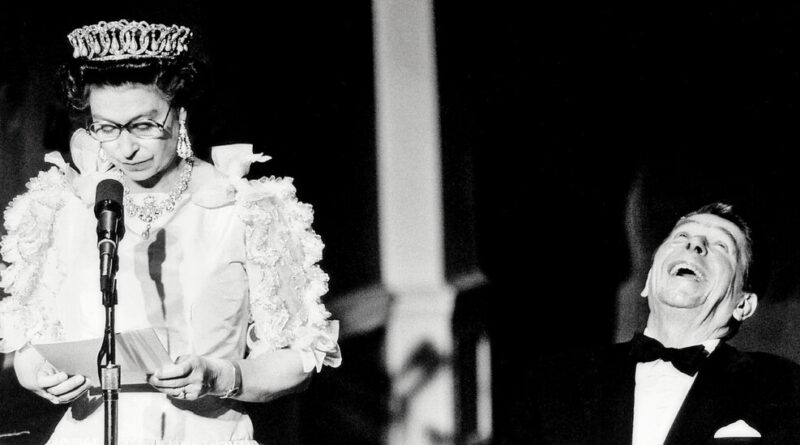
The queen relied on a classic British conversational topic to lighten her speech at a dinner with President Ronald Reagan in San Francisco in March 1983.
“I knew before we came that we had exported many of our traditions to the United States,” she said. “But I had not realized before that weather was one of them.”
Elizabeth had planned to sail into Santa Barbara, Calif., on the royal yacht, Britannia, as part of her 10-day visit to the United States. But a severe storm forced a change of plans, and the queen and Prince Philip instead had to take a U.S. Air Force plane to nearby Goleta, where they were met by the president and his wife, Nancy, and driven to the Reagans’ home in Santa Barbara. The queen thanked the president for his support of Britain in the Falklands War, which had taken place the previous year.
In a thank-you note to Mr. Reagan, the queen wrote:
“I hope that this visit will have served to strengthen even further the friendship between our countries and to remind the world that we are allies for always.”
7. A dazzling dance
Charles, then Prince of Wales, visited the United States again in 1985, this time with his first wife, Diana.
The three-day trip was not of great diplomatic significance, but it did yield a dazzling cultural moment at the White House, captured by the photographer Pete Souza: Diana, in a midnight blue velvet dress, dancing with John Travolta to the “Saturday Night Fever” soundtrack.
According to the Ronald Reagan Presidential Librarythe dance was “a well-orchestrated moment put together by Mrs. Reagan herself.” Diana apparently told the first lady that she wanted to dance with Mr. Travolta, and Mrs. Reagan made it happen.
In 1991, Queen Elizabeth notched up another milestone as the first British monarch to address Congress, at the request of President George H.W. Bush.
Karen de Witt, who covered the event for The New York Times, described the standing ovation for the queen as she entered the chamber. But she also noted that some lawmakers boycotted the speech to protest the British state’s actions in Northern Ireland.
In her speech, the queen thanked America for its leadership in the Persian Gulf war that year, while warning against a reliance on military force:
“Some people believe that power grows from the barrel of a gun. So it can, but history shows that it never grows well nor for very long. Force, in the end, is sterile. We have gone a better way: Our societies rest on mutual agreement, on contract and on consensus.”