History of Hurufism and Nuqtavism: Letters, Numbers, and Revelation
Between the Mongol conquests of the thirteenth century and the consolidation of the Safavid state in the sixteenth, Iran, Azerbaijan, and Anatolia produced a crowd of messianic movements. The old Abbasid order was gone, the caliphate in Baghdad had been destroyed, and Sufi brotherhoods, Shi’i networks, and charismatic claimants to the title of Mahdi filled the vacuum. Most of these movements left little behind. Two of them left manuscripts, poetry, rebellions, and martyrs: the Hurufis, who held that the letters of the alphabet are the structure of reality, and the Nuqtavis, who broke from the Hurufis and replaced the letter with the point.
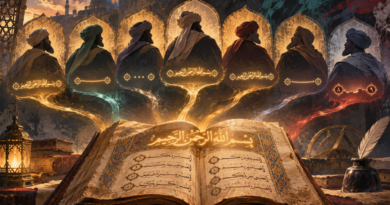
Both movements start from something every Muslim already has. The Quran opens twenty-nine of its suras with isolated letters whose meaning the tradition has never settled, and it describes creation as the product of speech: God says “Be,” and it is. The Arabic of 36:82 reads innamā amruhu idhā arāda shay’an an yaqūla lahu kun fa-yakūn. If creation is speech and speech is made of letters, then the letters are not a neutral container for meaning. They are, on this reasoning, the stuff of being itself. The Hurufis took that premise and built a religion on it. The dilemma they pose is one every student of the Quran eventually meets: at what point does close attention to the structure of the text stop being interpretation and become a new revelation that displaces the old one? Both movements crossed that line, and the way each crossed it explains why each was crushed.
Fadlallah Astarabadi and the Founding of Hurufism
The founder was Fadlallah Astarabadi, born around 1340 in Astarabad, in the Caspian region of northern Iran. He wrote in Persian and in the Gorgani dialect of his home region, composed poetry under the pen name Naimi, and gathered disciples while Timur’s armies were reordering the political map of the Islamic East. His central work is the Javidan-nama, the “Book of Eternity,” which survives in more than one recension and is arranged in a way that has long frustrated readers. Its pieces seem to follow no obvious sequence, and modern scholars still debate how to read it.
The core of the teaching is that God manifests Himself in language, and that the human being is the place where that language becomes visible. Arabic has twenty-eight letters and Persian has thirty-two, the extra four being the letters for sounds Arabic lacks. The Hurufis found these numbers written on the human face, which they said bears seven lines (the hairline, the two eyebrows, and so on) multiplied across the four elements, giving twenty-eight. The face is therefore a text, and a person who reads it correctly is reading God. This is a doctrine with deep roots in Shi’i and Sufi thought, including the old microcosm and macrocosm analogy and the Ismaili habit of locating divine reality in a human figure. What distinguishes the Hurufis, as the Cambridge History of Iran observes, is that they located the reality in the substance of letters rather than in the person of the Imam.
The method that connects text to reality is taʾwil, the tradition of interpretation that moves from the apparent sense of a word to its hidden source. The scholar Orkhan Mir-Kasimov, who has produced the most thorough recent study of Fadlallah, translates the term in this context as “ontological hermeneutics.” For Fadlallah, interpreting a verse was not a matter of finding its intended meaning. It was a matter of tracing the verse back to the letters from which the world was made. Abjad reckoning, the assignment of numerical values to letters, then allowed the Hurufi reader to find correspondences between words, names, and events, in a manner closely parallel to Jewish gematria.
The messianic claim followed from the method. Fadlallah taught that prophecy moves in cycles, and the Hurufis counted him as a manifestation of the divine force coming after figures like Adam and Moses. He announced the end of the old cycle and the dawn of the one in which the hidden meaning of scripture would be fully disclosed. Resurrection, judgment, paradise, and hell were read as events in the human sphere and the present age rather than as distant future happenings. His followers held that he was the Mahdi, and some went further and said that God had become manifest in him.
That was a fatal claim to make in the court politics of Timur’s sons. Fadlallah was arrested in the Caucasus and executed in 1394 by Miranshah, Timur’s son, at the fortress of Alinja. His movement did not die with him. His disciples spread through Iran, Azerbaijan, and Anatolia, and the most famous of them was the poet Imadaddin Nasimi, who wrote in Azeri Turkish, Persian, and Arabic. Nasimi’s verses declared the divinity of the human face in language that echoed the Sufi martyr al-Hallaj’s cry “I am the Truth,” and he was executed in Aleppo around 1418, reportedly by flaying. In 1426, a man identified in the chronicles as a Hurufi attacked the Timurid ruler Shahrukh in Herat, and the political authorities drew the obvious conclusion that the movement was a danger to the state as well as to orthodoxy. The community was driven underground in Iran.
From Persecution to the Bektashi Lodges
Hurufism survived by moving west. Disciples such as Ali al-Ala, who died in Azerbaijan in 1419, and Nasimi’s student Rafii, who went to the Balkans and died in Preveza, carried the doctrine into Ottoman territory. There it found a home in the Bektashi Sufi order and in the wider Alevi milieu of Anatolia. The Bektashis preserved the manuscripts, and many of the Hurufi texts we have today were copied in the Balkans and kept in Bektashi lodge libraries, including the Javidan-nama itself. Hurufi ideas shaped Bektashi poetry and ritual, including the habit of reading the human face as a divine text, and the order remained a repository of Hurufi teaching in Anatolia and the Balkans into the modern period. One scholarly account describes roughly five centuries of Hurufi manuscript activity in the Balkans, with a peak in the eighteenth century. The poetry of the Hurufi authors also left a mark on the development of Azeri and Ottoman Turkish as literary languages.
So the Hurufis were defeated as a political force and absorbed as a spiritual one. The same cannot be said of the movement that split from them.
Mahmud Pasikhani and the Nuqtavi Revolt
Mahmud Pasikhani came from Pasikhan in Gilan and had a personal link to Fadlallah. According to one standard account, he was expelled from the Hurufi community for arrogance. He then proclaimed himself the Mahdi around 1397, in the Hijri year 800, a date with obvious millennial weight, and he gathered his own following in the area of Anjudan near Kashan, a region long associated with Nizari Ismaili Shiism. His movement took its name from the Arabic and Persian word nuqṭa, “point.” Where the Hurufis found the ultimate unit of reality in the letter, the Nuqtavis found it in the point from which every letter is drawn. In their cosmology, the earth’s element was the source of all existence, and human bodies were temporary arrangements of matter that dissolved and recombined. This led them to a doctrine of the transmigration of souls and to a reading of resurrection as the recurrence of life in new forms. Scholars have pointed to Indian religious philosophy as a possible background for the transmigration idea, though that connection is debated.
The Nuqtavis then did what the Hurufis never quite did: they declared the end of Islam as a dispensation. Their calendar held that the earth’s existence spans 64,000 years, divided into four periods of 16,000 years, each of those split into two halves of 8,000 years, one an Arab epoch and the other a Persian epoch. The Arab epoch, the age of Muhammad and his Arabic scripture, had run its course. A Persian epoch had begun, with Pasikhani as its Mahdi. This explains the movement’s attachment to the four letters that Persian added to the Arabic alphabet, which they treated as spiritually significant in their own right, and it explains their promotion of Persian over Arabic in devotional life. A religion tied to an Arab epoch was, on this logic, a religion whose time had passed.
They also built their system around the number nineteen, based on Sura 74 verse 30 of the Quran, which states, ʿalayhā tisʿata ʿashar, “over it is nineteen.” Pasikhani never married and urged celibacy on his followers, teaching that the celibate attain the rank of wāḥid, which has the numerical value of nineteen. Pasikhani died around 1427 without bringing in the Persian age he had announced. His followers did not give up, and the movement acquired a second life in the sixteenth century.
Under the Safavids and in India
The Safavid dynasty, founded by Shah Ismail in 1501, had itself risen out of a messianic Sufi order, and its early military backbone was a body of Turkmen tribesmen, the Qizilbash, who treated their ruler as semi-divine. As the dynasty settled into statehood, its rulers tried to curb the radical elements that had carried them to power and to build a Twelver Shi’i establishment on legal foundations. The Nuqtavis, who had spread through Kashan, Qazvin, and other cities, were a standing challenge to that project. Around 1571, some of them attempted to proclaim Shah Tahmasp as the Mahdi, which was a gamble that his reign could be bent toward a movement that rejected the legal religion he was trying to enforce. Tahmasp refused it. The Nuqtavi poet Abu’l-Qasim Amri was reportedly blinded under Tahmasp and later killed under Shah Abbas.
The decisive confrontation came under Shah Abbas I, who took the throne in 1588. The Safavid chronicles of his reign tell the story differently, and modern scholars have compared them to sort out what actually happened. The chroniclers disagree about whether Abbas had been sympathetic to the Nuqtavis or even financed their center in Qazvin, about how he became convinced they were dangerous, and about who presided over the trial of their leader, Darvish Khosrow. One chronicle has the trial held before a figure called “Shah Yusufi,” a reference to the temporary substitute king installed during a court astrological crisis. What all the accounts agree on is the outcome. Darvish Khosrow was condemned, and the Nuqtavis of Qazvin were massacred. Shah Abbas had the movement’s remaining leaders hunted down, and it ceased to exist as an organized community in Iran.
Some Nuqtavis had already fled east. The movement had a presence in India, and Safavid officials suspected that the Mughal emperor Akbar, whose court was full of exiles and religious experiments, had been drawn toward it. How much real influence the Nuqtavis had on Akbar’s religious policy is a question the surviving evidence cannot settle, but the fact that Safavid intelligence took the possibility seriously says something about how large the Nuqtavis loomed in the imagination of the Persian state.
A late echo also deserves mention. In the nineteenth century, the writer Ali Muhammad Nazim al-Shariah claimed that the Bab, founder of the Babi movement, had absorbed Nuqtavi doctrines while imprisoned at Maku and carried them into his Bayan. The historian Nader Saiedi rejects the direct derivation, while acknowledging that the Nuqtavi and Babi systems share certain elements of numerical and letter symbolism.