Uber and Zipline's drone delivery service takes off in Texas, with dozens of cities to follow | TechCrunch
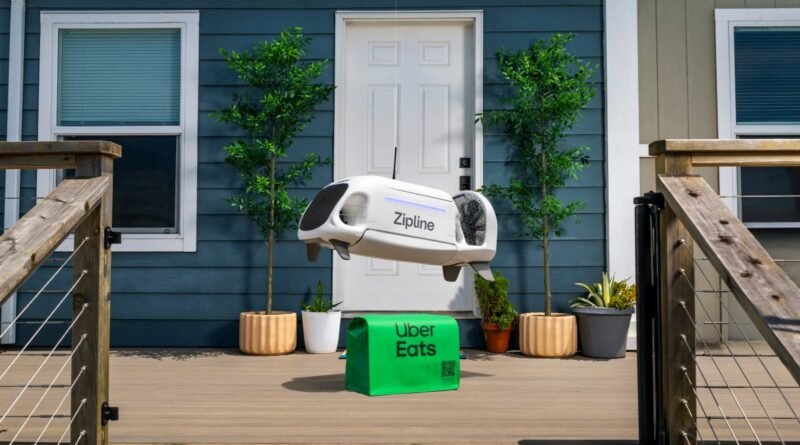
Uber Eats customers in a Houston suburb can now have their food delivered by a Zipline drone, the first commercial launch under a partnership announced earlier this year between Uber and the autonomous drone delivery startup.
The commercial partnership kicks off Tuesday in Spring, Texas, before expanding to Dallas. But the companies have far larger ambitions. Uber and Zipline plan to launch drone delivery services in dozens of additional U.S. cities in their collective bid to make one million deliveries per day using the startup’s drones by the end of 2029.
Zipline’s long-range autonomous delivery drones will be used to shuttle food orders weighing up to eight pounds to Uber Eats customers, flying about 300 feet above the ground at speeds of up to 70 miles per hour. Zipline drones don’t land. Instead, the drones lower the orders, which are encased in a small protective pod, to the customer’s location using a tether.
Uber Eats customers in service areas will be able to tap a new “drone” icon on the app’s home page to view all participating restaurants. Uber said that at launch in the Houston area, several nationwide chains, including Jersey Mike’s and Zaxby’s, along with dozens of local restaurants such as Urban Bird and Abu Omar Halal will offer drone delivery.
“In partnership with Uber Eats we’re going to create a new expectation for delivery in America,” Zipline CEO and co-founder Keller Cliffton said in a statement that underscores those aspirations.
Those nationwide goals mirror the ambitions of other drone delivery companies, including Alphabet-owned Wing and Amazon’s Prime Air service. And those plans have started to collide with concerns from residents in some locations who complain about noise and worry that the drones will disrupt wildlife and pose a risk to safety and privacy.
Companies trying to scale in this nascent industry have argued that delivery via drone is a net benefit for society, citing advantages such as traffic reduction. Customers won’t need to hop in their cars and drive to the store for that forgotten item or takeout order, instead relying on a drone, industry proponents have said.
And while Zipline and other companies have been developing their drones for years, the industry is still in its early days, as is adoption in the the communities where they services are available.
Zipline, which was founded in 2014, has developed a drone delivery ecosystem that includes aircraft, launch and landing systems, and logistics software. The California-based company’s initial focus was delivering blood in Rwanda, but it eventually expanded its scope to the United States. Its business in the U.S. scaled quickly after receiving its Part 135 air carrier certification from the Federal Aviation Administration in 2022, a critical regulatory hurdle that authorized the company to conduct long-range commercial drone deliveries.
Uber’s partnership extends beyond a commercial relationship with Zipline. The ride-hailing giant also invested in the startup. Neither company has disclosed the investment amount, but Zipline announced last week it had raised $1.5 billion in a round led by Paradigm, WCM Investment Management, and Layer Global and that included backing by Uber, among others.
When you purchase through links in our articles, we may earn a small commission. This doesn’t affect our editorial independence.