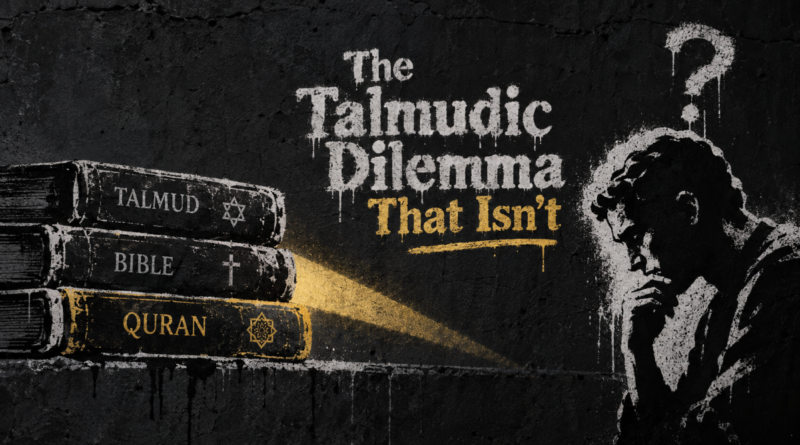
The Talmudic Dilemma That Isn’t
A new objection to the Quran has been making the rounds. Its authors call it the Talmudic Dilemma, and it is built on the frame of an older argument they named the Islamic Dilemma. The original ran like this: the Quran confirms the previous scriptures, yet the Quran contradicts them, so the Quran must be false. The new version simply swaps the target from the Bible to the Talmud. Laid out step by step, it goes:
- The Quran claims there were no prophets or messengers between Jesus and Muhammad.
- Therefore, no one received wahi (divine inspiration) during that gap.
- Yet some passages of the Quran contain material also found in the Talmud.
- The Talmud was written by men, centuries after the Injeel (roughly the fifth to sixth century).
- Therefore, the Quran is drawing on the words of men and is not from God.
It has the shape of a trap: each step looks modest, and the conclusion feels forced on you. But the argument only works if every link in the chain holds, and almost none of them do. Let us walk through where it breaks.
Break 1: The Quran never says inspiration stopped
Start with the hinge the whole thing swings on—step two. The claim is that because there were no messengers between Jesus and Muhammad, no one received wahi (divine inspiration) at all. That inference is where the argument quietly cheats. Just because a specific kind of envoy had not come for a while says nothing about the wider category of inspiration going silent. To leap from “no messengers were sent” to “no inspiration of any kind reached anyone” is to swap a small word for a much bigger one and hope nobody notices.
And that swap only works if you assume wahi is something only prophets and messengers ever receive. The Quran says the opposite.
Break 2: Wahi is not limited to prophets
This is the fundamental mistake in the whole objection. In the Quran, wahi is a broad word for inspiration—a communication or prompting placed swiftly into a receiver. It is used for prophets, yes—but also for people who were not prophets, for animals, for angels, even for the inanimate world and for the whispering of devils.
Consider the range:
And your Lord inspired (awḥā) the bee: build homes in mountains and trees… (16:68)
We inspired Moses’ mother: “Nurse him, and when you fear for his life, throw him into the river…” (28:7)
Recall that I inspired the disciples: “You shall believe in Me and My messenger.” (5:111)
Recall that your Lord inspired the angels: “I am with you; so support those who believed.” (8:12)
…the devils inspire their allies to argue with you… (6:121)
The bee is not a prophet. Moses’ mother was not a messenger. The disciples of Jesus were not prophets—and note that they received wahi after Jesus’ ministry had already begun. If inspiration can reach a mother, a group of followers, the angels, and even a bee, then the sentence “no messengers, therefore no wahi” simply does not follow.
The Quran even maps out the ways God reaches human beings, and a messenger is only one of three:
No human being can communicate with GOD except through inspiration (wahi), or from behind a barrier, or by sending a messenger… (42:51)
So inspiration is a channel God uses directly, alongside and independent of the sending of messengers. A gap in messengers closes exactly one of three doors. The argument treats it as if it had bolted all three.
Break 3: All truth comes from God, whatever carries it
Now suppose, for the sake of argument, that a genuine principle in the Talmud also appears in the Quran. What would that prove?
The critic wants it to prove the Quran copied from men. But that conclusion smuggles in an assumption the Quran flatly rejects: that a truth belongs to whoever wrote it down. In the Quran’s view, if God is one, then truth is one. It cannot be owned by a tribe, a lineage, or a book’s cover. A true statement about justice is no less God’s truth for turning up in a text whose keepers later went astray.
The Quran is explicit that the believer’s task is to follow truth wherever it is found:
They are the ones who examine all words, then follow the best. These are the ones whom GOD has guided; these are the ones who possess intelligence. (39:18)
Notice what this verse does not say. It does not say “listen only to speech from the right lineage.” It says weigh what you hear, from wherever it comes, and take the best of it. Discernment, not tribal filtering, is the faculty being praised.
This is also why the Quran is perfectly open about pointing to earlier material. When it states the principle that taking one innocent life is like destroying humanity—a principle found in the Mishnah (Sanhedrin 37a)—it does not pass it off as a fresh invention. It flags the source:
Because of this, we decreed for the Children of Israel that anyone who kills any person… it shall be as if he killed all the people; and anyone who spares a life, it shall be as if he spared the lives of all the people. (5:32)
A forger hides where his material came from. The Quran announces it. That is not the behavior of a book caught borrowing; it is the behavior of a book that regards the truth in older sources as God’s truth to begin with—and says so plainly.
Break 4: Quoting a source is not learning from it
Here is the simplest way to see the confusion at the heart of the objection. The Quran quotes all kinds of speakers. It records the words of Pharaoh:
“I am your Lord, Most High.” (79:24)
It records the words of Satan:
“I am better than he; You created me from fire, and You created him from mud.” (7:12)
It records the boasts of disbelievers, the excuses of hypocrites, and the slogans of idol worshippers. By the logic of the Talmudic Dilemma, we would have to conclude that the Quran got its theology from Pharaoh and its cosmology from Satan. Obviously not. Quoting a speaker is not adopting his views, and referencing a body of teaching is not confessing that you learned from it.
When the Quran engages Talmudic or rabbinic material, it does exactly what a judge does with testimony: it affirms what is sound and strikes down what is false. Some rabbinic understandings it confirms—like the sanctity of a single life. Others it quotes precisely in order to reject them.
Take the claim that punishment in the Fire is only brief—a notion with roots in rabbinic teaching. The Quran cites it and demolishes it:
This is because they said, “The hellfire will not touch us, except for a few days.” They were thus deceived in their religion by their own fabrications. (3:24; see also 2:80)
Or take the blasphemy that God’s power is somehow restrained:
The Jews even said, “GOD’s hand is tied down!” It is their hands that are tied down, and they are condemned for uttering such a blasphemy. Instead, His hands are wide open… (5:64)
Sit with what this does to the objection. If the Quran were simply drawing on the Talmud as a source of inspiration, why would it turn around and condemn the Talmud’s claims? You do not correct your own teacher’s notes and call them fabrications. A book that quotes rabbinic ideas in order to overrule them is not a book derived from them. It is a book standing over them in judgment.
The Quran names this role for itself:
Then we revealed to you this scripture, truthfully, confirming (muṣaddiq) previous scriptures, and superseding (muhaymin) them. (5:48)
Muṣaddiq: it confirms what is true in them. Muhaymin: it stands as the criterion that verifies and overrules. Citation, in that light, is not the Quran leaning on the Talmud for support. It is the Quran doing its job—pointing at a passage and saying this part is sound, keep it, or this part is false, drop it. Both moves are the same act: a standard measuring what came before.
Break 5: The argument is a textbook genetic fallacy
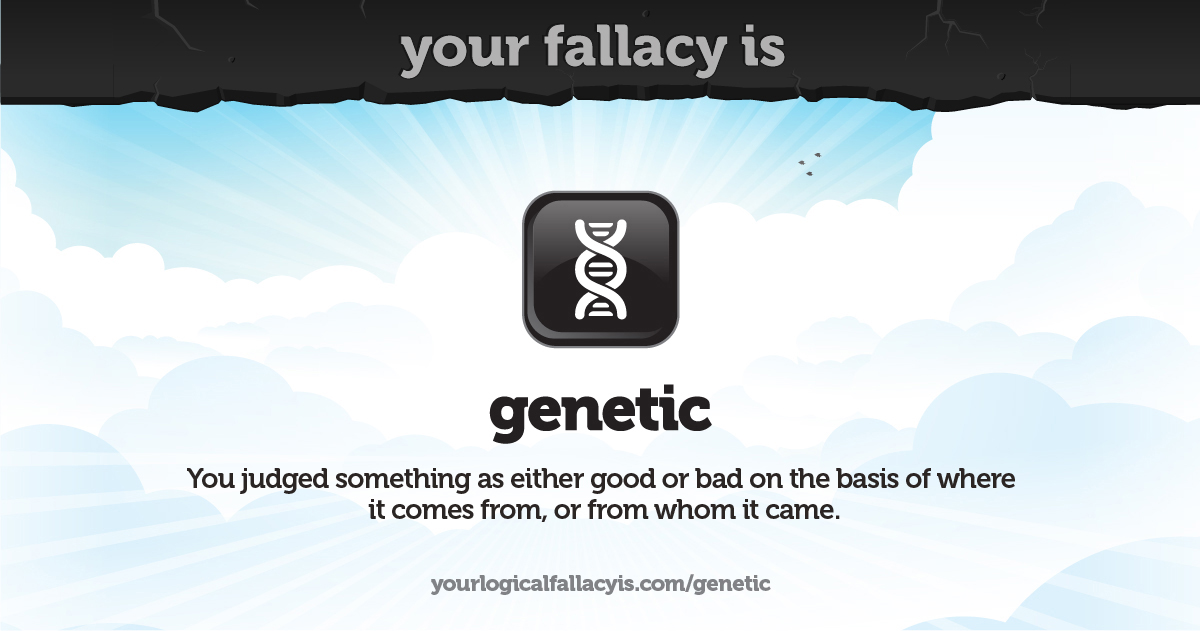
Strip away the theology and the objection reduces to a basic error in reasoning that logicians have a name for: the genetic fallacy—judging whether a claim is true by where it came from rather than by whether it is actually true.
“You only accept this because it is in the Talmud” is not an argument against the claim. A stopped clock was built by fallible hands, yet it is exactly right at noon. A known liar has a worthless reputation, yet if he shouts that the building is on fire and the building is on fire, you should still run. Origin and truth are two separate questions, and the whole dilemma depends on jamming them into one.
Once you see that, the objection’s core—”the Talmud was written by men, therefore anything shared with it is man-made”—falls apart. The origin of a text tells you nothing about the truth of a statement inside it.
Break 6: A written date is not an idea’s birthday
The fourth step leans on a second quiet move: because the Talmud was compiled in the fifth or sixth century, its contents must be fifth- or sixth-century human inventions.
But the date a tradition is finally written down is not the date the idea began. The Mishnah records oral rulings and interpretations understood to be far older, and the specific principle about a single life is itself presented as a reading of Genesis—the “bloods” of Abel crying out from the ground. Ideas can be centuries older than the manuscript that finally fixes them in ink.
There is a related assumption hiding in the objection: that if a narrative or saying is not in the Bible as it was finally canonized, it must be a later human invention. But the canon is a curated selection, not a complete archive—and its own authors say so. Luke opens his Gospel by noting that many others had already drawn up accounts of the same events (Luke 1:1). John’s Gospel reports that Jesus did much more than what was written down, and closes by admitting—in its own hyperbole—that the world itself could not hold the books it would take to record everything he did (John 20:30; 21:25). The Bible also tells some of the same stories more than once, in overlapping and not always identical versions. So a tradition that never made it between the covers of the canon is not thereby proven false; it may simply be sound material the compilers set aside. The mere fact that a detail the Quran affirms is missing from the canonized Bible—or surfaces instead in the Talmud—says nothing about whether it is true, or how old it really is.
And in any case, the Quran is not affirming a book’s publication history. It is affirming a truth. To an author who holds that all knowledge ultimately comes from God, the question of which human scribe first committed a true principle to parchment is simply beside the point.
Break 7: This is the old Meccan accusation under a new name
None of this is new. The Quran faced this exact charge in Muhammad’s own lifetime. His opponents claimed that a human being was secretly feeding him his material:
We are fully aware that they say, “A human being is teaching him!” The tongue of the source they hint at is non-Arabic, while this is a perfect Arabic tongue. (16:103)
They said, “Tales from the past that he wrote down; they were dictated to him day and night.” (25:5)
The Talmudic Dilemma is that same accusation, relabeled. And the Quran’s answer then still answers it now: far from hiding its relationship to earlier scripture, the Quran openly tells its audience to go and check with the people who possess it:
…ask those who know the scripture, if you do not know. (16:43)
A book worried about being caught borrowing does not send you to the lender.
Where that leaves the “dilemma”
Line the pieces back up and the trap has no jaws left:
- The Quran never says inspiration ceased between Jesus and Muhammad.
- Wahi was never limited to prophets. It reached a mother, disciples, angels, even a bee.
- Truth belongs to God, not to whoever transcribed it, so shared content proves nothing about copying.
- Quoting a source is not learning from it—especially when the Quran quotes rabbinic claims in order to refute them.
- Judging a statement by the pedigree of the book it sits in is the genetic fallacy.
- The compilation date of the Talmud is not the age of the ideas inside it.
- And the whole thing is just the seventh-century “a man is teaching him” charge under a new name.
Every version of this argument—the Islamic Dilemma, and now the Talmudic Dilemma—runs on the same hidden premise: that a truth can be discredited by its address. The Quran rejected that premise before the Talmud was ever bound into a book. It asks its reader to do the harder and more honest thing—to examine all words and follow the best, wherever they are found—because the best of what is said is simply the truth, and the truth has only one source.