Are the Arabs the Descendants of Ishmael?
Two roads to one question: what the texts say, and what the ground can show
Few genealogical claims are repeated as confidently as this one: the Arabs are the children of Ishmael, and Ishmael is the son of Abraham. It is stated in Sunday-school lessons, Friday sermons, popular histories, and the opening pages of countless books. Yet the sentence compresses several different claims, each resting on a different kind of evidence, and it only sounds simple because those claims are blended together.
This article separates them. It takes two roads and keeps them apart on purpose.
The first road is textual. It asks what the Hebrew Bible, the Jewish tradition, the Quran, and the later Muslim genealogists actually say, and how well those statements hold up and agree with one another. On this road, we accept the scriptural frame to see what it contains, without yet asking whether it is true.
The second road is historical and archaeological. It asks what inscriptions, king lists, archaeology, and science can show, and it cannot assume Abraham. To date, no source outside scripture attests to Abraham, or to Ishmael as a person, and this is not a minor technicality. A historian cannot prove descent from a figure whose existence the record cannot confirm. What the historian can do is ask a narrower question: do the peoples that scripture connects to Ishmael show up on the map of the ancient world, and do the connections hold?
Both roads end in the same place, and that is more interesting than a simple yes or no.
First, who are “the Arabs”?
Much debate has been had, with many volumes written on the question of the word “Arab” and who they represent.
The earliest generally accepted written reference to “Arabs” appears in the Assyrian record of the Battle of Qarqar in 853 BCE, where Shalmaneser III lists “Gindibu the Arab”, who contributed one thousand camels to the anti-Assyrian coalition. Later Neo-Assyrian inscriptions use terms such as Aribi and Arbaya for populations of the steppe and desert fringe—camel herders, caravaneers, and tribal confederations such as Qedar (Kedar). At this stage, “Arab” does not appear to designate a single nation descended from a common ancestor so much as a broad regional and social category.
The idea that all Arabs form one people with a common father is a later development. Several modern scholars, notably Jan Retsö and Peter Webb, have argued that a unified Arab ethnic identity was constructed in the early Islamic centuries, partly by the genealogists whose work we will examine below.
Today “Arab” mainly means someone whose first language is Arabic and who belongs to the Arabic-speaking cultural world. Hundreds of millions of people in Egypt, Iraq, Syria, North Africa, and elsewhere became Arabic-speaking through conquest, trade, and conversion. No serious version of the Ishmael claim extends to them. The claim, in its meaningful form and as addressed in this article, concerns the tribes of the Arabian Peninsula, and above all the Hijaz and Mecca, where the genealogy of Muhammad’s tribe, Quraysh, is placed.
The Hebrew Bible
The Bible’s treatment of Ishmael is more detailed, and more qualified, than the popular summary suggests.
Ishmael is promised a great nation. God tells Abraham, “I will make him a great nation,” and that he will father twelve princes (Genesis 17:20). The twelve are named in Genesis 25:13-15: Nebaioth, Kedar, Adbeel, Mibsam, Mishma, Dumah, Massa, Hadad, Tema, Jetur, Naphish, and Kedemah. Genesis 25:16 calls them “princes according to their tribes,” which is the vocabulary of tribal groups rather than of a single family.
Ishmael lives in the desert wilderness. Genesis says, “He lived in the wilderness (midbār) of Paran” (Genesis 21:21). The Hebrew midbār denotes desert, steppe, or sparsely settled pastoral country. His mother finds him a wife from Egypt. His territory is later described as extending “from Havilah to Shur, which is opposite Egypt in the direction of Assyria” (Genesis 25:18), placing the Ishmaelite horizon in the arid country adjoining Egypt and northern Arabia.
The Bible does not mention Mecca, or the Hijaz as a settlement of Ishmael. The Mecca connection is not in the Hebrew text. Paran is a wilderness region, and the Bible’s geography for Ishmael points north and west of where Muslim tradition places him. The link between Ishmael and the Sacred House in Mecca comes from the Quran (which, as we will see, is more reserved than often assumed).
The Bible does not treat “Arab” and “Ishmaelite” as the same thing. In the Joseph story, the caravan that sells Joseph is described as both Ishmaelites and Midianite traders (Genesis 37:25-28, 36), and in Judges 8:24 the Midianites Gideon defeats are said to wear golden earrings “because they were Ishmaelites.” The terms overlap and shift. They function more as labels for desert trading populations than as fixed genealogical categories.
Other Arabian peoples have entirely different ancestries in the Bible:
- The sons of Keturah, Abraham’s later wife, include Midian, Sheba, and Dedan (Genesis 25:1-4). These are also Arabian peoples. Abraham sends the sons of his concubines “eastward to the east country” (Genesis 25:6).
- The Joktanites descend from Eber through Joktan (Genesis 10:25-30), and the list includes names associated with southern Arabia. This is a Semitic line entirely separate from Abraham.
- Sheba and Dedan also appear in the Table of Nations as sons of Cush (Genesis 10:7), a second and different genealogy for names that elsewhere appear through Keturah.
- Edom descends from Esau, who marries Ishmael’s daughter Mahalath, “the sister of Nebaioth” (Genesis 28:9), thereby linking the two lines.
- Moab and Ammon descend from Lot, Abraham’s nephew.
So when the Bible surveys the peoples of Arabia, it gives them at least four or five different family trees, and it crosses them through marriage. Ishmael is one important branch, not the whole tree.
There is also a quieter point. Two of Ishmael’s sons, Mibsam and Mishma, appear again in 1 Chronicles 4:25 as descendants of Simeon, one of the twelve sons of Israel: “Shallum was his son, Mibsam his son, Mishma his son.” The same names turn up in an Ishmaelite list and an Israelite list. Whatever one makes of this (shared clan names, intermarriage, or Israelite clans absorbing or being absorbed), it shows that the Bible itself did not keep these lines hermetically sealed. Similarly, 1 Chronicles 5:19-22 records the tribes of Reuben, Gad, and half of Manasseh fighting the Hagrites, Jetur, Naphish, and Nodab, and then settling in their lands. Israelite tribes occupied territory once held by Ishmaelite groups, and the text expects the two to be neighbors and kin.
Ishmael in Jewish tradition
The rabbinic sources reflect the same slipperiness, with an added layer of attitude.
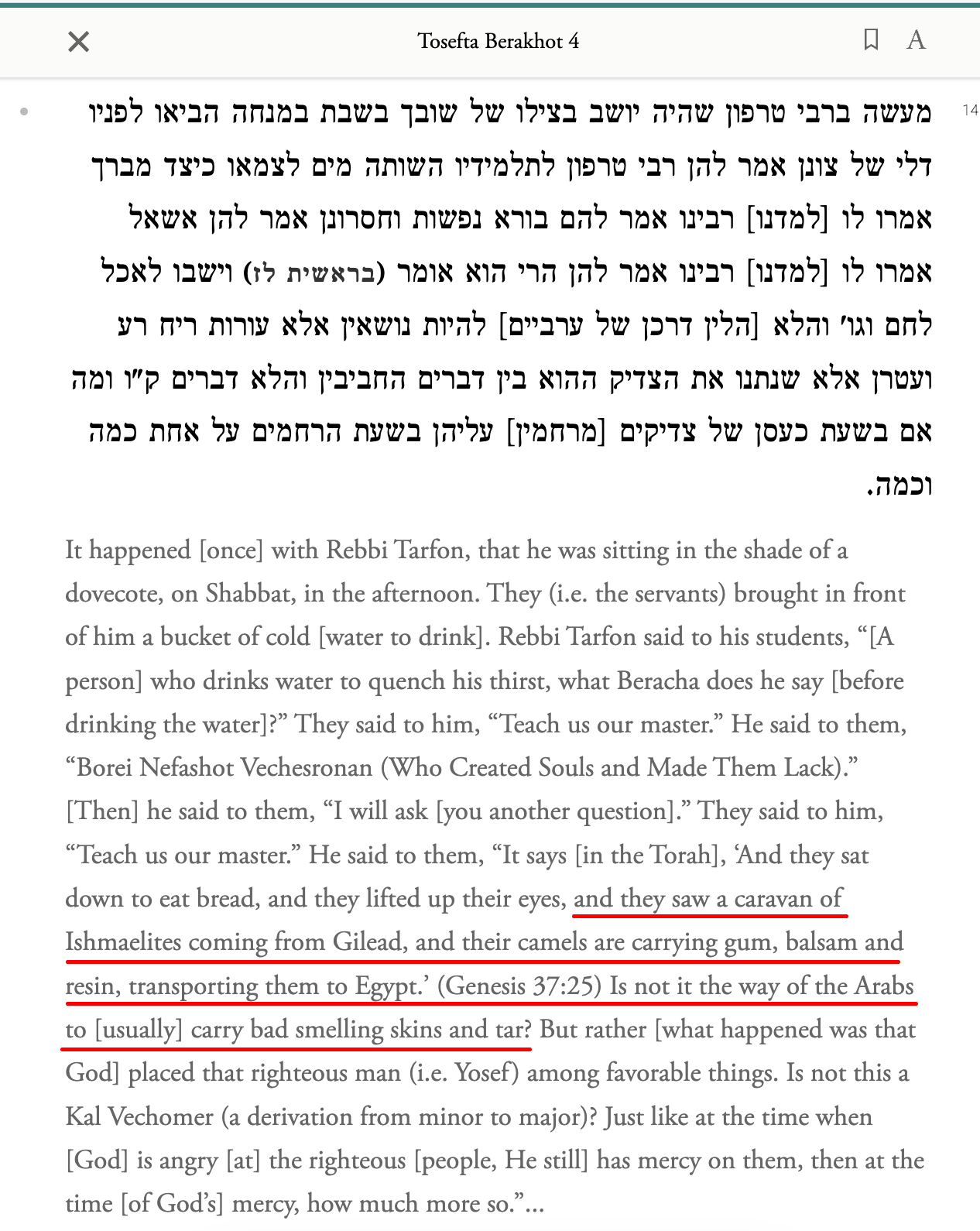
Tosefta Berakhot 4 retells a story about Rabbi Tarfon. Asked about the “caravan of Ishmaelites” in Genesis 37:25, he observes that it is the way of the Arabs to carry foul-smelling skins and tar, yet here they carried fragrant spices, because God was arranging comfort for the righteous Joseph. The rabbi equates “Ishmaelites” and “Arabs” without comment. The identification is simply assumed.
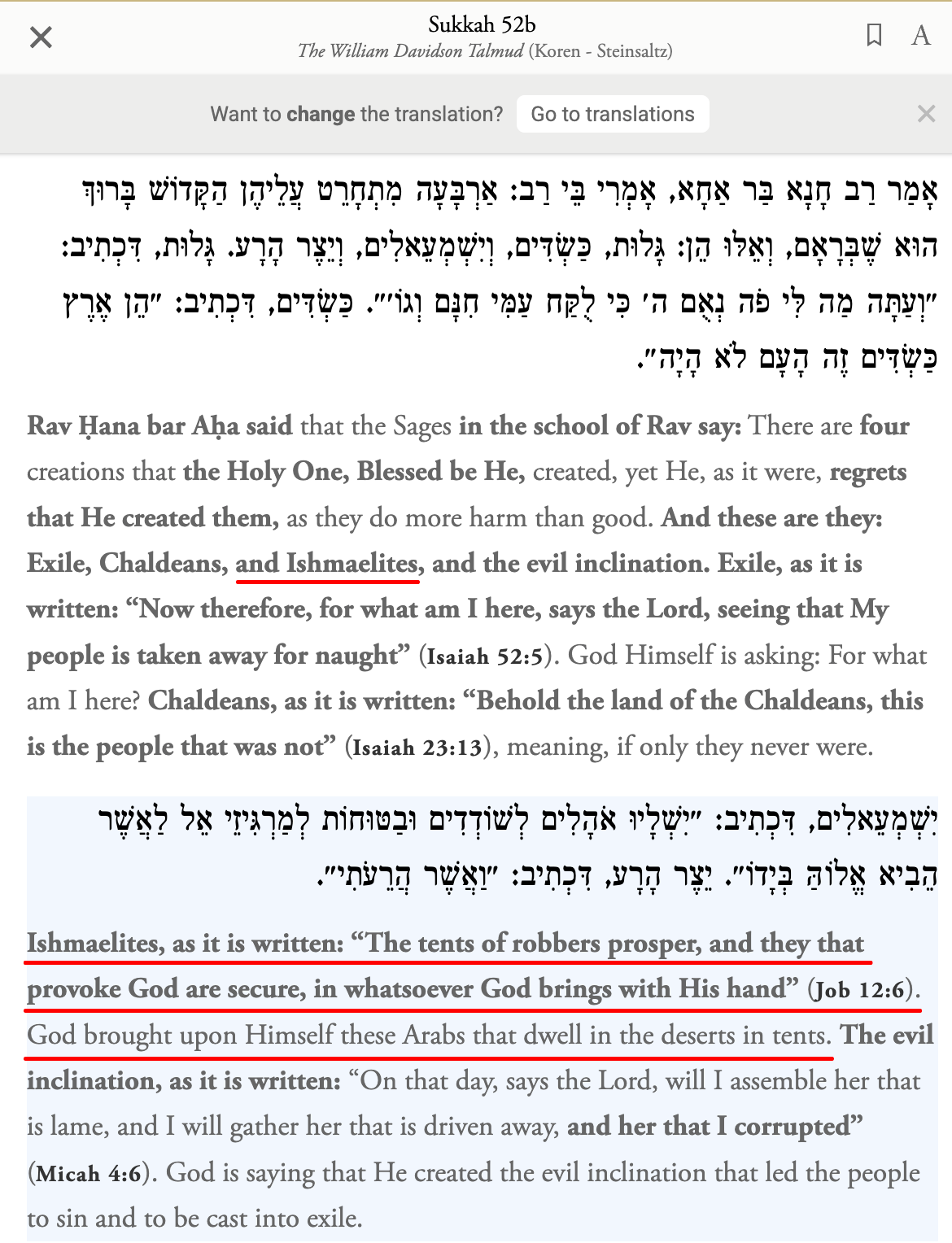
Sukkah 52b lists four creations God, in a manner of speaking, regrets: exile, Chaldeans, Ishmaelites, and the evil inclination. The Ishmaelites are tied to Job 12:6, “the tents of robbers prosper,” and the Steinsaltz commentary glosses them as “these Arabs that dwell in the deserts in tents.” The rabbis here speak of Arabs as a people of the tents, and the tone is hostile, which tells us something about the social reality of desert raiding and also something about rabbinic prejudice.
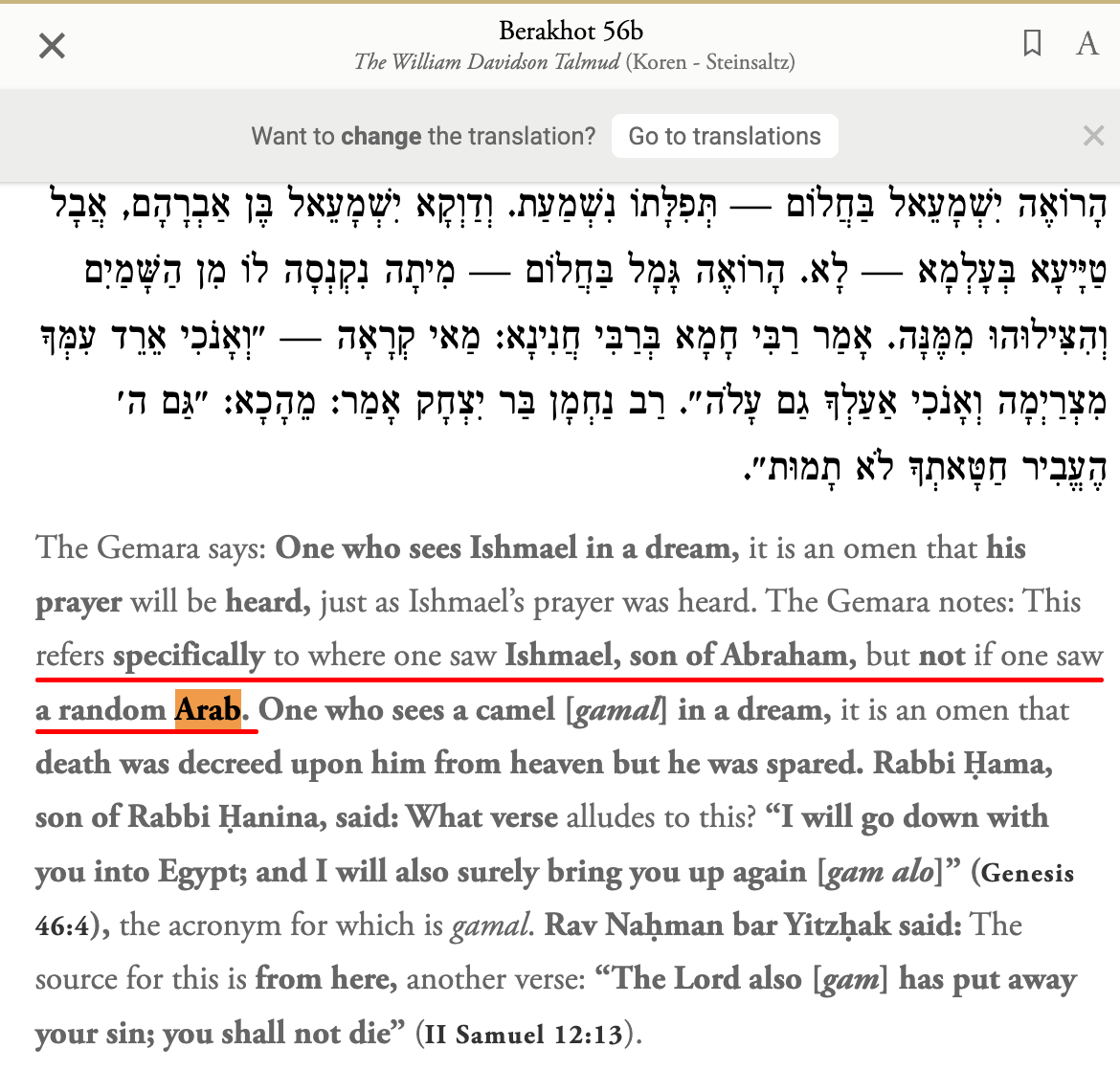
Berakhot 56b is the most interesting. In a discussion of dream omens, the Gemara says that seeing Ishmael in a dream is a sign that one’s prayer will be heard, and it adds that this refers specifically to Ishmael, the son of Abraham, “but not if one saw a random Arab.” Here the rabbis themselves distinguish the patriarch from the ethnonym. A random Arab is not Ishmael.
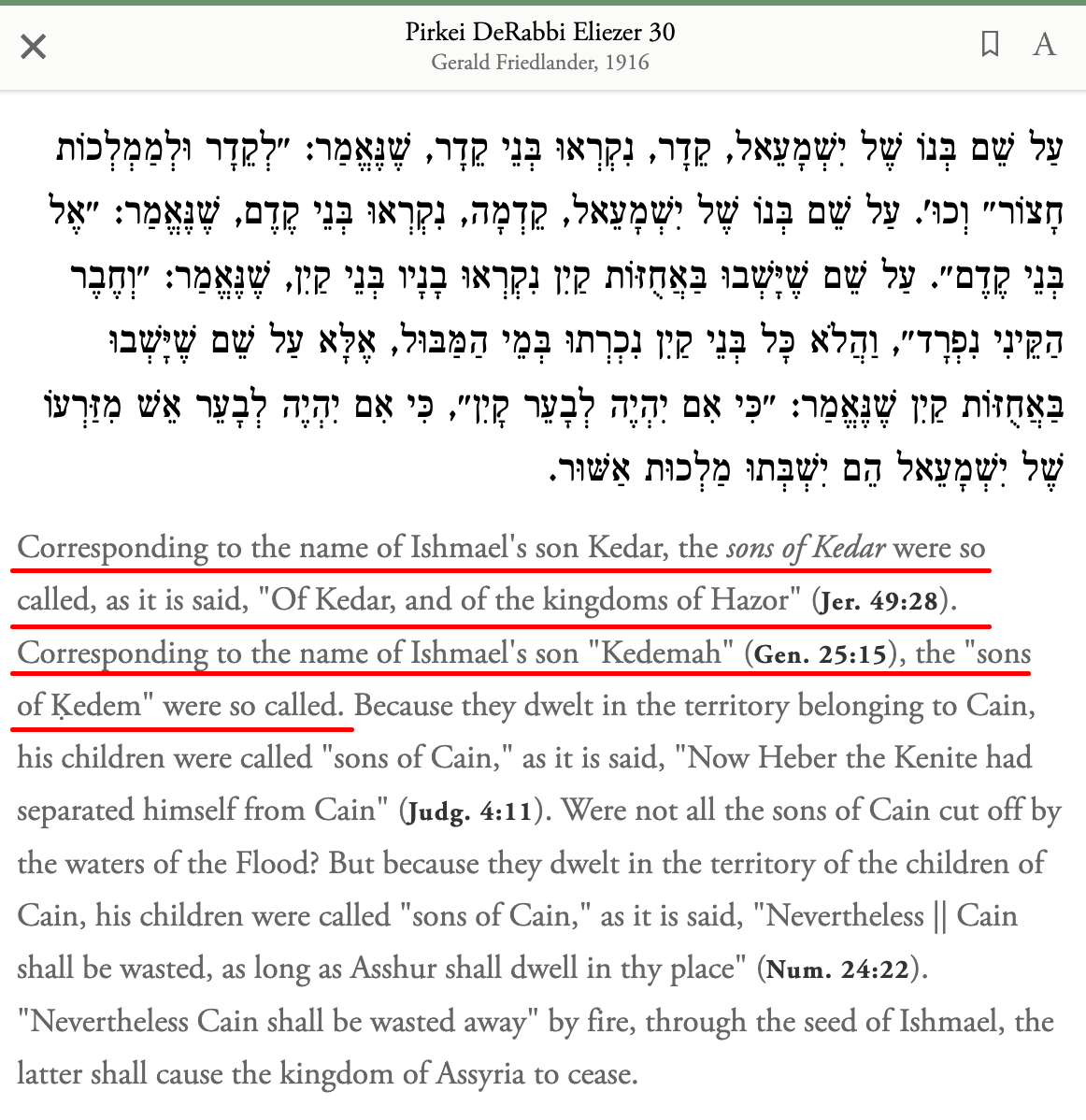
Pirkei DeRabbi Eliezer 30, in Friedlander’s 1916 translation, maps peoples onto Ishmael’s sons: the “sons of Kedar” are named for Kedar, and the “sons of Kedem” (the “people of the East”) for Kedemah. This is the same method of reading an ethnonym as a family name that we find in Genesis itself.
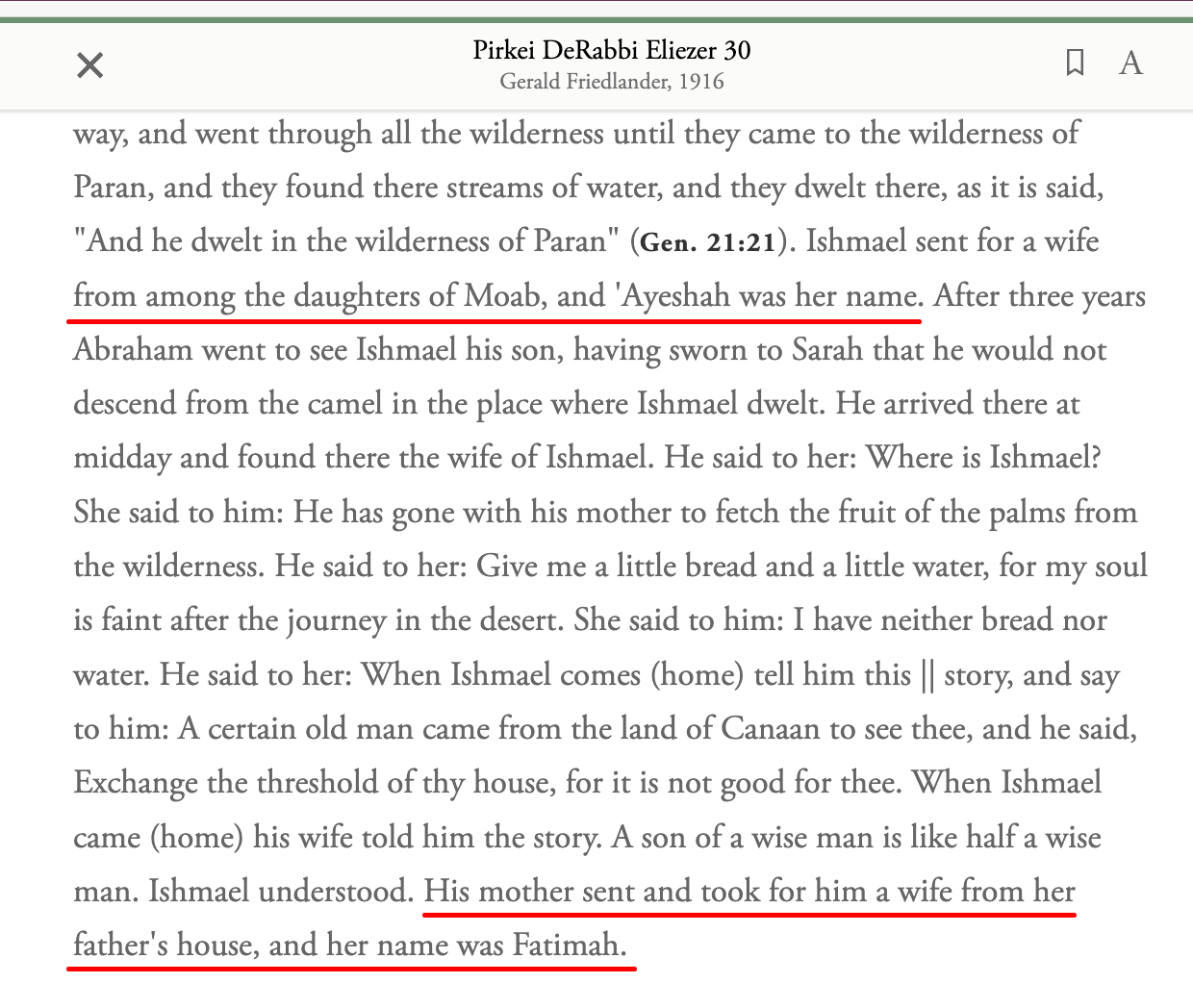
Interestingly, the same chapter names Ishmael’s wives Ayesha and Fatima, mirroring the wife of the Islamic Prophet Muhammad and his daughter. Because this writing is typically dated to the 8th and 9th centuries, scholars presume that Islamic history influenced these narrations. Nevertheless, this shows what Jewish tradition came to say about Ishmael and the Arabs, and it cannot be treated as evidence of what anyone believed before Islam.
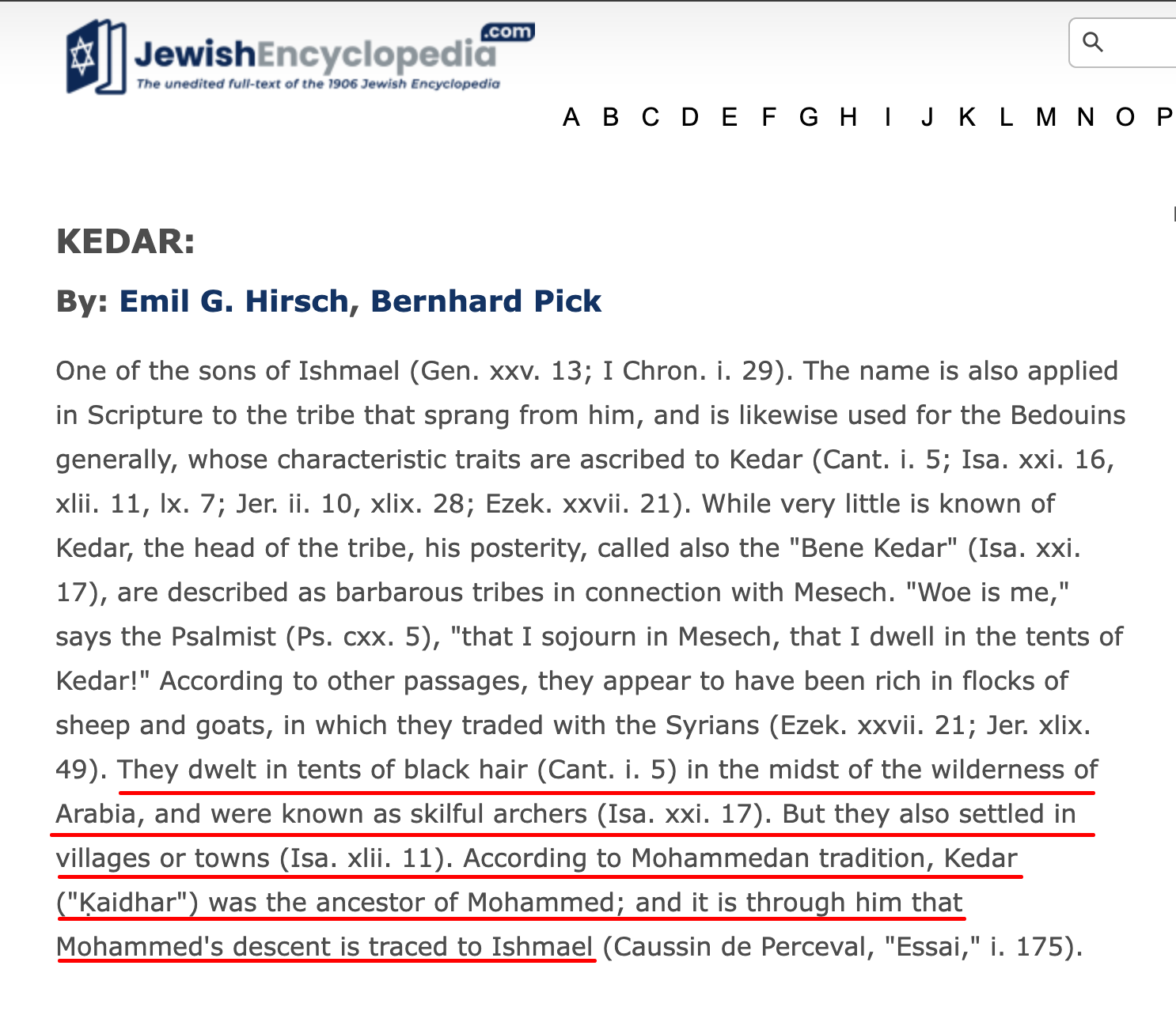
The 1906 Jewish Encyclopedia entry on Kedar is careful in the same way. It states the biblical facts (Kedar is a son of Ishmael, the name is applied to his tribe and loosely to Bedouin generally) and then adds a separate sentence: “According to Mohammedan tradition,” Kedar was the ancestor of Muhammad. The encyclopedia attributes the link to Muslim tradition and does not reject the claim.
Ishmael in the Quran
Here we must be exact about what the Quran says, because popular accounts say more than it does.
Abraham settles some of his descendants at the Sacred House. In 14:37, Abraham says he has settled min dhurriyyatī (مِن ذُرِّيَّتِي), “some of my offspring,” in an uncultivated valley by God’s Sacred House, so that they may establish the prayer. The phrase is min, “some of,” which implies that others of his offspring are elsewhere. The verse does not name Ishmael. Ishmael is named two verses later (14:39), where Abraham thanks God for giving him Ishmael and Isaac in old age.
[14:37] “Our Lord, I have settled part of my family in this plantless valley, at Your Sacred House. Our Lord, they are to observe the Contact Prayers (Salat), so let throngs of people converge upon them, and provide for them all kinds of fruits, that they may be appreciative. [14:38] “Our Lord, You know whatever we conceal and whatever we declare— nothing is hidden from GOD on earth, nor in the heavens. [14:39] “Praise be to GOD for granting me, despite my old age, Ismail and Isaac. My Lord answers the prayers.
The connection is natural, and 2:127 supports it by placing Abraham and Ishmael together raising the foundations of the House. But the identification of which offspring were settled there is inferred from context, and the text itself says only “my offspring.”
[2:127] As Abraham raised the foundations of the shrine, together with Ismail (they prayed): “Our Lord, accept this from us. You are the Hearer, the Omniscient.
It is worth mentioning that the Quran uses various names in reference to the Ka’bah:
- The House (Shrine) / الْبَيْتِ / l-bayti (2:125, 2:127, 3:96, 3:97, 8:35, 11:73, 33:33, 52:4, 106:3)
- Sacred Masjid / الْمَسْجِدِ الْحَرَامِ / l-masjidi l-ḥarām (2:144, 2:149, 2:150, 2:191, 2:196, 2:217, 5:2…
- [Your] Sacred House / الْبَيْتَ الْحَرَامَ / -bayta l-ḥarama (14:37, 5:97)
- The Sacred House (Shrine) / الْبَيْتَ الْحَرَامَ / l-bayta l-ḥarām (5:2)
- The Ancient House (Shrine) / الْبَيْتِ الْعَتِيقِ / l-bayti l-ʿatīqi (22:33)
Additional proof that these titles are one and the same can be found in the following verses:
[22:25] Surely, those who disbelieve and repulse others from the path of GOD, and from the Sacred Masjid that we designated for all the people—be they natives or visitors—and seek to pollute it and corrupt it, we will afflict them with painful retribution.
[22:26] We appointed Abraham to establish the Shrine: “You shall not idolize any other god beside Me, and purify My shrine for those who visit it, those who live near it, and those who bow and prostrate.
[22:27] “And proclaim that the people shall observe Hajj pilgrimage. They will come to you walking or riding on various exhausted (means of transportation). They will come from the farthest locations.”
إِنَّ الَّذِينَ كَفَرُوا وَيَصُدُّونَ عَنْ سَبِيلِ اللَّهِ وَالْمَسْجِدِ الْحَرَامِ الَّذِي جَعَلْنَاهُ لِلنَّاسِ سَوَاءً الْعَاكِفُ فِيهِ وَالْبَادِ وَمَنْ يُرِدْ فِيهِ بِإِلْحَادٍ بِظُلْمٍ نُذِقْهُ مِنْ عَذَابٍ أَلِيمٍ
وَإِذْ بَوَّأْنَا لِإِبْرَاهِيمَ مَكَانَ الْبَيْتِ أَنْ لَا تُشْرِكْ بِي شَيْئًا وَطَهِّرْ بَيْتِيَ لِلطَّائِفِينَ وَالْقَائِمِينَ وَالرُّكَّعِ السُّجُودِ
وَأَذِّنْ فِي النَّاسِ بِالْحَجِّ يَأْتُوكَ رِجَالًا وَعَلَىٰ كُلِّ ضَامِرٍ يَأْتِينَ مِنْ كُلِّ فَجٍّ عَمِيقٍ
Abraham and Ishmael pray for a community and a messenger. In 2:128, the two ask for wa-min dhurriyyatinā ummatan muslimatan laka (وَمِن ذُرِّيَّتِنَآ أُمَّةً مُّسْلِمَةً لَّكَ), “and from our offspring a community submitting to You.”
[2:128] “Our Lord, make us submitters to You, and from our descendants let there be a community of submitters to You. Teach us the rites of our religion, and redeem us. You are the Redeemer, Most Merciful.
رَبَّنَا وَٱجْعَلْنَا مُسْلِمَيْنِ لَكَ وَمِن ذُرِّيَّتِنَآ أُمَّةً مُّسْلِمَةً لَّكَ وَأَرِنَا مَنَاسِكَنَا وَتُبْ عَلَيْنَآ إِنَّكَ أَنتَ ٱلتَّوَّابُ ٱلرَّحِيمُ
In 2:129 they ask that God raise among them a messenger minhum (مِّنْهُمْ), “from among them.” Ishmael is a speaker, so his line is included. But the prayer is for the offspring of both speakers, and Abraham’s offspring include Isaac and Jacob.
[2:129] “Our Lord, and raise among them a messenger to recite to them Your revelations, teach them the scripture and wisdom, and purify them. You are the Almighty, Most Wise.”
رَبَّنَا وَٱبْعَثْ فِيهِمْ رَسُولًا مِّنْهُمْ يَتْلُوا۟ عَلَيْهِمْ ءَايَٰتِكَ وَيُعَلِّمُهُمُ ٱلْكِتَٰبَ وَٱلْحِكْمَةَ وَيُزَكِّيهِمْ إِنَّكَ أَنتَ ٱلْعَزِيزُ ٱلْحَكِيمُ
Abraham is called the father of the audience. In 22:78, the addressees are told to follow millata abīkum Ibrāhīm (مِّلَّةَ أَبِيكُمْ إِبْرَاهِيمَ), “the religion of your father Abraham.” Whether this is biological, spiritual, or both is debated.
Abraham: Original Messenger of Submission*
[22:78] You shall strive for the cause of GOD as you should strive for His cause. He has chosen you and has placed no hardship on you in practicing your religion—the religion of your father Abraham. He is the one who named you “Submitters” originally. Thus, the messenger shall serve as a witness among you, and you shall serve as witnesses among the people. Therefore, you shall observe the Contact Prayers (Salat) and give the obligatory charity (Zakat), and hold fast to GOD; He is your Lord, the best Lord and the best Supporter.
وَجَٰهِدُوا۟ فِى ٱللَّهِ حَقَّ جِهَادِهِۦ هُوَ ٱجْتَبَىٰكُمْ وَمَا جَعَلَ عَلَيْكُمْ فِى ٱلدِّينِ مِنْ حَرَجٍ مِّلَّةَ أَبِيكُمْ إِبْرَٰهِيمَ هُوَ سَمَّىٰكُمُ ٱلْمُسْلِمِينَ مِن قَبْلُ وَفِى هَٰذَا لِيَكُونَ ٱلرَّسُولُ شَهِيدًا عَلَيْكُمْ وَتَكُونُوا۟ شُهَدَآءَ عَلَى ٱلنَّاسِ فَأَقِيمُوا۟ ٱلصَّلَوٰةَ وَءَاتُوا۟ ٱلزَّكَوٰةَ وَٱعْتَصِمُوا۟ بِٱللَّهِ هُوَ مَوْلَىٰكُمْ فَنِعْمَ ٱلْمَوْلَىٰ وَنِعْمَ ٱلنَّصِيرُ
The Quran elsewhere uses family language for ancestors loosely, and 2:133 has Jacob’s sons speaking of “your fathers Abraham, Ishmael and Isaac,” counting Ishmael, Jacob’s uncle, among his ābāʾ.
[2:133] Had you witnessed Jacob on his death bed; he said to his children, “What will you worship after I die?” They said, “We will worship your god; the god of your fathers Abraham, Ismail, and Isaac; the one god. To Him we are submitters.”
أَمْ كُنتُمْ شُهَدَآءَ إِذْ حَضَرَ يَعْقُوبَ ٱلْمَوْتُ إِذْ قَالَ لِبَنِيهِ مَا تَعْبُدُونَ مِنۢ بَعْدِى قَالُوا۟ نَعْبُدُ إِلَٰهَكَ وَإِلَٰهَ ءَابَآئِكَ إِبْرَٰهِۦمَ وَإِسْمَٰعِيلَ وَإِسْحَٰقَ إِلَٰهًا وَٰحِدًا وَنَحْنُ لَهُۥ مُسْلِمُونَ
The Quran does not name the Quraysh as Ishmaelites. It names Quraysh once (106:1) and never traces their ancestry. It never gives Muhammad’s genealogy, and never mentions Kedar, ʿAdnān, or any link in the chain that the later genealogists supply.
So the Quranic position can be stated carefully. The Quran places some of Abraham’s descendants at the Sacred House, associates Ishmael with its foundation, and presents the messenger as an answer to a prayer for a messenger from among those descendants. It does not say, in so many words, that the Meccans were the children of Ishmael and of no one else.
Ishmael and the Muslim genealogical tradition
The full chain from Ishmael to Muhammad comes from later sources, and those sources are candid about its weak point. A standard genealogical table, such as the one printed in H. G. Sarwar’s biography of the Prophet, runs from Abraham to Ishmael to Kedar to ʿAdnān to Maʿadd, Nizār, Muḍar, and on through Quraysh to ʿAbd al-Muṭṭalib and Muhammad, with Genesis 25:12-16 cited for the opening links. The table presents every step as father-to-son, in identical dotted lines.
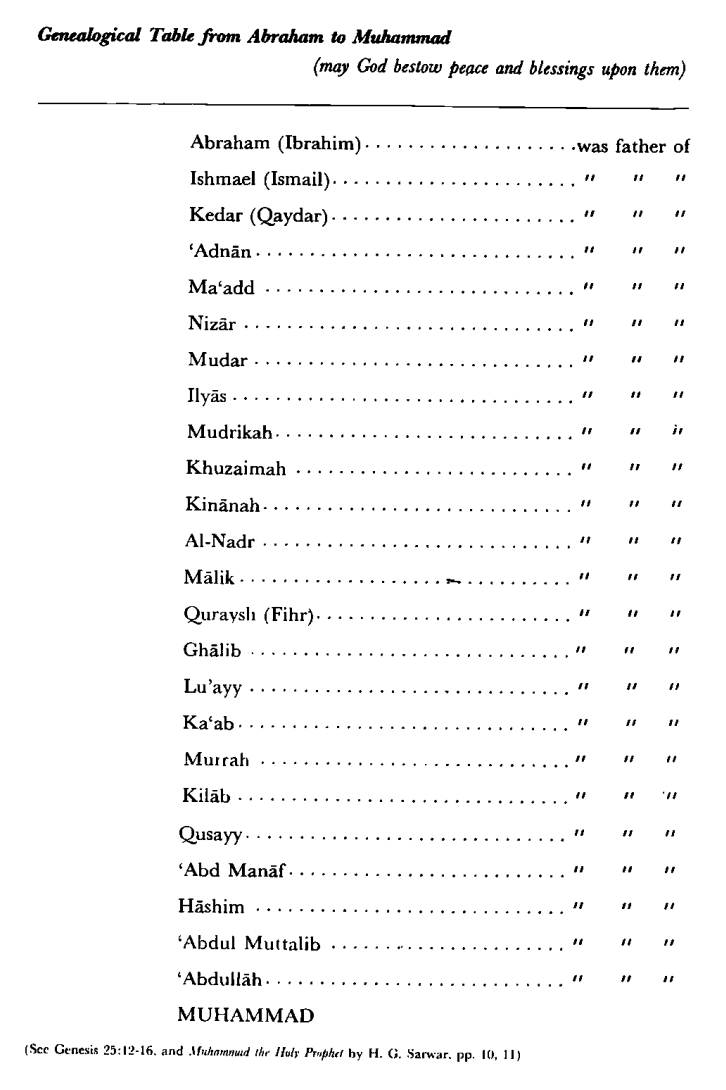
The early genealogists did not see it that way:
- The chain from Abraham to Ishmael to Kedar rests on the Bible (Genesis 25:13).
- The chain from ʿAdnān to Muhammad rests on Arabian tribal tradition, which is detailed and consistent in its major lines.
- The bridge from Kedar to ʿAdnān is the part scholars question. Classical scholars reported that the generations between Ishmael and ʿAdnān were unknown or disputed, and accounts that fill the gap name widely varying numbers of ancestors.
- Even the Kedar link is not unanimous. Some genealogists went through Nebaioth rather than Kedar.
The same tradition also contains the Qahtanite and Adnanite division, in which southern Arabians are descended from Qaḥṭān and northern Arabians from ʿAdnān. Historians have long suspected that this scheme took its final shape under the political rivalries of the Umayyad period. Mecca’s own earlier custodians in these narratives, Jurhum and Khuzāʿa, are placed in different ancestral camps, so even the traditional account does not give the Kaaba a single line of descent.
This does not make the genealogy false. It shows what kind of document it is: a tribal memory system that was committed to writing generations after the fact, with its gaps visible to its own authors.
Israel Was Never a Sealed Population
One obstacle to recognizing an Israelite presence in Arabia is the modern assumption that the Children of Israel were a tightly bounded people confined to Palestine and distinguished by an unbroken biological line. The biblical record itself presents something much messier. Israel is repeatedly formed through migration, intermarriage, incorporation, exile, and settlement among other peoples.
This begins before Israel even becomes a nation. Judah marries a Canaanite woman, while Joseph marries Asenath, an Egyptian woman and daughter of an Egyptian priest. Their sons Ephraim and Manasseh are then formally adopted by Jacob and elevated to full tribal status:
“Ephraim and Manasseh shall be mine, as Reuben and Simeon are.”
— Genesis 48:5
Two tribes of Israel therefore arise through an Egyptian mother. Israelite identity, at least in the biblical narrative, was never dependent upon ethnic purity.
The same pattern continues with Moses. After fleeing Egypt, he settles in Midian in northwestern Arabia and marries Zipporah, the daughter of a Midianite priest. Numbers later refers to a Cushite woman whom Moses had married. Israel’s central prophetic figure is therefore presented as having family ties extending into Arabia and Africa.
Even the Exodus does not describe a homogeneous population. When Israel leaves Egypt:
“A mixed multitude also went up with them.”
— Exodus 12:38
The Torah then establishes a principle under which outsiders can be incorporated into the same covenantal order:
“One law shall be for the native-born and for the stranger who dwells among you.”
— Exodus 12:49
The biblical concept of Israel therefore includes both descent and incorporation. People could enter the community, marry into it, and become part of its continuing lineage.
More important for the historical question is dispersion. The Assyrian conquest of the northern kingdom in the eighth century BCE scattered Israelites across Mesopotamia and Media:
“The king of Assyria carried Israel away to Assyria, and placed them in Halah, and on the Habor, the river of Gozan, and in the cities of the Medes.”
— 2 Kings 17:6
The Babylonian conquest later relocated much of Judah’s elite to Mesopotamia, while many of those exiles chose not to return even after Cyrus permitted them to do so. By the Persian, Hellenistic, and Roman periods, major Jewish communities existed throughout Mesopotamia, Egypt, Asia Minor, and the Mediterranean. By the first century CE, Alexandria had become one of the great centers of Jewish life outside Judea.
The Bible itself expects this dispersion:
“The LORD will scatter you among all peoples, from one end of the earth to the other.”
— Deuteronomy 28:64
Scattering, however, does not mean extinction. It means that descendants of Israel lived for generations among other populations, adopted local languages, intermarried, and sometimes retained a clear Jewish identity while others would inevitably have been absorbed into surrounding societies.
This is why the distinction between “Arab” and “Israelite” cannot automatically be treated as genealogically exclusive. “Arab” could describe geography, language, tribal affiliation, or way of life. An Israelite population that had lived in Arabia for generations could become culturally Arab without ceasing to have Israelite ancestry, just as Jewish communities elsewhere became Greek-speaking, Persian-speaking, or Egyptian in culture.
That possibility matters when we turn to Arabia. Jewish communities in the Hijaz and Yemen did not appear in an historical vacuum. They existed within a much older pattern of Israelite dispersion across the ancient Near East. The historical record cannot tell us how much of Arabia’s population carried Israelite ancestry, but the biblical model itself gives us no reason to imagine Israel as a sealed population confined permanently to Palestine.
The more realistic picture is of a people repeatedly scattered, incorporated, intermarried, and absorbed across surrounding regions. Once that is recognized, the possibility that some Arabian populations—including groups no longer practicing Judaism—carried Israelite ancestry becomes much less surprising.
This version uses the strongest parts of your earlier article—mixed ancestry, incorporation, Moses in Arabia, the Assyrian/Babylonian dispersions, and the distinction between identity and geography—without dragging in examples like David, Solomon, or every foreign marriage, which would slow the new article down.
The Quran and the Children of Israel:
While the Quran never explicitly says that Quraysh were descendants of Ishmael, it repeatedly addresses the Children of Israel as a living audience. This implies that at least some of the Arabian community receiving the Quran have understood themselves as descendants of Israel rather than as a people entirely separate from them.
The first evidence is the Quran’s language of direct address. Sura 2 repeatedly turns to the Children of Israel in the second person:
[2:40] O Children of Israel, remember My blessings which I bestowed upon you. Fulfill your covenant with Me, and I will fulfill My covenant with you.
The same formula returns in 2:47 and 2:122. The stories that follow concern Israel’s ancient past—Moses, Pharaoh, the calf, the covenant—but the people being commanded to remember, believe, pray, and fulfill the covenant are being addressed in the present. Banī Isrāʾīl in the Quran does not appear to be a distant people but the direct audience recieving the Quran.
The more interesting evidence comes from the word ummī. Muhammad’s audience is famously described this way:
[62:2] He is the One who raised among the ummiyyūn a messenger from among themselves, reciting to them His revelations, purifying them, and teaching them the Book and wisdom.
Ummī is often rendered “gentile,” and sometimes understood to mean a people outside the biblical scriptural tradition. But that interpretation creates a problem in 2:78. In the middle of the Quran’s discussion of the scriptural community, it says:
[2:78] And among them are ummiyyūn who do not know the Book except through hearsay, and they only conjecture.
The important phrase is simply وَمِنْهُمْ أُمِّيُّونَ — “and among them are ummiyyūn.” This signifies that the ummiyun cannot by itself designate someone genealogically outside the Children of Israel. The Quran can use it for people within the scripture-associated population who nevertheless do not know the Book. This is exactly what we can extract in the following verse, where the ummiyyin are contrasted to those who were given the scripture.
[3:20] If they argue with you, then say, “I have simply submitted myself to GOD; I and those who follow me.” You shall proclaim to those who received the scripture, as well as the ummiyyin, “Would you submit?” If they submit, then they have been guided, but if they turn away, your sole mission is to deliver this message. GOD is Seer of all people.
That becomes significant when 62:2 identifies the people among whom Muhammad arose as ummiyyūn. The contrast may therefore be less between “Israelites” and “gentile Arabs” than between those who possess and know scripture and those who do not.
There is another reason to take this seriously. The description of Muhammad’s mission in 62:2 closely reproduces the prayer made by Abraham and Ishmael at the Sacred House:
[2:128] “Our Lord, make us submitters to You, and from our descendants a community submitting to You.”
They then ask:
[2:129] “Our Lord, raise among them a messenger from among themselves, who will recite to them Your revelations, teach them the Book and wisdom, and purify them.”
Then 62:2 describes Muhammad:
[62:2] …A messenger from among themselves, reciting to them His revelations, purifying them, and teaching them the Book and wisdom.”
The verbal correspondence is unmistakable. The messenger requested in 2:129 is to come “from among them” (minhum); the messenger of 62:2 comes “from among them” (minhum). Both recite God’s revelations, teach the Book and wisdom, and purify their people. The Quran appears to present Muhammad’s mission as the realization of Abraham and Ishmael’s prayer for their descendants.
The evidence therefore supports a narrower claim. The Quran does not give us the clean division assumed by the later genealogy: Israelites through Isaac on one side, and the Arabs of Mecca through Ishmael on the other. It never identifies Quraysh as Ishmaelites. Instead, it addresses living Children of Israel, recognizes ummiyyūn among a people connected with scripture, and describes Muhammad’s mission among the ummiyyūn in language that deliberately recalls Abraham and Ishmael’s prayer for a messenger from among their descendants.
That does not establish that the Meccans were Children of Israel. But it makes the possibility textually viable—and it means that the later claim that Quraysh descended through Ishmael rather than Israel cannot simply be read backward into the Quran as though the Quran itself had said it.
Jews and Israelites in Arabia
Whatever the ancestry of the Meccans themselves, Arabia was not cut off from the wider Israelite and Jewish world. Jewish communities were established across the peninsula centuries before Islam, from the northern Hijaz to Yemen. What is harder to determine is how those communities came to be there: whether they descended from Israelite migrants, from local Arab populations that adopted Judaism, or—as is probably more realistic—from some combination of the two.
Tayma, in the northern Hijaz, provides some of the earliest evidence of this broader environment. The Babylonian king Nabonidus made the oasis his residence for roughly a decade in the sixth century BCE. A later Jewish text found among the Dead Sea Scrolls, the Prayer of Nabonidus, places the king in Tayma and describes his encounter with a Jewish exorcist. The text itself is later than Nabonidus, so it cannot establish a Jewish community there in his lifetime, but it shows that Tayma had entered Jewish memory well before Islam.
Farther south, Yathrib (Medina) and Khaybar were home to substantial Jewish communities by the time of Muhammad. The early Islamic sources describe tribes such as Banū Qurayẓa, Banū al-Naḍīr, and Banū Qaynuqāʿ in Yathrib and a major Jewish population at Khaybar. Significantly, Muslim historians themselves preserved competing explanations of their origins. Some traditions traced them to Israelites who had migrated into Arabia—occasionally even assigning priestly ancestry—while others regarded them as Arab tribes that had adopted Judaism. The disagreement is itself instructive: their Jewish identity was not in question, but their biological ancestry already was.
The clearest evidence from southern Arabia comes from Ḥimyar in Yemen. By late antiquity, its rulers had abandoned the old South Arabian pantheon for a monotheistic religion increasingly associated with Judaism. Fifth- and sixth-century inscriptions invoke the God of Israel and employ explicitly Jewish language, while external Christian sources likewise describe the kingdom as Jewish. By the eve of Islam, Judaism was therefore not a foreign religion confined to scattered immigrants. It had become part of Arabia’s political and religious landscape.
What the evidence does not allow us to do is draw a clean line between “Israelite settlers” and “Arab converts.” Ancient populations rarely worked that way. Migration, intermarriage, conversion, tribal incorporation, and political alliance could all change a community’s identity over generations. Even the biblical conception of Israel allows outsiders to be incorporated into the covenantal people, while Israelites themselves are repeatedly depicted as dispersing among neighboring populations.
The historical point, then, is not that every Jewish community in Arabia can be shown to descend biologically from ancient Israel. It is that Israelite and Jewish populations had a real and longstanding presence within Arabia, and the boundary between “Arab” and “Israelite” was never necessarily as absolute as later genealogical schemes make it appear.
Here we set the Bible and Quran aside as sources and ask what can be shown independently.
Abraham is not on the table
No inscription, king list, or archaeological find mentions Abraham, Ishmael, Isaac, or Jacob. This is the ordinary situation for figures of the early second millennium BCE who appear only in later traditions, and it does not prove they did not exist. It does mean that a claim of biological descent from Ishmael cannot be tested by tracing lines back to him. There is no endpoint to trace to.
What can be tested is a weaker and still significant claim: that the peoples Genesis assigns to Ishmael were real Arabian groups whose names are attested independently.
Ishmael’s sons on the Assyrian map
This is where the historical road is strongest, and it favors the Genesis list.
Several names in Genesis 25:13-15 correspond to Arabian peoples and places known from Assyrian royal inscriptions of the eighth and seventh centuries BCE:
- Kedar (Qidri, Qedar) appears repeatedly as a powerful Arab confederation, and in the Assyrian records Qedarite rulers, including queens, deal with the Assyrian kings. A fifth-century BCE silver bowl from Egypt names “Qaynu son of Geshem, king of Qedar,” and this Geshem is probably the “Geshem the Arab” who opposed Nehemiah.
- Tema is Tayma, the oasis already mentioned.
- Dumah matches Adummatu, the oasis later called Dumat al-Jandal.
- Massa appears as a tribute-paying Arabian group under Tiglath-pileser III.
- Jetur is generally connected with the later Itureans.
- Nebaioth is probably the Nabaiati of Ashurbanipal’s annals, although the equation with the later Nabataeans is debated on linguistic grounds and should be stated as a possibility only.
The Keturah list shows the same effect. Ephah (Genesis 25:4) appears in Tiglath-pileser’s records as an Arabian group, and Sheba and Dedan are the well-known Sabaean and Dadanite polities.
The best reading is that Genesis 25 preserves an authentic ethnographic memory of the tribal map of northern Arabia in the first millennium BCE, organized as a family tree. That is real evidence that the Bible’s authors knew these peoples, and it is consistent with Arabian tribes being grouped, in Israelite memory, under the name of Ishmael. It is not evidence that they were biologically descended from a single man. Genealogy of this sort is how ancient tribal societies recorded alliance, proximity, and shared identity.
What Mecca does and doesn’t give us
When the question narrows to Mecca and Quraysh, the historical record becomes thin.
Mecca has not been excavated in any systematic way, since the sacred precinct is closed to archaeology, and therefore almost no pre-Islamic inscriptions have been allowed to be uncovered at Mecca or Medina. Ilkka Lindstedt has stressed the unevenness of the epigraphic record, in which far more survives from other parts of western and northern Arabia than from the Hijaz’s two best-known towns. Patricia Crone’s 1987 study of Meccan trade showed how little independent evidence there is for Mecca’s pre-Islamic prominence, and the debate her book began has not been resolved.
So the history of Mecca before Muhammad is known mainly through Islamic-era sources. We can say that Arabian peoples were present across the Hijaz, that they are attested in inscriptions from Dadan to Hegra, and that Jewish communities lived in the region. We cannot say who the ancestors of the Quraysh were, or reconstruct the population of seventh-century Mecca.
Genetics
Modern DNA studies of Arabian populations show regional structure, deep West Asian ancestry, and varying contributions from Africa and South Asia. They are valuable for understanding migration and admixture. They cannot answer the Ishmael question, for three reasons.
First, there is no ancient DNA from pre-Islamic Mecca, and modern Arabian populations have been reshaped by centuries of pilgrimage, trade, slavery, and migration.
Second, “Levantine-related ancestry” is not “Israelite ancestry.” The Levantine genetic signal predates Israel by millennia and is shared widely.
Third, a single paternal haplogroup is one line among thousands of ancestors. Popular claims that a particular Y-chromosome lineage marks “Abraham’s descendants” stretch coalescence estimates, which carry wide uncertainty, onto a named individual whom no genetic method can identify.
The same limits apply to the Israelite question. Genetics cannot separate a Meccan of Ishmaelite lineage from one of Israelite lineage, because both would sit inside the same regional ancestry.
Genealogy as social technology
One final historical observation matters for how to read every chart discussed above. Arabian genealogy served social functions: it defined who could ally with whom, who owed blood-money, who shared grazing rights. Ibn Khaldun made this point in the fourteenth century, arguing that what binds a tribe is the sense of kinship and mutual support, and that outsiders were routinely absorbed into a lineage over time. Genealogies were edited as alliances shifted. This is why the Qahtanite and Adnanite scheme, the gap between Kedar and ʿAdnān, and the competing candidates for Quraysh’s ancestor all coexist in the tradition. They are not corrupted copies of a single original. They are the working records of a society that used descent as a language.
| Question | What the evidence supports |
|---|---|
| Did Ishmael exist, and is he the ancestor of Arabs? | Cannot be tested. No source outside scripture attests him. |
| Does the Bible make Ishmael the sole ancestor of the Arabs? | No. It gives Arabian peoples several genealogies (Ishmael, Keturah, Joktan, Cush, Esau, Lot) and crosses them by marriage. |
| Does the Bible place Ishmael in Mecca? | No. Its geography is the wilderness of Paran and the arc from Havilah to Shur. |
| Do Ishmael’s sons correspond to real Arabian peoples? | Yes, in several cases (Kedar, Tema, Dumah, Massa, Jetur), through independent Assyrian records. |
| Does the Quran place some of Abraham’s offspring at the Sacred House? | Yes (14:37), with Ishmael associated with the House (2:127). |
| Does the Quran say Quraysh descend from Ishmael? | No. It names Quraysh (106:1) and gives no genealogy. |
| Is the full chain from Ishmael to Muhammad documented? | No. The link between Kedar and ʿAdnān is acknowledged but unsubstantiated by early Muslim scholars themselves. |
| Were there Jewish or Israelite populations in Arabia? | Yes, in the north, the Hijaz, and Yemen. Whether by descent, conversion, or both is unsettled. |
| Does the Quran treat its first audience as part of the Children of Israel? | Yes, but this could be the Arabs or just a subset of the Arabs that received the Quran. |
What follows
The title question, taken at face value, is the wrong shape. It assumes that “Arab” names one people, that “Ishmael” names a single testable ancestor, and that descent from Ishmael and descent from Israel are exclusive alternatives. None of those assumptions survives contact with the sources.
What survives is more interesting. Genesis 25 captures a real tribal landscape and files it under Ishmael’s name. The Bible’s own family trees braid Arabian and Israelite lines together, in Mibsam and Mishma, in the Midianite household of Moses, in the Hagrite wars of the eastern tribes. Israel, as the Bible and the Quran both describe it, was a covenant people that scattered, absorbed, and was absorbed, and Arabia was one of the places it went. Jewish communities in the Hijaz and Yemen are historically certain. Mecca’s own population before Muhammad is, for now, beyond reach of any method.
Within the Quran’s own frame, the opposition between “Ishmael’s children” and “Israel’s children” does not look like the fault line it became in later polemic. Both are Abraham’s offspring, the prayer of 2:128-129 is spoken by the fathers of both lines, and the audience is addressed in the vocabulary of both. A reading in which the first recipients of the Quran stood inside the wider Children of Israel is coherent, and algins with historical and Biblical claims, but is achieved by abduction, an inference to the best explanation, and not by an explicit claim.