

The data center gold rush is creating unlikely winners
At 5 a.m. in Northern Virginia, chefs are already preparing chicken and chile roja enchiladas, fried shrimp tacos, and big batches of rice and beans to feed thousands of data center construction workers.
By late morning, a crew brings the food from the off-site kitchen to a break tent where workers can pick up lunch without leaving the worksite. They don’t pay: The Big Tech companies spending billions on AI infrastructure foot the bill.
On an average day, National Jobsite Catering serves about 1,500 meals at each of its dozen data center construction sites across Northern Virginia, Texas, Ohio, Louisiana, Nevada, and Georgia, founder Scott Kaplan tells me. The busiest sites serve twice as many. After one to three years, the crews wrap up and move on. Kaplan, whose business used to consist of a fleet of food trucks catering one-off events along the East Coast, designed a venture that can follow them. If you build it, they will cook.
Jason Andrew for BI
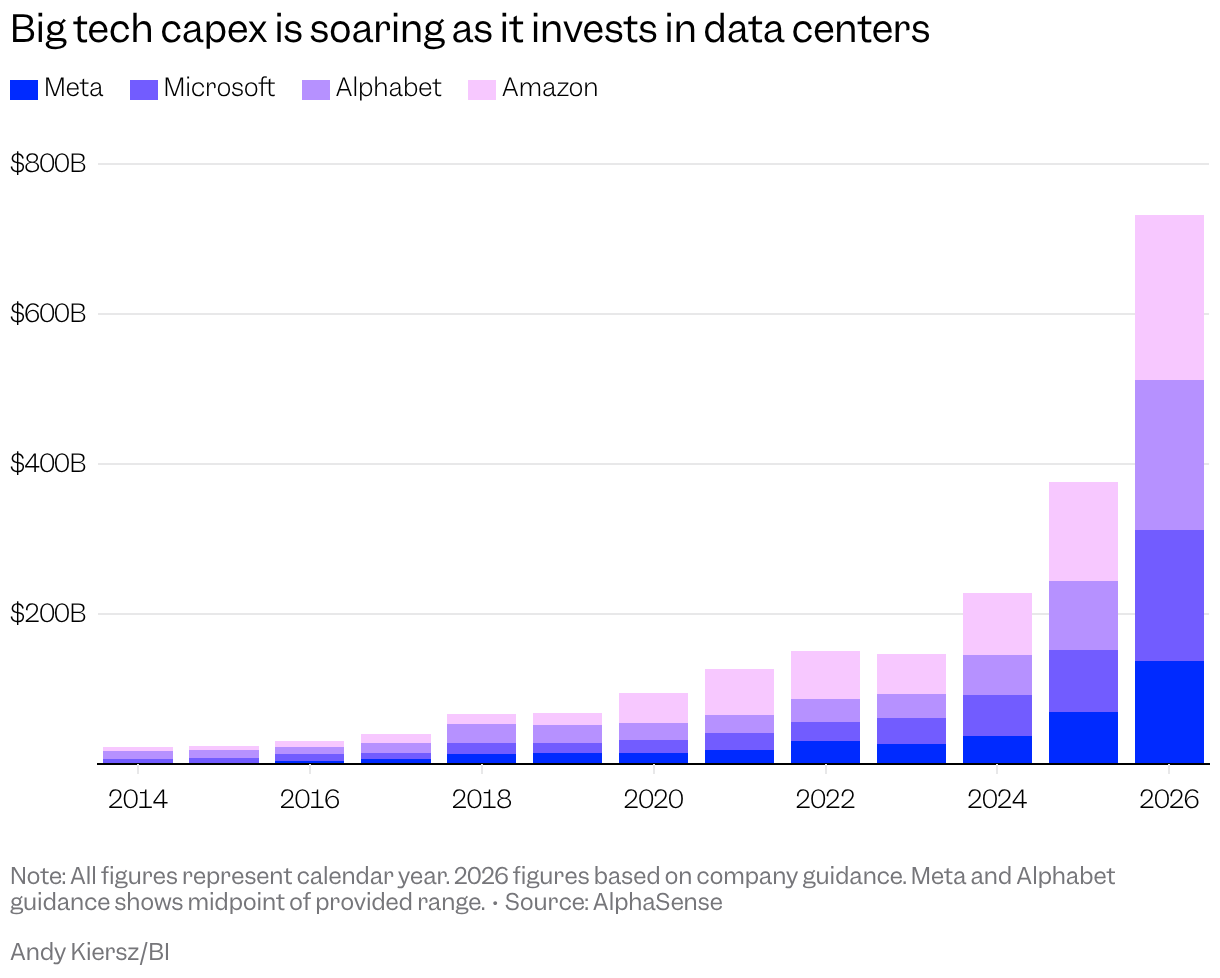
National Jobsite Catering is part of the economic ecosystem being generated by America’s data center boom. The tech giants leading the AI buildout are expected to spend more than $5 trillion on technology and data centers through 2030, with more than 1,500 data centers already in the works in the US.
The room where a worker sleeps, the gym he hits before his shift, his parking spot, his lunch — these are all provided by a growing network of businesses. Local firms in the suburban and rural areas where the bulk of data centers are being built can get a windfall from a single project, but a more lasting proposition is the opportunity to serve site-to-site as construction crews move around. Whether that translates into lasting benefits for host towns is at the heart of growing pushback against the wave of data centers popping up across the country.
Kaplan recognized the new opportunity a few years ago when a hyperscaler hired him to bring trucks to a site outside Philadelphia to feed 2,500 workers. “Literally the town that it was in had one restaurant — and it was in a strip club,” he says.
To avoid a lunch-hour bottleneck, Kaplan proposed preparing meals in a temporary kitchen and bringing them to the site. After replicating this model for other projects, his company now has 20 full-time employees and partners with established local vendors, helping them add equipment and plan production. He estimates a project can employ about 15 local people in kitchen, delivery, and distribution roles.
Jason Andrew for BI
“They know what they’re doing,” Kaplan says of the local partners. “But they’ve never cooked for 1,000 to 3,000 people.”
Since pivoting to data centers exclusively four years ago, revenue has gone up 10X, Kaplan says.
Before thousands of construction workers can arrive on-site, they need somewhere to leave their cars — a logistical challenge that’s creating a new market.
WhereiPark began as a marketplace for city parking spots, but its fastest-growing business now comes from leasing lots near data center construction sites. General contractors have asked WhereiPark to find as many as 2,000 spaces for a project. A church lot used mainly on Sundays might work, as might a struggling shopping center or a nearby fairground or casino. In more remote locations, a contractor may need to grade and stripe land. Local landowners, meanwhile, earn temporary income from unused space without selling the farm.
“If there’s nowhere for the construction workers to park, the thing doesn’t get built,” says Joshua Eisen, WhereiPark’s chief revenue officer.
A team in Toronto does much of the search via property data, calls, and emails; a partner or the general contractor then inspects a prospective lot locally. The company also partners with shuttle operators to ferry workers between the lots and construction sites. For a builder juggling several projects, that means one contact and billing relationship instead of a new search and lease negotiation in every town.
A completed facility the size of a Walmart might have just 50 spaces, so most lots return to their previous use. WhereiPark can repeat the search around another project without owning land.
With global AI investment expected to exceed a trillion dollars in 2026 alone, companies of all sizes are getting in on the gold rush. Food services and facilities management giant Aramark launched a new division called Nexus earlier this year, which offers hotel-like amenities, fitness centers, and recreation to help attract skilled workers. The company noted that Nexus contracts carry higher-than-average profit margins. Executives projected that three initial data center sites could each generate Aramark about $150 million in annualized revenue once fully running.
Jason Andrew for BI
The data center housing business has a precedent in the oil patch, where companies have long followed temporary crews from project to project. Target Hospitality, a $1.8 billion company that has housed oilfield workers and operated two Texas detention centers for ICE, is building and operating accommodations for data center construction crews, including a $550 million deal for a 4,000-bed facility in North Texas. The company advertises furnished bedrooms equipped with small fridges and microwaves, as well as communal dining, gyms, and WiFi. Its modular assets can be redeployed elsewhere. In August, the company said it has secured contracts representing more than 9,000 beds and $1.4 billion since January.
Facing growing opposition, hyperscalers have pitched the AI buildout as an engine of economic development, promising spillover benefits for local areas.
Microsoft’s “community-first” promise cited its experience in Washington state to estimate that for every direct construction job created, another is generated in sectors including security, maintenance, retail, and food service. While spillovers certainly occur, the exact level varies project to project.
To capitalize on that before-and-after job creation, Salute sells data center clients security, safety oversight, and technical support during construction and facility management after it opens. The company, which has worked exclusively with data centers since its founding in 2013, brings in experienced staff to get sites running while recruiting and training locally. It tends to employ veterans and oil and gas workers accustomed to remote job sites, and hopes those who relocate will put down roots. While engineers move to the next project, guards, cleaners, and some technical workers can remain. After all, for a security guard, the job doesn’t change much. “It’s still the same perimeter. It still has the same fence line,” CEO Erich Sanchack says.
For local businesses, the work can be unpredictable. In Louisiana, a couple spent more than $40,000 on a food truck to serve workers building Meta’s Hyperion data center, Fortune reported. Orders fell from more than 100 a day to fewer than 40 after a contractor brought in an out-of-state caterer. Business later picked up again after a local journalist covered their plight, and Meta gave them a catering job. Now they’re serving about 80 orders a day, owner Katie Stewart told me. They went through a boom, a bust, and a recovery before construction was even over.
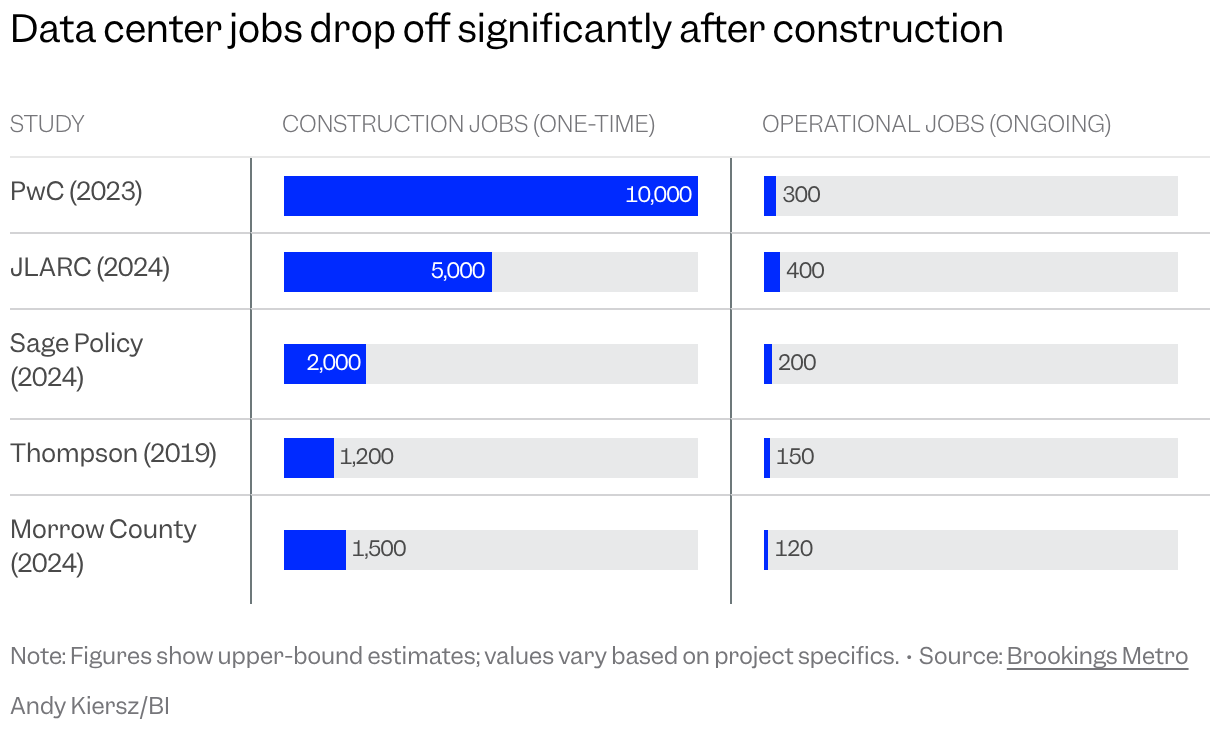
Mark Muro, a senior fellow at Brookings Metro who has studied data centers’ local economic impact, found that the drop in activity after construction can be steep — jobs can climb into the thousands during construction and fall to the low hundreds once the facilities open. But for small towns and rural areas, even those remaining jobs “should be acknowledged as a contribution,” he says. “It is genuine economic activity.”
How long that activity lasts depends in part on the deal a town strikes with data center builders. Negotiations can include how much work goes to locals, tax revenue collected, and whether the developer helps meet demands on housing, roads, and other public services.
Due in part to blowback against data centers, towns have more leverage than they realize, Muro says. They should ask for the infrastructure, training, or jobs they need, he adds, “If they need a $400,000 fire truck or whatever, ask for it.”
Business Insider’s Discourse stories provide perspectives on the day’s most pressing issues, informed by analysis, reporting, and expertise.