Deconstructionism & the Quran
Deconstruction is a way of reading, developed by the French philosopher Jacques Derrida in the 1960s, and its aim is closer to the opposite of demolition. It is the careful, almost affectionate act of noticing how a text quietly resists the tidy surface-level reading. It is an approach to reading texts and ideas that looks for the hidden assumptions, oppositions, and tensions that make their meaning possible. In plain language: it asks how a text’s apparent meaning depends on implicit contrasts, and then shows that those oppositions are often less stable than they first appear.
Deconstructionism can be applied to any text, but the most interesting cases appear in great works. Consider the multitude of debates over contracts, legal rulings, great literature, or major philosophical works. These differences stem from unstated assumptions in the text, which lead different readers to different interpretations. No text has a richer history of this than the Quran, the most intensely read document in human history. Fourteen centuries of scholars have pressed on every word. That long tradition of reading gives us unusually clear examples of the exact phenomena deconstruction describes. In fact, as we will see, readers noticed many of these features long before anyone in Paris had a name for them.
First, what deconstruction is not
Three quick misconceptions to clear away:
Deconstruction is not destruction. Derrida chose a word that sounds like “destruction” on purpose, then spent his life insisting it was not that. A demolition crew wants the building gone. A deconstructive reader wants to understand how the building stands—and where the invisible load-bearing assumptions that cause differences in interpretation lie.
This does not mean that “the text means nothing.” The claim is subtler: a text means more than its surface-level reading, and no reader can ever fully encompass its total meaning in its entirety.
This does not mean that “anything goes.” Some readings are still better supported than others. Deconstruction does not say every interpretation is equal; it says no single interpretation is ever the final, sealed, complete one.
[18:109] Say, “If the ocean were ink for the words of my Lord, the ocean would run out, before the words of my Lord run out, even if we double the ink supply.”
[31:27] If all the trees on earth were made into pens, and the ocean supplied the ink, augmented by seven more oceans, the words of GOD would not run out. GOD is Almighty, Most Wise.
The core idea in a sentence
Here is the argument of deconstructionism compressed: a text cannot fully control its own meaning, because meaning is produced by differences between words rather than by any word’s private connection to reality, and the neat oppositions a text relies on tend to wobble the moment you lean on them.
Part one: meaning comes from differences, not from things
Open a dictionary and look up a word. What do you find? More words. Look those up, and you find still more words. You never reach a place where language touches the world directly and stops. Every word is defined by its difference from other words—”hot” means something only against “cold,” “day” only against “night.”
This applies to nouns as well. Take the word bird. You might define it as an animal with feathers, wings, and a beak—but now you have introduced animal, feathers, wings, and beak, each of which requires more words to explain. Or take yourself. You might define yourself by your name, your family, your job, your nationality, your beliefs, or your personality—but every one of those terms depends on still other terms and relationships. Even the seemingly simple question “Who are you?” never arrives at a final word that explains itself completely.
Derrida gave this endless deferral of meaning a coined name, différance, but you do not need the term to grasp the point. Meaning is relational. It lives in the gaps between words, not inside any single word like a nut inside a shell. And because those relationships never come to rest, a final, fixed meaning is always postponed—always one more look-up away.
Part two: every text runs on opposites, and the opposites lean on each other
Serious texts organize the world into pairs, and they almost always rank one side above the other: good over evil, light over dark, belief over disbelief. Deconstruction’s favorite move is to show that the “superior” term secretly depends on the inferior one it claims to rise above.
The Quran is built from such pairs. Belief and disbelief (iman and kufr), guidance and misguidance (huda and dalal), light and darkness, this world and the next. Consider light and darkness:
“GOD is Lord of those who believe; He leads them out of darkness into the light.” (Quran 2:257)
The verse depends on the contrast. “Light” carries its entire meaning here because darkness is set against it. Guidance is only legible as guidance because misguidance is possible. Remove one side of each pair and the other side goes dark too. The privileged term cannot stand alone; it needs its opposite to mean anything at all. This is a consistent theme in the Quran.
The blind and the seer are not equal.
Nor are the darkness and the light.
Nor are the coolness of the shade and the heat of the sun.
Nor are the living and the dead; GOD causes whomever He wills to hear. You cannot make hearers out of those in the graves. (Quran 35:19-22)
The Quran even indicates that it contains contrasting pairs of examples.
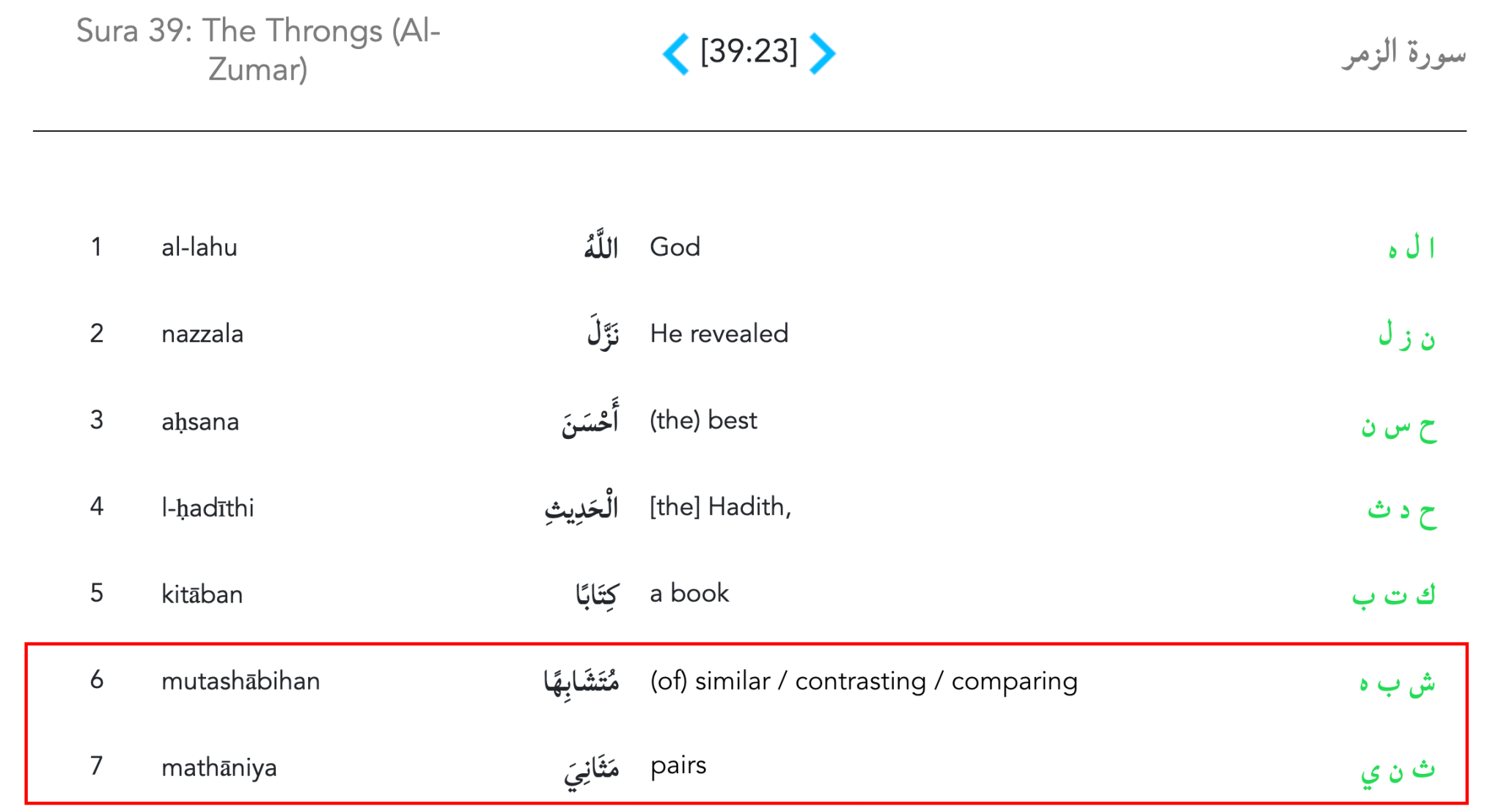
GOD has revealed herein the best Hadith; a book that is consistent, and points out both ways (to Heaven and Hell). The skins of those who reverence their Lord cringe therefrom, then their skins and their hearts soften up for GOD’s message. Such is GOD’s guidance; He bestows it upon whomever He wills. As for those sent astray by GOD, nothing can guide them. (Quran 39:23)
The expression كِتَابًا مُتَشَابِهًا مَثَانِيَ can be understood as “a book comparing/contrasting pairs.”
A neat hierarchy would keep the two sides cleanly apart—light from God, darkness from elsewhere. But the Quran also says that both guidance and misguidance flow from the same source: God.
We did not send any messenger except (to preach) in the tongue of his people, in order to clarify things for them. GOD then sends astray whomever He wills, and guides whomever He wills. He is the Almighty, the Most Wise. (Quran 14:4)
The opposition that the text runs on turns out to have a single origin behind it.
Say, “I seek refuge in the Lord of daybreak.
“From the evils among His creations. (Quran 113:1-3)
That is not a flaw a reader invents; it is a tension sitting in the text itself, and centuries of theologians argued over it precisely because it will not resolve into a tidy split. This does not mean there isn’t an answer that resolves this tension, but that the answer is not explicit and requires extrapolation that leads to various interpretations.
The recitation versus the written word
Derrida’s most famous target was what he called logocentrism—the deep Western habit of treating the spoken word as the real, living, authentic thing, and writing as a secondary copy of it. Speech feels present: the speaker is right there, seemingly able to guarantee what the words mean. Writing feels more distant: marks left behind after the speaker is gone, able to travel into new contexts and acquire meanings the author cannot control. Derrida argued that this hierarchy is far shakier than it looks.
The Quran provides a fascinating example because it presents itself through both categories and resists any simple separation between them.
Its very name, al-Qur’an, comes from a root meaning “to recite.” It is the Recitation—the word delivered orally, memorized in the chest, and sounded aloud. This is the “speech” side, but the term al-Qur’an also signifies that what is being recited is from something written. That is why the Quran also repeatedly calls itself al-Kitab, the Book. The revelation is therefore presented at once as something spoken and something written.
The tension goes deeper. The Quran also refers to itself as the speech of God, kalam Allah. Yet it also describes itself as belonging to a “Preserved Tablet” (al-lawh al-mahfuz), an inscribed heavenly archetype that precedes its earthly recitation. The supposedly simple hierarchy between original speech and secondary writing now becomes difficult to maintain. The revelation is speech, but the speech points back toward inscription; it is recited, but it is also Book; it arrives through a voice, yet it is associated with a text that precedes that voice.
And this is the important deconstructive move: the point is not simply to reverse the hierarchy and declare writing superior to speech. It is to notice that neither category can remain pure. The Quran’s identity as Recitation depends upon something that can also be called Book, while its identity as Book is continually realized through recitation. Speech and writing, rather than standing as clean opposites, turn out to inhabit one another.
That is exactly the kind of instability Derrida wanted readers to notice. The opposition still matters—we can distinguish speaking from writing—but the closer we examine it, the harder it becomes to maintain the neat hierarchy with which we began.
When a text leaves open its own meaning
Here is a delightful example. There is a verse specifically about how to read the Quran—which parts are clear and which are open:
“He sent down to you this scripture, containing straightforward verses—which constitute the essence of the scripture—as well as multiple-meaning or allegorical verses.” (Quran 3:7)
So far so good: the Quran divides itself into clear verses (muhkamat) and multi-meaning or allegorical ones (mutashabihat). But then the same verse says who is able to properly interpret the multi-meaning ones—and this is where it gets interesting. In the translation by Dr. Rashad Khalifa, it renders it:
“None knows the true meaning thereof except GOD and those well founded in knowledge.” (Quran 3:7 con’t, Khalifa)
On this reading, learned humans can understand the ambiguous verses.
But many other translators render the very same Arabic:
“None knows its interpretation except God. And those well grounded in knowledge say, ‘We believe in it…” (Quran 3:7 con’t)
On this reading, only God knows, and the learned merely affirm their faith.
Which is right? The difference hinges on a single decision: where you pause when reading the Arabic—
إِلَّا ٱللَّٰهُ ۗ وَٱلرَّاسِخُونَ فِى ٱلْعِلْمِ
Do you stop after “except God” (illa Allah)—making the following clause a new sentence about the learned merely believing? Or do you read straight through—”except God and those grounded in knowledge” (wa’r-rasikhuna fi’l-‘ilm)—making the learned co-knowers? Classical Arabic was written without the pause marks that would settle it. The grammar genuinely permits both. And the two readings produce opposite doctrines about whether human beings can ever plumb the depths of scripture.
Sit with the irony. The one verse that tells you some parts of the text are multi-meaning is itself multi-meaning. The text that repeatedly describes itself as clear also informs readers it has verses that are unclear. A deconstructive reader could not ask for a cleaner demonstration, and note that no reader had to smuggle it in—it was there in the sentence all along.
Meaning that never finishes
At the opening of twenty-nine chapters, the Quran presents fourteen different sets of disconnected Arabic letters:
| No. | Sura No. |
Sura Title |
Quranic Initials |
| 1. | 2 | The Heifer | A.L.M. |
| 2. | 3 | The Amramites | A.L.M. |
| 3. | 7 | The Purgatory | A.L.M.Saad. |
| 4. | 10 | Jonah | A.L.R. |
| 5. | 11 | Hûd | A.L.R. |
| 6. | 12 | Joseph | A.L.R. |
| 7. | 13 | Thunder | A.L.M.R. |
| 8. | 14 | Abraham | A.L.R. |
| 9. | 15 | Al-Hijr Valley | A.L.R. |
| 10. | 19 | Mary | K.Ha.Y.‘A.Saad. |
| 11. | 20 | T.H. | T.Ha. |
| 12. | 26 | The Poets | T.Seen.M. |
| 13. | 27 | The Ant | T.Seen. |
| 14. | 28 | History | T.Seen.M. |
| 15. | 29 | The Spider | A.L.M. |
| 16. | 30 | The Romans | A.L.M. |
| 17. | 31 | Luqmaan | A.L.M. |
| 18. | 32 | Prostration | A.L.M. |
| 19. | 36 | Y.S. | Y.Seen. |
| 20. | 38 | S. | Sad. |
| 21. | 40 | Forgiver | H.M. |
| 22. | 41 | Elucidated | H.M. |
| 23. | 42 | Consultation | H.M. ‘A.Seen.Q |
| 24. | 43 | Ornaments | H.M. |
| 25. | 44 | Smoke | H.M. |
| 26. | 45 | Kneeling | H.M. |
| 27. | 46 | The Dunes | H.M. |
| 28. | 50 | Q. | Q. |
| 29. | 68 | The Pen | NuN |
For roughly fourteen centuries the answer was a shrug of reverence toward what these initials meant. As Dr. Khalifa himself noted, the classical commentaries agreed that “no one knew the meaning or significance of the Quranic Initials.” Their meaning was held to be known to God alone—which is to say, endlessly deferred, forever one interpretation short of closure. Again, this doesn’t mean the letters lack meaning or purpose, as Dr. Khalifa demonstrated: they serve as the foundation of the Quran’s mathematical structure, but they were placed inside the text for fourteen centuries, left to be pondered.
The same open-endedness scales up to the whole book. The tradition of tafsir—Quranic commentary—runs to thousands of volumes across Sunni, Shia, Sufi, philosophical, and rationalist schools, and it has not stopped. Each generation finds meanings the last did not. A text that could be finished would have been finished by now. That it keeps yielding new readings is not a scandal; it is the condition of a text that is endless in meaning that can be read an infinite number of times and still extract new findings each time.
Context decides—and even the context is contested
One last example, because it shows how far the différance reaches. There is a verse traditionally cited to explain how one part of scripture can supersede another:
“When we abrogate (nasakha) any miracle (ayah), or cause it to be forgotten, we produce a better miracle (ayah), or at least an equal one.” (Quran 2:106)
The word rendered “abrogate” (nasakha) launched an entire doctrine—naskh—according to which some verses (ayat) cancel or replace others. However, the word “ayah” can also mean a sign, miracle, or revelation, and depending on how one interprets the word in each verse, one will draw different conclusions.
For example, Dr. Khalifa understood “ayah” in this verse as “miracle,” such that old miracles are abrogated by new ones (2:106). So the verse meant to explain what abrogates what is itself undefined about what is being abrogated. Its meaning depends entirely on the interpretive frame one brings, and the text does not explicitly hand the frame.
This is the general lesson. Meaning depends on context; context is open, and no verse arrives with instructions for its own reading stapled to it. To reiterate, this doesn’t mean there isn’t a correct understanding or that all understandings are equal, only that the text is written in a way that on a surface level opens the door to multiple interpretations.
So does this make the Quran deficient?
No—and understanding why is the whole point.
Everything above describes how language itself works, in every serious text. Run the same procedure on the Bible, on the Constitution, on a great poem, and the same features surface: load-bearing oppositions that lean on each other, voices that turn out to depend on writing, sentences that cannot fully fix their own sense, meanings that keep generating and never close. The Quran is not being singled out as defective. It is being used as an unusually clear specimen of a universal condition, precisely because it has been read so hard for so long.
And notice what that convention already knew. The Quran named the category of ambiguous verses (mutashabihat) and left readers to debate for centuries where to pause in 3:7. It proclaimed the disconnected letters but did not explicitly state their function. The Quran did not consider openness as a threat. It left it as a sign of depth—a text whose waters will never be exhausted.
That is perhaps the most useful thing deconstruction offers a reader of any scripture: not a demolition, but a form of humility. Any confident claim to possess the final, complete, closed meaning of the text is claiming something the text itself will not grant. Believers can hold this in more than one way. Some take the endless deferral as evidence of the divine—infinite meaning from an infinite source, never exhausted by finite minds. Others take it as a caution against any human authority that claims to have sealed the book shut. Deconstruction does not decide between these. It only insists, gently and stubbornly, that the reading is never over.
Related Articles