1.7 Million Satellites Will Have ‘Devastating Consequences,’ Study Says
Topline
A new study by the European Southern Observatory warns that plans to launch more than 1.7 million satellites into orbit could have “devastating consequences for astronomy,” making the night sky brighter and reducing scientists’ ability to observe the galaxy and the universe beyond. SpaceX is set to build a new economy in low Earth orbitexpanding its current Starlink telecommunications constellation and adding orbital AI data centers and even wirelessly transmitted solar power from space. The study — only the latest to warn about the scientific and environmental dangers of crowding Earth’s orbit — concludes that Earth orbit should be limited to no more than 100,000 faint satellites, all below naked-eye visibility, to protect modern ground-based astronomy. According to Orbital Radarthere are currently 17,501 satellites orbiting Earth — 10,000 of them active SpaceX Starlink satellites.
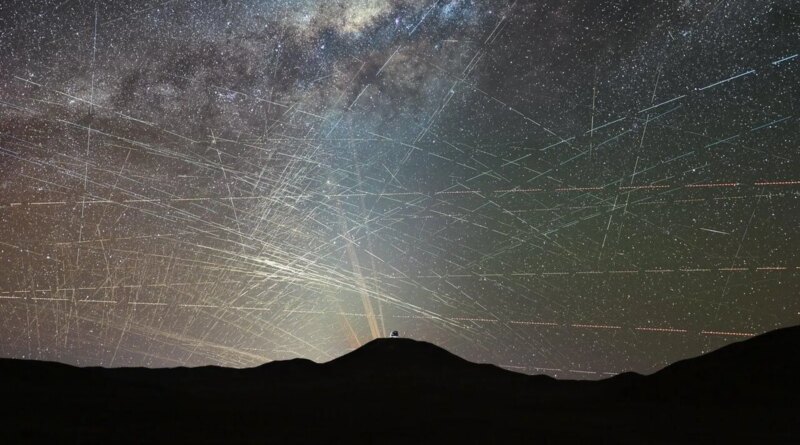
This image shows satellites crossing the night sky above the northern Atacama Desert in Chile, over a period of just one hour. It is a stack of a time-lapse video taken on 15 October 2025 about two hours after sunset. A few streaks are caused by planes, and can be easily identified by their blinking-coloured lights, but most trails are due to satellites. In the foreground we see the dome of ESO’s Extremely Large Telescope (ELT), the world’s largest optical/infrared telescope, currently under construction atop Cerro Armazones. Behind it we see the lasers of ESO’s Very Large Telescope (VLT) at Paranal Observatory, 22 km away from the ELT.
F. Kamphues, ESO/M. Kornmesser
Key Facts
The peer-reviewed researchled by ESO astronomer Olivier Hainaut and accepted for publication in Astronomy & Astrophysicsis the first to calculate how large and bright satellite constellations could affect astronomical observations by increasing background sky brightness.
Since 2019, the number of active satellites orbiting Earth has risen rapidly, led largely by SpaceX’s Starlink network. Proposed constellations could push that figure far higher.
SpaceX has plans to launch 20,000 Starlink satellites. It currently has 10.3 million subscribers across 164 countries. It has also filed plans to send one million additional satellites into orbit for space-based data centers.
Other projects, including Reflect Orbital, E-Space’s Cinnamon constellation and China’s CTC-1 and CTC-2 systems, could add hundreds of thousands more satellites.
The global space economy is forecast to grow from about $630 billion in 2023 to $1.8 trillion by 2035, according to the World Economic Forum. That’s about twice the rate of global GDP growth.
Bright Satellites Will Change The Night Sky
“Until now we have managed, but it’s getting worse,” said Hainaut, an astronomer at ESO for over 30 years. Although some companies have taken steps to reduce satellite brightness, he warned that current proposals go “beyond the limit” of what astronomy can withstand.
Satellites illuminated by the sun can leave bright streaks across telescope images, blocking faint galaxies, Earth-like exoplanets and potentially dangerous asteroids. Hainaut found that SpaceX’s mega-constellation could create dozens of satellite trails in images taken by ESO’s Very Large Telescope in Chile two hours into the night. That could cause field-of-view losses of up to 28%. Since they reflect light from the sun when it’s just below the horizon, it’s always just after sunset and just before sunrise that satellites cause the most problems. Wide-field cameras, such as the one at the Vera C. Rubin Observatory, could be even more vulnerable. A bright satellite trail can saturate detectors, produce ghost trails and potentially make images unusable.
This image illustrates how sunlight scattered by Reflect Orbital’s space mirrors would increase the overall brightness of the sky above ESO’s Very Large Telescope (VLT). The left image was captured with an all-sky camera on a moonless night on 16 May 2026. North is up, and West is to the right. The domes hosting the four 8-m telescopes of the VLT can be seen to the top-right. The image to the right is a simulation showing how much brighter the sky would be with Reflect Orbital’s full constellation of 50 000 mirrors. Even though the mirrors are not pointing directly at the observatory, they still diffuse light sideways, which is then further scattered by the atmosphere. As a result, the sky would be up to three to four times brighter.
ESO/O. Hainaut
Reflect Orbital’s ‘Sunlight On Demand’ Plans
The study raises particular concern about Reflect Orbital, a U.S. start-up planning large mirror-like satellites designed to provide sunlight at night. The company aims to launch a prototype soon and expand to 50,000 satellites by 2035. Hainaut’s calculations show these satellites could become the brightest objects ever placed in orbit. From inside a reflected beam, one satellite could appear four times brighter than the full moon. Even when not aimed directly at an observer, each satellite could appear as bright as Venus. From a light-polluted city, its satellites would be the only ‘stars’ visible in the night sky.
Strict Limits Required
Hainaut argues the worst impacts can only be avoided by limiting the total number of satellites, existing and future, to around 100,000. He also stresses that satellites must be fainter than visual magnitude 7, so they remain invisible to the naked eye even under dark skies. Although they can be that bright soon after launch, Starlinks are typically fade to magnitude 5.5 once they reach their operational orbit, according to Astronomy magazine.
SpaceX and Reflect Orbital have each filed with the U.S. Federal Communications Commission (FCC) for permission to launch. “The FCC received over 1,800 comments regarding Reflect Orbital and nearly 1,500 comments on the application by SpaceX,” said Betty Kioko at the ESO’s Institutional Affairs Office. “The ball is now in the FCC’s court, and we wait to see the determinations they make on both filings. For optical astronomy, this is an existential threat, and we hope that the regulators will share that view.”