With The Washington Post In Freefall, An Awkward Question For Jeff Bezos
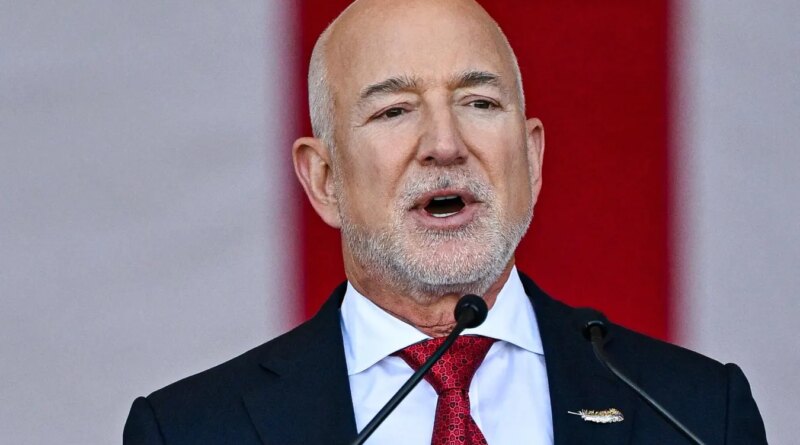
Blue Origin CEO Jeff Bezos speaks onstage ahead of US Defense Secretary Pete Hegseth at Blue Origin in Cape Canaveral, Florida, on February 2, 2026. (Photo by Miguel J. Rodriguez Carrillo / AFP via Getty Images)
AFP via Getty Images
Jeff Bezos launched Amazon back in the mid-1990s, and by the time his company reached the 13-year mark it had already survived the dot-com bust, become an online retail juggernaut, and seen the launch of Amazon’s Prime membership subscription program. By that point, around 2007, Bezos had also placed two of the most important bets in his company’s history: 2006 saw the introduction of Amazon Web Services, which would become the backbone for a large chunk of the Internet, while 2007 brought the unveiling of Amazon’s popular e-reader, the Kindle.
Contrast that with how things have unfolded at The Washington Postnow that it’s been 13 years since Bezos bought the newspaper in 2013 for $250 million.
Amazon-style innovation stil missing at The Washington Post
In many respects, the nearly 150-year-old paper is the least complicated of its billionaire owner’s many business interests, which include a global e-commerce empire, the private space company Blue Origin, and a portfolio of investments that span logistics, media, and technology. And yet, 13 years into Bezos’ ownership, the Post has seen no obvious equivalent to Amazon’s Prime, Kindle, or AWS moments—no big strategic moves or structural reinvention of the sort that he engineered so relentlessly at Amazon.
And based on his own words, he knows the newspaper needs that kinds of risk-taking.
“I don’t think you can keep shrinking the business,” Bezos said in September 2013, during his first staff meeting at the Post shortly after buying it. “You can be profitable and shrinking. And that’s a survival strategy, but it ultimately leads to irrelevance, at best. And, at worst, it leads to extinction.”
Even so, despite being a far less complex operation than Amazon or Blue Origin—a newspaper being largely built around hiring journalists to create content and then monetizing that work through a revenue mix that includes advertising and subscriptions—the Post days ago saw more than 300 employees join the ranks of the newly unemployed (and, for some, the newly Substacked).
The layoffs on Feb. 4 included shuttering entire sections of the paper like the Books section and making deep Metro cuts. The cuts were so far-reaching they included an entire team of reporters covering the Middle East, as well as a Ukraine correspondent—not to mention the Post’s own Amazon beat reporter.
Demonstrators attend the Save the Post rally outside The Washington Post offices on Thursday, February 5, 2026, after about 300 newsroom employees were laid off.
CQ-Roll Call, Inc via Getty Images
Coverage of the paper’s dramatic one-day contraction, by the way, has correctly noted that it shrunk the newsroom by 30%, but stepping back from this week also reveals an even deeper erosion. Bezos—whose net worth when he bought the Post was about $25 billion, a figure that’s since climbed to $250 billion as of this month—has actually seen the Post newsroom shrink by 50% since 2023.
The paper had more than 1,000 newsroom employees three years ago. It’s down to around 500 or so today.
In a memo to staff, Post executive editor Matt Murray framed the layoffs as a response in part to external forces, such as the fact that “platforms like Search that shaped the previous era of digital news … are in serious decline. Our organic search has fallen by nearly half in the last three years.”
The Bezos playbook
Part of what’s so surprising here is that it’s happening at all, given who Bezos is. Because anticipating the decline of once-dominant platforms and building something new in their place is precisely what defined his career at Amazon. He doesn’t even necessarily need to invent a new playbook for the Post—he already wrote one at Amazon, and many of his insights there were already evident by the same point in Amazon’s life cycle that he’s now reached at the Post. They include:
Customer obsession. At Amazon, there was never much mystery about who the customer was or what they wanted—things like low prices, fast delivery, abundant choice, and a shopping experience that didn’t get in the way.
At the Post, the equivalent question still feels … kind of unresolved. The newsroom keeps shrinking and sections vanishing, with little evidence of a compelling vision taking their place. That point was underscored this weekend by the sudden exit of WaPo publisher Will Lewiswhich only deepens questions about where the paper might be headed.
Long-term thinking. Amazon under Bezos famously made a habit of playing the long game. Some big bets failed—like the Fire Phone, which was quietly written off and moved past. Others like scaling AWS, growing the Prime subscription business, and eventually adding the Netflix-like service Prime Video to the Prime bundle were clear reflections of the Bezos-led emphasis on long-term vision and experimentation.
The Post, on other hand, is reeling from devastating cuts that arrived suddenly, without a clear sense of what the next version of the paper is supposed to look like.
Ruthless prioritization, not just cost-cutting. At Amazon, Bezos became known for making hard calls decisively—walking away from ideas that weren’t working, while putting real money and executive attention behind a small number of bets he believed could fundamentally change the company’s trajectory.
At the Post, the evolution has been in large part about subtraction.
In his first public statement since the layoffs, Bezos struck a note of confidence. “The Post has an essential journalistic mission and an extraordinary opportunity. Each and every day our readers give us a roadmap to success. The data tells us what is valuable and where to focus.”
Even so, a roadmap for the paper’s future has yet to emerge. Which is why, if he hasn’t yet, it might be worth Bezos at this point turning to an unconventional source for inspiration for what to do next with his shrinking asset. For example, he could always check out The PostSteven Spielberg’s 2017 drama about the paper and its identity as a public trust.
It’s currently available to rent or buy on Prime Video.