War In The Gulf And Strait Of Hormuz – Are There Winners And Losers?
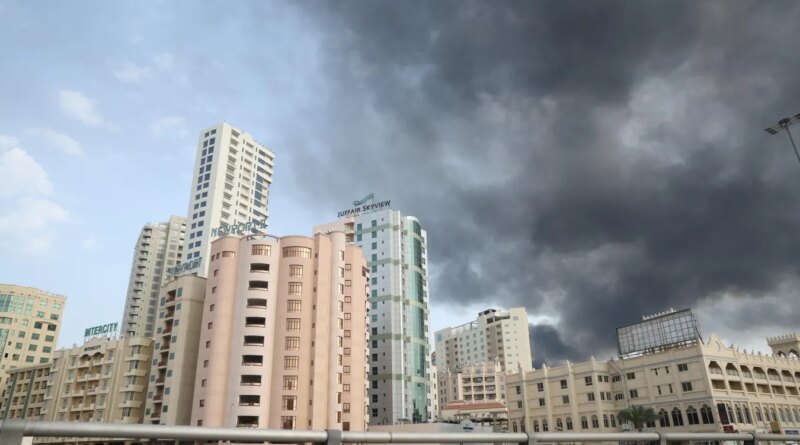
MANAMA, BAHRAIN – FEBRUARY 28, 2026: Smoke rises after Iran launched a missile attack targeting the headquarters of the U.S. Navy’s Fifth Fleet in Manama, following U.S. and Israeli strikes. The incident marks a significant escalation in tensions in the region. (Photo by Stringer/Anadolu via Getty Images)
Anadolu via Getty Images
War in the Persian Gulf has cut traffic through the Strait of Hormuz, a key global chokepoint for oil and gas trade, to a near standstill. Early signs are mixed as to how large and how long the price spike might be in world markets, particularly for oil. President Trump has stated that the current war might last a month.
But another question of equal import is who might be the winners and losers should this war continue and, not least, involve strikes against oil export infrastructure. Saudi Arabia, Kuwait, UAE, Qatar, Iraq, and Iran itself are all hugely dependent on the Strait, and thus so are their major customers.
Oil Prices and Uncertainty
To say that investors are nervous about what lies ahead would be an underestimation. No one expected such a sudden and intense attack from the U.S. and Israel, let alone one that would succeed in killing Iran’s Supreme Leader, Khameini, plus key military leaders. Nor, perhaps, based on Iran’s response to the aerial assaults of mid-2025, did they anticipate such a large-scale counterattack by Iranian missiles and drones against Arab Gulf countries that give support to U.S. military presence.
War brings chaos, and this is no exception. Even as President Trump said Iran’s new leadership wants “to talk,” attacks escalate. The U.S. military has claimed nine Iranian warships have been sunk, yet Iran insists it has closed the waterway and several tankers have been attacked in the Strait.
Predictions about what oil prices will do in coming days or weeks have varied wildly, from a nudge to $80 to a surge beyond $100. The first of these may seem less likely than the second, but arguments can go either way. Much depends on what transpires in coming days.
Infographic showing map of the Gulf with refineries and liquefied natural gas terminals operational in February 2026, as well as density of maritime tanker traffic in the Gulf region. (Graphic by Nalini LEPETIT-CHELLA and Omar KAMAL / AFP via Getty Images)
AFP via Getty Images
Both history and experience suggest no oil crisis is a predictive model for others. Market conditions are too specific to the moment and trader psychology therefore commensurately unique for the past to be either prologue or prototype. Price forecasts in a time of war are usually worth what we pay for them (or less).
Winners And Losers If The War Continues
Yet the current geopolitics of oil and gas, complex though they are, do offer ideas about who might benefit or be disadvantaged by this conflict or both.
Russia is foremost among those who could benefit from a significant price rise, dependent as are its economy and its own war in Ukraine on hydrocarbon exports, crude oil most of all. At the same time, Iran is a key ally that has helped the Kremlin gain new drone technology and factories to build it.
Other winners would be exporters lacking any cooperation with Iran and not located west of the Strait of Hormuz. This would include other OPEC+ producers, as well as countries like Brazil, Australia, and Guyana, as well as Canada and the U.S. In the last two cases, however, benefit would go mainly to the oil industry itself and to related services, while higher fuel prices would not be welcomed by consumers—indeed, they could be a serious political liability for Trump and Republicans in the 2026 U.S. midterm elections.
Who, then, stands most to lose? This is not difficult to say: East Asia, India, and, to a lesser degree, Europe.
ANKARA, TURKIYE – JUNE 17: An infographic titled “Strait of Hormuz” created in Ankara, Turkiye on June 17, 2025. Connects oil and LNG production in the Middle East to global markets via the Arabian Sea and the Indian Ocean. (Photo by Murat Usubali/Anadolu via Getty Images)
Anadolu via Getty Images
China, Japan, South Korea, and Taiwan all stand out here. For China, not only is it the world’s largest oil importer, but more than half of these imports come from Persian Gulf countries, especially Saudi Arabia, Iran, Iraq, and Kuwait (in that order). The other three importers, however, are even more exposed—70% (South Korea) to 80% (Japan) of their oil comes through the Strait, primarily from Saudi Arabia, UAE, and Kuwait. Overall, the Strait of Hormuz might be called the East Asia oil “canal.”
India also stands to be negatively impacted to a significant degree, since Gulf producers Iraq, Saudi Arabia, and UAE
As for the EU, as of now the world’s second largest crude oil importer, it is less exposed to related risk but not free from it. Imports from Gulf states have been important to filling the gap created by massive cuts in Russian crude, now as low 1% – 2%, with EU plans to eliminate it altogether in 2027. Top oil suppliers now include Norway (14.6%), the U.S. (14.5%), and Kazakhstan (12.2%), with Saudi Arabia and Iraq (~10%), and a diversity of other, non-Gulf exporters making up the rest.
The Risk Is Shared By Exporters, Too
Gulf states understand very well, and have for a long time, that their own security is directly tied to the Strait of Hormuz. Their economies, prosperity, and, to a significant degree, their stability rely on oil and gas exports through this narrow channel. The so-called “tanker wars” of the 1980s, part of the brutal conflict between Saddam Hussein’s Iraq and an Iran under Ayatollah Kohmeini, proved that a variety of ways exist for it to be closed or restricted.
Military blockade or attacks using ships, mines, missiles and now drones are one obvious way shown by that episode. More than 400 ships were damaged in the Gulf, and though commercial traffic fell, it mostly continued through the decade and came to be protected by the U.S. in the last phase of the war. A related risk to outright military attack on tankers is harassment and detention of crews, whether by naval or unidentified vessels. The 1980s conflict also highlighted the role of insurers, who increased premiums by up to 50% or more, leading some firms to send their shipping elsewhere.
A US Navy minesweeping helicopter leads the way for the 12th US reflagged Kuwaiti tanker convoy 22 October 1987. Two tankers, Gass Prince and Ocean City, are being escorted by four US war ships (Haws, Ford, Raleigh and Standley) and the US helicopter carrier Guadacanal. The convoy is heading out of the Gulf three days after US ships bombed two Iranian oil platforms. The Tanker War started properly in 1984 when Iraq attacked Iranian tankers and the vital oil terminal at Kharg island. Iran struck back by attacking tankers carrying Iraqi oil from Kuwait and then any tanker of the Gulf states supporting Iraq. The air and small boat attacks did very little to damage the economies of either country and the price of oil was never seriously affected as Iran just moved it’s shipping port to Larak Island in the straits of Hormuz. AFP PHOTO NORBERT SCHILLER (Photo by NORBERT SCHILLER / AFP) (Photo by NORBERT SCHILLER/AFP via Getty Images)
AFP via Getty Images
Some of these effects, including the last, are apparent in the current war. At this writing, other than Iranian- and Chinese-flagged ships, most commercial vessels have stopped transiting the Strait, in part due to a jump in insurance premiums. Though, in addition to U.S. bases, Iran has targeted airports, hotels, some ports, as well as residential areas, it has not targeted oil and gas export terminals of other Gulf nations. These were consistent targets during the tanker wars—including by the U.S. in its 1988 one-day decimation of the Iranian navy (Operation Praying Mantis). There is no guarantee they will not remain so this time either.
As a result of repeated threats from Iran to close the Strait, other Persian Gulf states have built pipelines that bypass it. This includes Saudi Arabia’s Yanbu line to the Red Sea, the UAE’s Fujairah line to the Gulf of Oman, and—perhaps surprisingly, but perhaps not—Iran’s own Goreh-Jask pipeline and export terminal, Bandar-e Jask, on the northern coast of the Gulf of Oman. What could the first two achieve? At most a quarter of the 21 million barrels per day that normally move through the Strait of Hormuz. Not quite enough, in other words.
The new war in the Persian Gulf, whatever its outcome, is already a risk for global energy security.
Gas by Appointment Signs Increased Each Day in Portland and Other Parts of Oregon until the State Put Into Effect the Odd-Even Gas Plan. Other States Also Adopted the Scheme to Decrease the Gas Lines. Image courtesy National Archives, 1973. (Photo by Smith Collection/Gado/Getty Images).
Getty Images