Trump threatens NATO exit, scaling up tensions with allies
By John Irish and Sam Tabahriti
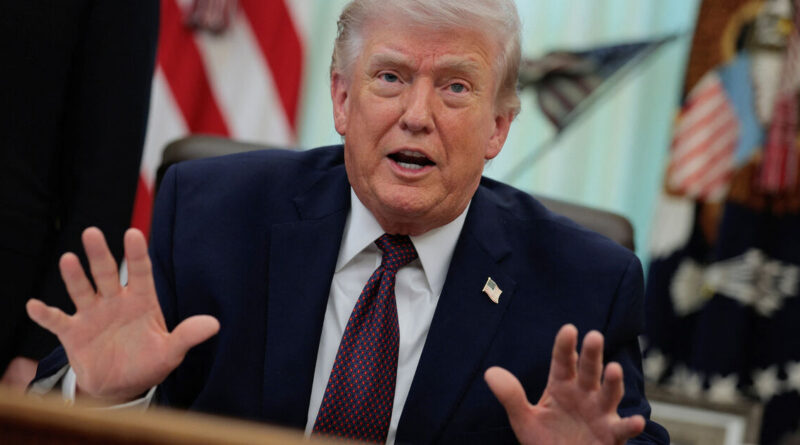
PARIS/LONDON, April 1 (Reuters) – Tensions between the United States and NATO allies flared up as President Donald Trump said he was considering pulling the U.S. out of the military alliance due to its European members’ refusing to send ships to unblock the Strait of Hormuz.
NATO, which includes European countries, the United States and Canada, was formed in 1949 with the aim of countering the risk of Soviet attack and has been the cornerstone of the West’s security ever since.
Trump’s remarks on Wednesday came just hours after his Defense Secretary Pete Hegseth declined to reaffirm the U.S. commitment to NATO’s collective defence, a concept that lies at the heart of the alliance.
‘PAPER TIGER’
“I was never swayed by NATO. I always knew they were a paper tiger, and (Russian President Vladimir) Putin knows that too, by the way,” Trump told Britain’s Daily Telegraph, saying he had moved “beyond reconsideration” of U.S. membership.
Experts have long warned that remarks suggesting that the United States might not honour its NATO commitments could encourage Russia to test NATO members’ readiness to enforce the alliance’s Article 5, which states an armed attack against one member state is an attack on all.
France was among the first European NATO members to react – though without directly addressing Trump’s threat to leave NATO.
“Let me recall what NATO is,” French junior army minister Alice Rufo said.
“It is a military alliance concerned with the security of territories in the Euro-Atlantic area. It is not intended to carry out an operation in the Strait of Hormuz, which is not in accordance with international law.”
CALL FOR CALM
In Poland, Defense Minister Wladyslaw Kosiniak-Kamysz called for calm.
“I hope that amid the emotions surrounding the President of the United States today, a moment of calm will come,” he said. “And why? Because there is no NATO without the United States, and it is in our interest that this calm comes. But there is also no American power without NATO.”
NATO had no immediate comment.
A German government spokesperson, when asked to react to Trump’s comment, said Germany remained committed to NATO. “This isn’t the first time he’s done this, and since it’s a recurring phenomenon, you can probably judge the consequences for yourself,” the spokesperson told a regular government press conference, speaking of Trump.
British Prime Minister Keir Starmer said he would act in his country’s interest, whatever the “noise”. The instability caused by the Iran war meant Britain should pivot to focus on closer economic and defence ties with Europe, he said.
COLLECTIVE DEFENCE?
The Iran war has exacerbated tensions between the U.S. and Europe that have mounted since the start of Trump’s second term in office over everything from trade to his demands for ownership of Greenland, an autonomous territory of NATO ally Denmark.
Europe is also nervously watching Trump’s efforts to broker an end to the war between Russia and Ukraine, with some senior European officials concerned Trump appears to support an agreement in Moscow’s favour.
Asked on Tuesday if the United States was still committed to NATO’s collective defence, Hegseth said: “As far as NATO is concerned, that’s a decision that will be left to the president. But I’ll just say a lot has been laid bare.”
“You don’t have much of an alliance if you have countries that are not willing to stand with you when you need them,” Hegseth said.
France has refused to allow Israel to use its airspace to resupply a flight carrying American weapons being used in the war against Iran, and Italy denied permission for U.S. military aircraft to land at the Sigonella air base in Sicily before heading to the Middle East, sources told Reuters. Both France and Italy said it was standard policy and nothing had changed.
Spain, however, said publicly it had fully closed its airspace to U.S. planes involved in attacks on Iran.
Trump has also repeatedly blasted Britain for not joining the United States when it launched the war.
(Writing by Ingrid Melander; Additional reporting by Phil Stewart in Washington, Andreas Rinke in Berlin, Sarah Young in London, Barbara Erling in Warsaw, Andrew Gray in Brussels; Editing by Alex Richardson)