Trump looking at inviting Belarus’s Lukashenko to White House
Unlock the White House Watch newsletter for free
Your guide to what Trump’s second term means for Washington, business and the world
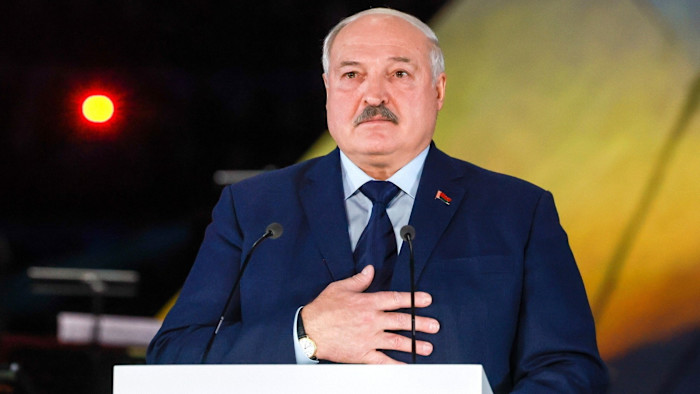
The US is looking at inviting Belarusian President Alexander Lukashenko to meet Donald Trump at the White House or his home in Mar-a-Lago as it pursues a diplomatic thaw with the authoritarian state.
Trump’s special envoy to Belarus, John Coale, confirmed in an interview with the FT that internal discussions about inviting the strongman leader to meet with Trump had been going on “for months” but stressed that nothing had been set in stone.
“We’ve still got a lot of work to do to get there, but I think we’ll get there,” Coale said.
Lukashenko said on Friday that Trump had invited him to Mar-a-Lago to discuss a “big deal”.
Since Trump returned to the White House last year, the US has sought to re-engage with Lukashenko, a close ally of Russian President Vladimir Putin, securing the release of hundreds of Belarusian political prisoners in exchange for sanctions relief.
An invite to meet with Trump in the US would be a boon for Lukashenko, who was heavily sanctioned by the west following a violent crackdown on protesters in 2020.
He was further isolated after allowing Belarus to be used as a staging ground for Russia’s full-scale invasion of Ukraine.
Coale was in Belarus last week as 250 political prisoners were freed in the single largest release thus far. In exchange, the US agreed to lift further sanctions from the Belarusian finance sector, including the Ministry of Finance and the Belarus development bank, as well as three potash companies, Belaruskali, Belarusian Potash Company, and Agrorozkvit.
A US official said that some 500 political prisoners had been released as a result of US engagement, including prominent opposition leaders Siarhei Tsikhanouski, Maria Kalesnikava and Nobel laureate Ales Bialiatski.
Six American citizens and dozens of foreign nationals have also been released.
“Sanctions relief is conditional on sustained improvements in behaviour and President Lukashenko’s fulfilment of his pledge to immediately cease all politically motivated arrests,” the official said.
Coale declined to say what, if any, preconditions could be set for a meeting between Trump and Lukashenko. “Ultimately that’s up to the president,” he said.
The envoy said he was hopeful that they could secure the release of remaining political prisoners by the end of the year. According to the Belarusian human rights group Viasna, almost 900 political prisoners remain behind bars.
Lukashenko, who has ruled Belarus for more than 30 years, has long sought to play Russia and the west off each other for his personal gain. During the first Trump administration, the US sought a thaw in relations with Belarus in a bid to bolster the country’s independence from Moscow.
US officials have sought to cast their recent efforts at rapprochement as a largely humanitarian gesture.
“This is 95 per cent humanitarian. I’m not going to push any wedge between him and Putin. That’s a 30-year relationship,” said Coale, who has travelled to Belarus and met with Lukashenko a number of times over the past year.
“I know who Lukashenko is,” he said. “But we have a very good relationship. We trust each other,” Coale said. “This is Trump, this is Trump-type foreign policy where you get to know somebody.”
Lukashenko’s dependence on Putin runs deep, and the US is unlikely to draw Belarus out of Russia’s orbit, experts said.
“It’s not possible at this stage,” said Artyom Shraibman, a non-resident scholar at the Carnegie Russia Eurasia Center.
But in opening up lines of communication and coaxing Belarus to release its political prisoners, the Trump administration is potentially laying the necessary groundwork for improved relations in the future, Shraibman said.
“The US now effectively helps the future Belarus-west dialogue to clear the agenda from at least some problems,” said Shraibman.