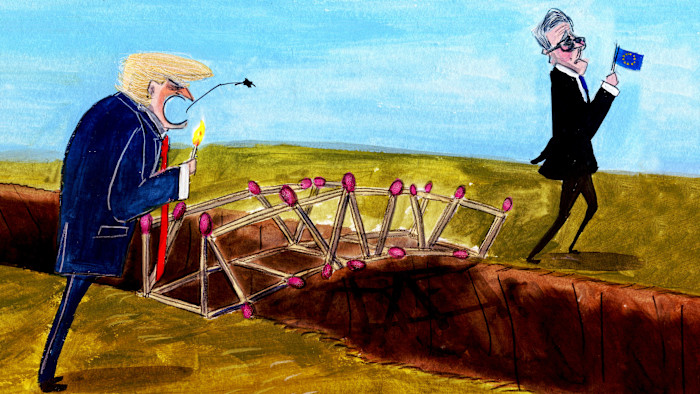
Trump is hastening Britain’s return to the EU
Last week, Donald Trump and Sir Keir Starmer both gave big speeches to the nation. Trump’s effort reminded me of Macbeth’s verdict on life: “A tale told by an idiot, full of sound and fury/Signifying nothing.” Starmer’s felt more like a tale told by a lawyer, empty of drama or panache — but quietly significant.
The prime minister’s address was the most pro-European speech that he has given since winning power. Starmer spoke of the need to be bolder in building a partnership with the EU “for the dangerous world that we must navigate together”. There is an ambitious vision lurking behind those words. Future historians may look back on his speech as a crucial step down the long and winding path that will eventually lead Britain back into the EU.
Trump has done a lot to create the conditions for Britain to draw closer to the EU. The US president’s erratic and abusive behaviour towards the UK — imposing tariffs, insulting the British armed forces, courting Russia — has alienated the British public and woken up the country’s governing class. A YouGov poll last week showed that just 14 per cent of British people still believed Britain and the US had a “special relationship” and only 18 per cent wanted to be closer to America. By contrast, 57 per cent wanted to get closer to the EU.
Economics, geopolitics and domestic politics now all point the Starmer government towards Brussels and away from Washington.
In his speech, the prime minister openly acknowledged that “Brexit did deep damage to our economy”. America’s non-partisan National Bureau of Economic Research recently estimated that it had cumulatively cost the UK up to 8 per cent of GDP. Supporters of Brexit dispute these figures. But they are losing the argument with the British public. A large majority now believe that it was a mistake to leave the EU.
Despite his warmer rhetoric towards the EU, Starmer’s formal position remains cautious. He has ruled out rejoining the customs union or single market — let alone the EU itself. Some of his colleagues publicly favour the customs union. But, in private, senior figures in the government acknowledge that a customs union alone would not provide a significant gain to the economy. They believe that the ultimate goal has to be the boost to trade and investment that would come with rejoining the EU single market — and ultimately the EU itself.
The strategic case for getting much closer to the EU also strengthens by the day. Russia continues to wage a bloody war on Ukraine. But Trump is speaking openly about leaving Nato and had denigrated his European allies, including Britain, as “cowards”.
The British know that — if and when America pulls back from Europe — only a collective European effort can continue to deter Russia. The UK would rely heavily on the troop numbers and manufacturing capacities of EU nations like Finland, Poland, Germany and France. The Europeans will also look to Britain. UK armed forces are in an alarmingly threadbare state. But Britain still has industrial and military capacities vital to collective European defence.
It is perfectly possible for Britain and other European nations to co-operate on security outside the framework of the EU. But UK membership would make it easier — as well as allowing Britain to access the billions of euros that the EU is mobilising to spend on defence.
Until recently, Starmer has been extremely tentative about making the case for Europe because he feared alienating pro-Brexit voters in the “red wall” of former Labour strongholds.
But the domestic politics have changed since the election. Labour is now trailing Reform in the polls. However, Reform and its leader, Nigel Farage, are closely associated with two things that are increasingly unpopular in the UK — the Trump administration and Brexit. As an election draws closer, it would make obvious sense for Labour to hang both around Farage’s neck.
If Starmer is truly bold he would go into the next election advocating not just a closer partnership with Europe but rejoining the EU. That would give Labour something that it currently sorely lacks — a bold and positive agenda for the future. Rejoining the EU already commands majority support in Britain and is particularly popular among the young voters that Labour is losing to the Greens.
Of course, in reality, getting back in would be no simple matter. Britain would probably have to commit to joining the euro and would not get a full restoration of the budget rebate originally negotiated by Margaret Thatcher. Initial public enthusiasm for rejoining the EU might swiftly erode when confronted with those realities.
The EU itself would also legitimately hesitate about even starting the process of negotiating a British re-entry, until it was backed by a clear national consensus in the UK. Having gone through Brexit once, there is zero appetite in Brussels, Berlin or Paris to repeat the exercise.
For that reason, Starmer is right to treat this as a step-by-step process for now. Trust needs to be rebuilt on both sides of the Channel and concrete benefits need to be demonstrated to encourage further progress.
But this cannot be too leisurely a process. Events are moving fast. Neither Britain nor Europe has decades to get it right.