Truce offers moment of respite for battered Tehran
Residents of Tehran emerged on Wednesday to the first day of nearly 40 free from the blasts of explosions. But the city they found looked different to the one they knew before.
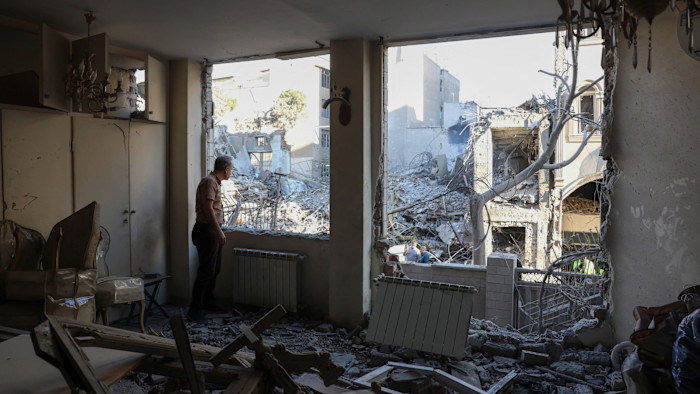
On affluent Gandhi Street, the large hospital was a charred, dilapidated ruin, abandoned and gutted by fire. In the old city, flower beds in the alleys near the historic Grand Bazaar were filled with shards of glass, while furniture and kitchen appliances were visible in the ruins of a bombed-out building on Baluchistan Street in the west.
At the Sheikh Fazlollah Expressway, only the metal skeleton of the dome of Iran’s Space Research Center was left. On a nearby wall, someone had spray-painted “Trump’s aid” — a sarcastic reference to the US president’s pledge to help anti-regime protesters in January.
The usually frenetic city of 10mn remained subdued and as quiet as on a public holiday, its streets largely emptied of cars and motorcycles and many shops shuttered. Few really believed that the devastating conflict, which came to a messy pause after the US and Iran announced a two-week ceasefire early Wednesday, was over.
Yet, even so, the truce offered a precious moment of relief, as locals celebrated the small joys of everyday life. “Nothing else matters to me anymore,” Somayyeh, a 25-year-old university student, said.
“Not even rising prices, or any other hardship, bothers me,” she said. “The only thing that matters is that there’s no bombing and I can sleep peacefully at night.” Like others interviewed for this story, the FT used a pseudonym to protect Somayyeh’s identity.
The ceasefire, in which the US and Israel agreed to halt strikes in return for Iran reopening the Strait of Hormuz, quickly came under strain.
Iran kept its de facto blockade on the passage of oil tankers through the strait on Wednesday after Israel launched a massive bombing campaign in Lebanon targeting Hizbollah, its most important proxy.
And though the US and Iran had been expected to hold talks in Islamabad this weekend, Iran threatened to withdraw from the deal altogether if the attacks continued.
Iranian state television channel Press TV cited a senior security official calling the ceasefire “fragile and temporary” and warning that Israel was violating the deal by attacking Lebanon.
Reza, a cashier scanning groceries at a large supermarket in the neighbourhood of Gisha, echoed the widely held sentiment that it was only a matter of time until war returned to their lives. “They’re only buying time to attack again,” he said of the US. “The war isn’t over. It’s just a pause so they can regroup and hit us again.”

The regime, too, appeared to be on high alert. Despite rhetoric on state television declaring that Iran had emerged victorious and stronger from the conflict, the Islamic republic was quick to stress that it was ready to resume fighting.
“They have seen that our hands are on the trigger, and the moment the enemy makes the slightest mistake, it will be met with a forceful response,” the Islamic Revolutionary Guard Corps said in a statement.
In front of Tehran’s Sharif University of Technology, a prestigious engineering school that had been hit in an air strike on Monday, a dozen young women in black chadors, worn by conservative women supporting the Islamic republic, had gathered to wave Iranian flags with the ruins of the university’s computing and data centre behind them.
“The US will never keep its promises,” one of the women said, citing US and Israeli attacks on Iran in the middle of negotiations in both February and June last year. “Nothing has changed. They can never be trusted.”
The security presence across Tehranwhich only months earlier had been at the centre of a brutal crackdown on anti-regime protesters in which thousands were killed, was notable.
The Islamic republic has repeatedly throughout the war warned Iranians against returning to the streets, issuing violent threats.
In central Vanak Square, riot police stood guard beside armoured cars. Vehicles mounted with machine guns were also stationed on Saadi Street and security forces staffed checkpoints throughout downtown Tehran.
One checkpoint had been set up just outside the former US embassy compound on Taleqani Street, dubbed the “Den of Espionage” after it was seized by students following the Islamic revolution in 1979.
Across the road, a billboard from before the war read: “Enmity with the US will not be resolved through negotiations.” From the street, a building destroyed in the strike inside the compound was hidden from view.

Despite the tense atmosphere, many residents of Tehran tried to continue on with their lives as best as they could.
One man, who sold generators in the city’s business district on Imam Khomeini Street, had kept his shop open throughout the war even after part of the ceiling collapsed from a nearby explosion.
He explained that, with Donald Trump repeatedly threatening to decimate Iran’s power plants if Tehran did not reopen the Strait of Hormuz, many people had been desperate to buy backup generators in case of power blackouts. “Every day, trucks would come and unload more generators,” he said.
Hassan, a shopping mall security guard near the Grand Bazaar, reflected widespread disdain — not only towards the US and Israel, but also the Iranian regime.
“Whatever the outcome, the Islamic republic always claims victory. They never lose. Always winners in every arena,” he said.
“We, the people, are the ones who suffer,” Hassan added. “Israel and the US will come back. I don’t think anything has changed. Decades of enmity, all those slogans, all that flag-burning — in the end, it dragged the country into war.”