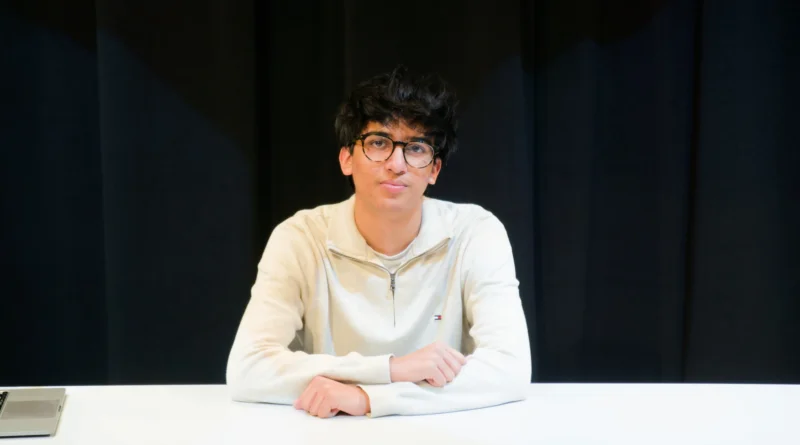
This 16-year-old refused a $300,000 offer to drop out of high school and now runs his own AI company
Rudrojas Kunwar
- Rudrojas Kunvar, 16, built Evion, an AI tool that helps farmers analyze crop health.
- The tool collects aerial crop data from drone-captured images.
- Kunvar created Evion to make that data more accessible to small and midsize farms.
While meeting with a venture capitalist last year, 16-year-old Rudrojas Kunvar received an offer that would excite even the most nonchalant teens: accept $300,000 to drop out of high school and run his AI startup full-time.
“It was definitely a rough couple of weeks of contemplating,” Kunvar, who lives in Germantown, Maryland, told Business Insider. “That's a lot of money.”
Kunvar had spent the summer before building Evion, a free AI crop-analysis tool that uses images taken by basic camera drones that farmers can purchase themselves.
The AI model analyzes images and generates a crop health map that farmers can integrate into their existing platforms or access via a dashboard. Green means healthy, while red means unhealthy.
Evion
“Farmers can use that to predict the future of their crops,” Kunvar said. “You can see what areas need more water or fertilizer, rather than just spraying everywhere.”
Like construction and defense, drones are reshaping America's agriculture industry. There were about 5,500 agricultural drones registered with the Federal Aviation Administration in 2025, up from about 1,000 in 2024, according to Michigan State University researchers.
Kunvar said Evion can help farmers save money because the targeted data can eliminate crop health uncertainty, meaning they'll be less likely to waste water or fertilizer.
Kunvar says Evion is positioned as an alternative to companies that market pricey agricultural drone products or services. Instead, farmers can buy cheap camera drones, take their own photos, and upload the information themselves.
“It's meant to be a more affordable plan for these low to mid-scale farms,” Kunvar.
After building Evion, Kunvar partnered with Jacob Lee, who has experience creating tech tools, to expand its reach. Kunvar launched the initial pilot in the fall.
Ultimately, Kunvar declined the $300,000 drop-out offer, saying he wanted to ensure his product remained accessible and didn't get wrapped up in chasing profits.
It all started with a question
The idea behind Evion came during Kunvar's sophomore year at Poolesville High School in Montgomery County while attending a community festival. One-third of Montgomery County is designated as an Agricultural Reserveor protected local land meant to preserve rural space.
“I asked a farmer about how they're able to tell when a disease is coming or what slight discoloration means,” Kunvar said. “Essentially, he said he's guessing. I spoke to a few other farmers, and I realized there was a common thread among all of their responses.”
Kunvar, who said he's had a lifelong love for technology, was surprised.
“We've had a lot of AI advancements in various verticals and various industries,” he said. “Why isn't there much happening for agriculture?”
Initially, Kunvar wanted to make his own fleet of fully autonomous drones that could capture the data, but went a different direction after talking with mentors and crunching the numbers. Instead, he studied drones and pinpointed what's driving their cost: the multispectral camera.
“The camera was the leading cost. I wondered, 'What if there's a way to get similar data without needing this camera? What if I could use a simple camera?'” Kunvar said.
He pointed toward Tesla and its autonomous vehicles as proof it work. Unlike Waymo and other companies that use lidar, Tesla relies on cameras.
After setting up the logistics and AI model, the founders sought clients by sending cold emails and LinkedIn messages. They found better luck, however, partnering with agriculture-oriented nonprofits and organizations to reach farmers.
Now, the technology is helping farmers in North America, Southeast Asia, and India.
As for his future plans, Kunvar wants to continue growing Evion while exploring opportunities in different fields, including AI infrastructure.
“There's so much ambiguity in entrepreneurship, especially in startups, but I've learned there's beauty in ambiguity,” Kunvar said. “There's been times where nothing's working out, and then you have the tiniest win, and it's like, 'wow, maybe I can do this.'”