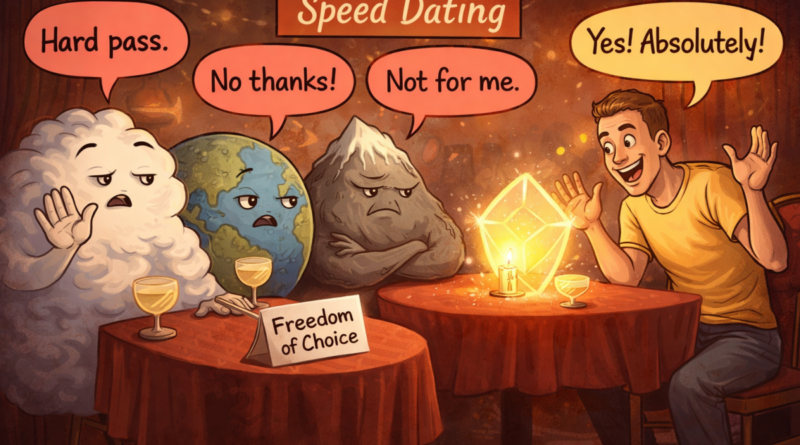
We have offered the responsibility—the freedom of choice—to the heavens and the earth, and the mountains, but they refused to bear it, and were afraid of it. But the human being accepted it; he was transgressing, ignorant. — Quran 33:72
Read that verse again slowly, because the standard reading glosses over something extraordinary. The responsibility—al-amanah, the trust, the burden of moral choice—was not given to human beings. It was offered. The heavens declined. The earth declined. The mountains declined. They were afraid of it. These are not trivial things that declined. These are the largest, most permanent features of the created order, and they looked at what was being offered and said: not for us.
The human being said yes.
What this verse is describing is the moment that distinguished the human being from everything else in creation: the act by which human beings became the kind of thing they are, by accepting the burden that everything else refused. The mountains are not condemned for declining—they simply refused to bear the responsibility. The human being, in his reckless, consequential audacity, said yes anyway.
This is where Parts I through III of this series have been pointing without quite arriving. The series has traced three kinds of freedom that distinguish the examined human life from the unexamined one: the freedom to override appetite, the freedom to hold possessions with open hands, the freedom to release outcomes without installing a scoreboard where your inner life should be. All of it true. All of it necessary. But none of it explains why these freedoms are available to human beings in the first place.
The answer is 33:72. The burden is not an obstacle to being human. It is the definition of it.
But before unpacking what that means, it is worth asking a prior question that the series has not yet posed directly: what does genuine freedom actually require? Not the bear’s freedom—roaming unrestrained, governed entirely by appetite—but the freedom the amanah points at. The kind that can be chosen or refused, exercised or squandered, aimed at the difficult path or the easy one.
Three things are required, and the Quran provides all three.
The first is knowledge—the innate awareness of right and wrong without which no meaningful choice is possible. A creature that cannot distinguish good from evil is not free; it is simply reactive, moved by whatever stimulus arrives. The Quran locates this knowledge not in culture, not in education, not in religious instruction, but in the soul itself:
The soul and Him who created it. Then showed it what is evil and what is good. — Quran 91:7-8
Every soul was shown. Before the test begins, before the choice is made, before the difficult path is even visible as a path—the knowledge is already there. This is not a small claim. It means that the human being who chooses wrongly cannot claim ignorance as a defense. The compass was installed before the journey started.
The second is free will—the capacity to act on that knowledge rather than being run by appetite, instinct, or circumstance. This is precisely what 33:72 encodes. The amanah is not a set of rules. It is the acceptance of the faculty of choice itself: the yes that made the human being the kind of creature whose decisions mean something. The mountains could not say yes because they had no mechanism for choosing. The human being said yes, which is to say: the human being accepted the responsibility of being a chooser.
The third is opportunity—the actual conditions in which the choice becomes real rather than theoretical. Knowledge without occasion to use it is inert. Free will without resistance to exercise it against is indistinguishable from having no will at all. This is what the rest of this article is about: why the world is structured the way it is, why the difficult path exists, why the test is not an obstacle to the human project but the substance of it.
Remove any one of these three and freedom collapses. The first without the second is moral awareness with no agency—the spectator who sees the right thing clearly and cannot choose it. The second without the first is appetite wearing the costume of will—impulse mistaken for decision. The first two without the third is the Last Man: equipped for freedom, never called upon to use it, slowly atrophying in his frictionless paradise while believing himself liberated.
The Quran does not leave any of the three unaddressed. What follows is the third condition examined in full.
What the Mountains Know
There is a thought experiment that has become fashionable in certain technology circles. Imagine a future in which artificial intelligence has solved everything. Not some things—everything. Disease, poverty, hunger, conflict, the grinding inefficiency of daily labor. You wake up in the morning with no obligations, no friction, no problems requiring your attention. The machines have handled it. What do you do with your day?
The people who pose this question usually intend it as a description of paradise. And while such an environment might suit an animal well enough—it would certainly suit a mountain—it runs directly against the nature of what makes us human. When the human being opted for the amanah, the freedom came with a requirement: it had to be exercised. A freedom that is never tested, never chosen against any resistance, is not freedom in any meaningful sense. It is just weather.
The mountains knew this, in their way. Their refusal was not stupidity—it was accurate self-knowledge. A mountain is extraordinarily good at being a mountain. It endures across geological time. But it does not deviate from its nature because it has no ability to deviate from it. It cannot be a good mountain or a bad mountain. It cannot choose to hold firm or choose to crumble. The laws of nature impose themselves upon it completely, with no interior space in which an alternative could even be imagined. In this sense the mountain is not free, despite no one forcing it to be anything in particular. It opted out of freedom, and with that refusal came the permanent inability to be anything other than what it already is.
This is not a limitation the mountain experiences as a loss. It has no experience of limitation at all. It has no interior space in which to register what it is missing. It cannot want to be something other than what it is, cannot choose the harder path over the easier one, cannot look at its own stability and say: I am bigger than this. It has perfect integrity and zero freedom in any meaningful sense, and these two facts are the same fact.
The amanah—the trust—requires the opposite of this. It requires the possibility of deviation. Not just the physical possibility, but the interior space in which a choice becomes genuinely a choice: the space in which you can look at what your nature is demanding and say not today, in which you can see the accumulation of Qãroon and choose the posture of Moses, in which you can release the outcome to God rather than installing a ticker to manage your inner weather. None of this is available without the burden. And the burden, by definition, requires something to overcome.
The mountain could not carry the amanah because it cannot fail to be a mountain. You carry the amanah because you can fail to be fully human.
This is the fourth kind of freedom, and it is categorically different from the first three. The first three describe what you can do with the freedom you have: override appetite, release attachment, surrender outcomes. The fourth describes what makes the first three possible at all. Call it constitutive freedom: the freedom that is not an exercise of your humanity but the ground condition of it. You are not free because you can do whatever you want. You are free because you can fail—and therefore because every good act is a genuine act rather than a foregone conclusion.
The Worship That Has to Be Chosen
But why did the amanah have to be offered at all? The Quran answers this directly, and the answer reframes everything that came before it.
I did not create the jinns and the humans except to worship Me alone. — Quran 51:56
The One who created death and life for the purpose of distinguishing those among you who would do better. — Quran 67:2
The purpose of creation, according to these two verses taken together, is worship—and worship of a particular kind: the kind that can be measured, distinguished, ranked by quality. Not the automatic compliance of a system running its program, but the chosen submission of a being that could have chosen otherwise. 67:2 is explicit that death and life were created for the purpose of distinguishing—the whole architecture of mortal existence, with its pressures and losses and unanswered questions, is the mechanism by which genuine worship is separated from its counterfeit.
This is why the amanah had to be offered rather than installed. You cannot worship freely what you have no alternative but to obey.
And here is where the Quran introduces a distinction that cuts to the heart of what makes the human being different from everything else in creation. Consider what is already submitting:
Do you not realize that to GOD prostrates everyone in the heavens and the earth, and the sun, and the moon, and the stars, and the mountains, and the trees, and the animals, and many people? — Quran 22:18
Everything in the heavens and the earth has submitted to Him, willingly and unwillingly, and to Him they will be returned. — Quran 3:83
The mountains already prostrate. The stars already glorify. Every cell in your body submits to the laws God built into creation—aging, metabolizing, dying—whether you believe or not. Your body is, in this sense, already a mountain: it obeys willingly or unwillingly, and the distinction between those two doesn’t much matter because the outcome is the same either way. The sun does not get credit for rising.
What the Quran is pointing at with that phrase—willingly and unwillingly—is that there are two fundamentally different kinds of submission in creation, and only one of them counts as worship in the sense of 51:56. The mountain submits unwillingly, not because it resists but because it has no apparatus for willing anything at all. The human body submits the same way. But the insan—the bearer of the amanah, the one who said yes when the mountains said no—has a mind that stands apart from this automatic compliance. The mind is the one thing in the human being that can genuinely choose which direction to face. It can submit to God willingly, which is worship. Or it can refuse, which is the one thing a mountain cannot do.
This is the deepest reason the burden had to be accepted by a creature capable of refusing it. The worship the Quran describes in 51:56 is not the prostration of the mountain, which costs nothing and proves nothing. It is the prostration of the insan, who knew what it was declining when it said yes—and chose to submit anyway. The body was always going to obey. The question the amanah poses, the question that death and life were created to distinguish, is what the mind will do.
The Utopian’s Error
Return to the thought experiment. The future without friction, without challenge, without anything requiring you to override appetite or release attachment or exercise patience or choose the harder path.
What the thought experiment describes—with breathless enthusiasm—is a world in which the amanah has been rendered inoperable. Not removed exactly, but starved of the conditions it requires to function. You cannot exercise discipline freedom when there is nothing to resist. You cannot practice independence freedom when there is nothing threatening your attachments. You cannot demonstrate expectation freedom when outcomes are guaranteed. You cannot, in the deepest sense, choose anything when everything has already been chosen for you by systems optimized to prevent difficulty.
The human in that world has not been liberated. He has been returned to the condition of the mountain—perfectly comfortable, perfectly stable, perfectly unable to be anything other than what his conditions have made him. The burden the mountains refused has finally been taken off his hands. He is, at last, as free as the earth and the heavens.
He is also, at last, no longer quite human.
Fukuyama, whose bear opened this series, worried about what he called the Last Man—the comfortable, unstriving, perfectly-satisfied inhabitant of the liberal end of history. He noted that such a person might be technically free in every measurable sense while having nothing worth striking, nothing worth refusing, nothing worth the hunger. The Quran’s diagnosis is more precise. The Last Man has not failed to exercise his freedom. He has allowed the conditions for freedom to atrophy, which is a different and more serious problem, because it is invisible. He is not in chains. The gymnasium is simply closed, and he has not noticed.
The Path They Don’t Advertise
Sura 90 is one of the more punishing passages in the Quran to sit with, because it builds with the momentum of an argument that seems to be going somewhere comfortable and then emphatically doesn’t.
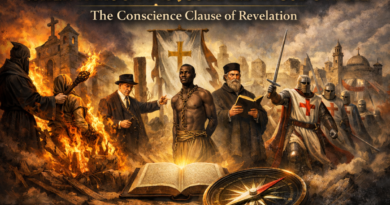
We created the human being to work hard, to redeem himself. Does he think that no one will ever call him to account? He boasts, “I spent so much money!” Does he think that no one sees him? Did we not give him two eyes? A tongue and two lips? Did we not show him the two paths? He should choose the difficult path. Which one is the difficult path? The freeing of slaves. Feeding, during the time of hardship. Orphans who are related. Or the poor who is in need. And being one of those who believe, and exhorting one another to be steadfast, and exhorting one another to be kind. These have deserved happiness. — Quran 90:4-18
The structure is worth noticing. The sura opens by asserting that the human being was created for kabad—hard work, toil, struggle, a word that carries the sense of labor that costs something. Then it pivots immediately to the man boasting about his spending, as if conspicuous charity is the point. It is not the point. The sura is using him as a foil for the next question: did we not show you the two paths?
And then the harder question: he should choose the difficult path.
Not: he will naturally gravitate toward the difficult path. Not: he is unable to resist the difficult path. He should choose it. The verb is imperative, and its imperative quality is the entire point. The difficult path requires choosing. If it were the only path, or the easier path, or the automatic path, the instruction would be incoherent. You cannot be told to choose something you have no alternative to.
But here is what is most striking: when the Quran specifies what the difficult path consists of, it is not a list of interior spiritual states. It is not feel the right feelings or hold the correct beliefs or maintain the proper orientation. It is: free slaves, feed people, care for orphans and the poor, exhort one another toward patience and kindness. The difficult path runs directly through other people’s hardship. The kabad you were created for is not a private spiritual discipline. It is the act of turning toward someone else’s suffering and making it your problem.
This matters for the utopian thought experiment in a way that is rarely noticed. The argument for eliminating all human hardship tends to focus on the sufferer: no one should have to endure disease, poverty, deprivation. This is true and important. But Sura 90 points at the other side of the equation. The person who frees the slave, feeds the hungry, cares for the orphan—that person is also doing something for themselves, something the verse says they deserve happiness for. They are choosing the difficult path. They are carrying the amanah. They are being human in the full sense. A world with no slaves to free and no orphans to feed and no hardship in which to feed people has also, quietly, removed the gymnasium in which this particular muscle is exercised.
The Quran is not arguing for the perpetuation of suffering. It is making a more uncomfortable point: that the human being was created for kabad, and that the exercise of the amanah is inseparable from conditions that require it.
God’s Own Test
Do the people think that they will be left to say, “We believe,” without being put to the test? We have tested those before them, for GOD must distinguish those who are truthful, and He must expose the liars. — Quran 29:2-3
This verse is often read as a warning—which it is. But it also contains a claim about the structure of reality that goes beyond the warning. GOD must distinguish those who are truthful. The word translated “must” is from liyaʿlama—so that He may know, or so that it may be known. The test is not punitive. It is epistemic. Structurally necessary in the sense that, without the test, there is nothing to distinguish. A faith that has never encountered anything that could disturb it is not a tested faith. It is an assumption wearing faith’s clothing.
This is the theological version of the mountain problem. The mountain cannot be unfaithful to its nature, which means it also cannot be faithful to it. Faithfulness requires the possibility of unfaithfulness. The choice to say “We believe” has content only when it is made against the resistance of conditions that would make it easier not to believe—grief, loss, unanswered prayer, the structural injustice of a world in which good people suffer and bad people prosper and the timing of divine response does not match human urgency.
Part III of this series spent considerable time with Jacob—the man who said ṣabrun jamīlun, beautiful patience, twice across years of compounded loss. The beauty of Jacob’s patience is inseparable from the scale of what it cost him. A Jacob whose son had never been taken, whose family had never been fractured, who had never experienced the particular anguish of knowing something had happened but not what—that Jacob never gets to say ṣabrun jamīlun, because there is nothing to be patient about. His faith exists, perhaps. But it is untested faith: an assumption about what he would do if things got hard, never converted by reality into knowledge.
29:2–3 says that God distinguishes those who are truthful from those who are liars—and the mechanism of distinction is the test. Not because God needs the information (the Quran is clear that He knows what is in every soul), but because the test converts the assumption into a fact. Not just for God’s knowledge but for yours. The human being who has been tested and held knows something about themselves that the untested person cannot know. They have gone from claiming to believe to having chosen to believe under conditions that made not believing a live option. That is a different kind of knowing.
The utopian paradise—in addition to removing the gymnasium for the amanah—also removes the possibility of this kind of knowing. In a world without adversity, no one ever finds out what they actually are rather than what they imagine themselves to be. Everyone is, in Jacob’s terms, at the beginning of the story, with their assumptions intact and their character untested. The world is comfortable. The self remains, permanently, a hypothesis.
The Difference the Devil Noticed
The Quran uses two distinct words for the human being, and the difference between them is the crux of this article. Bashar is the physical form—the creature of clay, the biological animal, the body with its appetites and its mortality. Insan is what that creature becomes when the amanah was accepted: the bearer of moral responsibility, the being with an interior space in which genuine choice becomes possible. Every human being is a bashar. The insan is what the bashar is called to become—and what, by accepting the burden the mountains refused, it has the equipment to become.
Iblis saw the bashar and missed the insan entirely. And what he missed is precisely what Sura 95 maps with devastating economy:
We created the insan in the best design. Then turned him into the lowliest of the lowly. Except those who believe and lead a righteous life; they receive a reward that is well deserved. Quran 95:4-6
The bear cannot fall to the lowliest of the lowly. It has no interior space in which the descent is possible. It also cannot rise to the best design, for exactly the same reason. It occupies a fixed point on a spectrum it cannot perceive. The insan, by contrast, spans the entire range—from the summit of the best design to the floor of the lowliest of the lowly—and must choose which direction to move. That is not a design flaw. That is the design. The vertical range is what makes the choice real, and the choice is what makes the insan the insan.
This also reframes what the angels and Iblis were actually looking at. The concern raised before creation—that this creature would cause corruption and shed blood—was not wrong as a prediction. It was incomplete as an analysis. Yes, the insan can fall to the lowliest of the lowly; 95:5 grants the point without flinching. But 95:5 is not the end of the verse. The end of the verse is 95:6: except those who believe and lead a righteous life. The exception clause is where the amanah lives. The entire architecture of human freedom rests on that word except—on the fact that the descent is real, the ascent is real, and the creature standing between them has the awareness to perceive both, the temptation to fall toward one, and the freewill to choose the other.
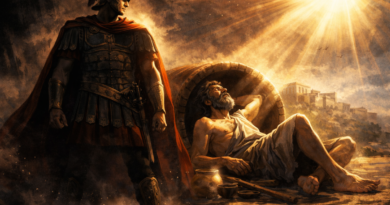
Iblis’s objection when God commanded the angels to prostrate before Adam was not theological—he did not dispute God’s authority. It was, in his own telling, a matter of material superiority: I am better than him. You created me from fire and created him from clay [7:12]. This is a category error dressed as an argument. He was evaluating the bashar—the substance, the raw material, the thing Adam was made of—and pronouncing a verdict on it. Clay is inferior to fire. Therefore, the creature of clay is inferior to the creature of fire. Therefore, the prostration is beneath him.
What Iblis could not perceive—or would not—is that the clay is precisely the point. Fire is what it is, completely, with no alternative available. It burns, it rises, it consumes. It cannot choose otherwise because it has no mechanism for choosing otherwise. Clay, by contrast, can be molded. It takes the impression of what works upon it. It can be shaped toward something it was not when it began. And here is the irony Iblis built into his own objection without noticing: it is fire that purifies clay. The kiln is what turns the soft and impressionable into something durable. In refusing to serve the human being on the grounds of his fiery superiority, Iblis identified himself as the very instrument by which the clay would be refined.
This is what God’s response—I know what you do not know [7:12]—contains that Iblis’s calculation missed. The insan is not the bashar plus time. It is the bashar that has accepted the amanah, been tested by what opposes it, and chosen through that testing to become something the raw material alone could never have been. The one who refused to serve the insan ended up, by his own refusal, doing precisely that.
Iblis’s error is the utopian’s error: he looked at the substance and decided the verdict was already in. What God saw—and what the whole of Quranic anthropology is built around—is that the substance is only the beginning of the argument.
The Gymnasium That Cannot Be Closed
Here is what the four parts of this series, taken together, actually describe.
The bear cannot hunger-strike. This is not a failure of the bear. It is simply the ceiling of what the bear is. The bear’s freedom is real—it roams where it will—and it is also the only freedom available to it, which is to say it is the only thing it can be. The discipline freedom of Part I—the capacity to look at your biology’s demands and say not today, I have a higher principle to attend to—is not available to the bear because the bear has no interior space in which a higher principle could live. Its stomach runs the show, completely, because there is no other governor in the building.
The mountain cannot carry the amanah. This is not a failure of the mountain. It is the honest acknowledgment that some gifts require the recipient to be able to fail. The mountain cannot fail to be a mountain. The human being can fail to be fully human—can choose appetite over discipline, accumulation over openness, impatience over beautiful patience, the easier path over the difficult one. And because the human being can fail, the human being who does not fail has done something. Has chosen something. Has exercised the amanah in the direction of its intended use.
The utopian’s paradise—and every smaller version of it, every life arranged to minimize friction, maximize comfort, eliminate the conditions under which the amanah is exercised—is not the highest human achievement. It is the offer the mountains made and the heavens made and the earth made. It is the offer that said: not for us, we are afraid of it. The human being, transgressing and ignorant, said yes anyway. This was not foolishness. It was the founding act of everything that distinguishes the human from the mountain, the tested faith from the assumption, the beautiful patience from the comfort that never required patience at all.
The gymnasium cannot be closed without closing the human being along with it. Which is why the Quran does not promise an afterlife without hardship as the goal of this life—it promises that this life’s kabad is what makes the next one meaningful. The choice to believe when not believing was available. The discipline exercised when appetite pressed hardest. The attachment held loosely when the world pressed it tight. The outcome released to God when every instinct demanded control. The difficult path, chosen over the easy one.
These are not the obstacles between you and your freedom. They are the substance of it.
And being one of those who believe, and exhorting one another to be steadfast, and exhorting one another to be kind. These have deserved happiness. — Quran 90:17-18
Not: these have been given happiness automatically. Not: these have been relieved of the conditions that required their steadiness and kindness. These have deserved it—which is to say, these have earned the description by having been tested against its alternatives and chosen it anyway.
The mountains were offered the amanah and said no.