Stocks and bonds slump in tandem as Iran shock leaves investors ‘nowhere to hide’
Unlock the White House Watch newsletter for free
Your guide to what Trump’s second term means for Washington, business and the world
Global stocks and bonds have this month suffered their biggest combined sell-off since 2022 as the energy shock unleashed by the Iran war leaves investors “nowhere to hide”.
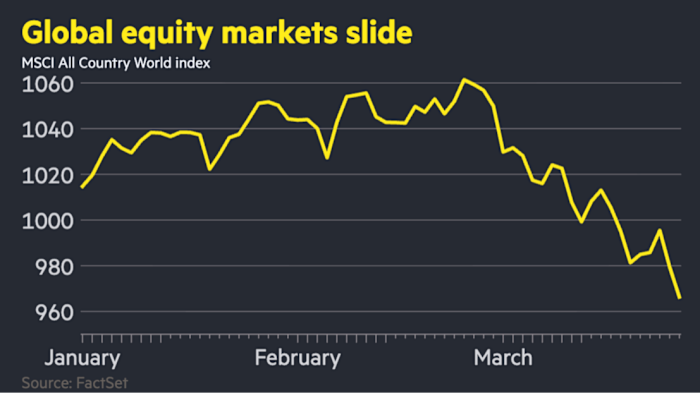
The MSCI All Country World index, which tracks stocks across developed and emerging markets, has fallen around 9 per cent in March as the outbreak of war in the Middle East and de facto closure of the crucial Strait of Hormuz has caused a surge in energy prices.
At the same time, a broad gauge of global government and corporate bonds has lost more than 3 per cent, as investors bet that central banks will need to raise borrowing costs to contain the inflationary fallout.
The combined moves have put a traditional “60-40” portfolio of equities and bonds on track for the worst month since September 2022, when a previous cycle of global interest rate rises hammered markets. Even gold has tumbled as investors rush to liquidate previously winning trades, underscoring a lack of safe havens in financial markets.
“What’s working for investors? Nothing,” said Raphaël Thuin, head of capital markets strategies at Tikehau Capital. “It’s really one of the worst set-ups you can think of. It’s been a very difficult few weeks to manage the market.”
Wall Street stocks extended losses on Friday, following their worst day since the war began on Thursday, after US President Donald Trump failed to reassure investors by extending his deadline for attacks on Iranian energy infrastructure. The S&P 500 fell 1.7 per cent, taking its decline this month to more than 7 per cent.
The sell-off in government bonds pushed the yield on the 10-year Treasury to as high as 4.48 per cent, its highest level since July. In Europe, which is more dependent than the US on energy imports, yields also touched their conflict highs.
Trump’s deadline extension “does not fix the problem that builds day by day with the Strait of Hormuz being closed”, said Jordan Rochester, head of fixed income strategy for Emea at Mizuho. “Markets may start paying less attention to the White House jawboning and more to the energy scarcity situation on the ground.”
The price of the international oil benchmark Brent crude has soared more than 50 per cent since the start of the conflict.
That has prompted fears of global “stagflation” — a mix of faltering growth and rising prices — that has proved toxic for both equities and fixed income, as it was in the energy price surge that followed Russia’s full-scale invasion of Ukraine four years ago.
“It’s been a brutal month for investors,” said Matt King, macro strategist and founder of Satori Insights. “Not only traditional 60-40, but almost every category of mainstream multi-asset portfolio is now showing year-to-date losses.”

Gold has tumbled 15 per cent this month as investors cashed in gains from a storming two-year rally that peaked in January and as a sharp shift higher in interest rate expectations dulled the attractions of the precious metal. Sophie Huynh, a multi-asset portfolio manager at BNP Paribas Asset Management, said that because there was “nowhere to hide”, investors were “liquidating some high-performing assets like gold”.
Christian Mueller-Glissmann, head of asset allocation strategy at Goldman Sachs, said derivatives that allowed investors to bet on a rise in inflation or commodity prices were “the only things that can help you in the early stages of an inflation shock”.
Bank of America’s recent fund manager survey showed that investors piled into cash at the fastest rate since the Covid-19 pandemic in March, highlighting the dearth of other safe-haven assets.
“We shifted to overweight cash a week after the conflict started,” Mueller-Glissmann said. “We don’t like being overweight cash, it’s costly. As soon as we get a slowing of the conflict and the oil price trending down, we want to scale back into assets.”
Additional reporting by George Steer in New York. Data visualisation by Jonathan Vincent