Stand Out of My Sunlight (Part II of What is Freedom?)
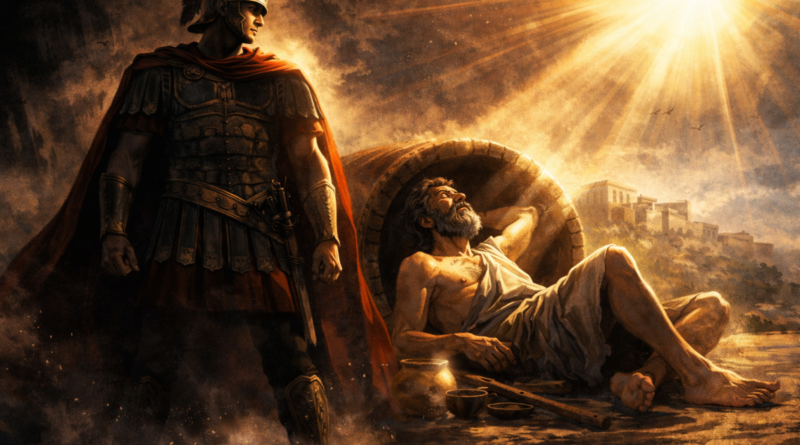
Alexander the Great was, by any reasonable accounting, the most powerful man in the Greek world when he paid a visit to Diogenes of Sinope. He had conquered nations, commanded armies, and possessed the kind of authority that made other men nervous just standing near him. He approached Diogenes—who was lying in the sun doing nothing in particular—and generously offered to grant whatever the philosopher might desire. Diogenes looked up and said: “Yes. Stand out of my sunlight.”
Alexander was not offended. He reportedly told the men around him that if he were not Alexander, he would wish to be Diogenes. The remark is worth sitting with, because it is not the kind of thing powerful men usually say about austere philosophers lying on the ground. What Alexander recognized—and what the story has preserved across two and a half millennia—is that Diogenes had achieved something Alexander, with all his power, had not. He had made himself so genuinely free of need that the most powerful offer imaginable produced in him something close to indifference. You cannot bribe a man who wants nothing you have.
While the last article was about what we might call discipline freedom: the capacity to override appetite, to look at what your biology is demanding and say not today. That is one axis of freedom. But Diogenes points to a second axis that receives considerably less attention. Not “I can resist what I want” but “I have discovered I don’t need most of what I thought I wanted.” Call it independence freedom: the state of being genuinely unentangled from the things the world uses to control people. The Cynic’s achievement was not heroic resistance. It was clarity. He had looked at the vast menu of things that power, wealth, and status can provide and concluded that the menu was largely irrelevant—and that once you genuinely believed that, its power over you evaporated entirely.
Discipline freedom is the hunger strike. Independence freedom is Diogenes in the sun. Part One was about the first. This is about the second.
Qãroon’s Keys
The Quran tells a story that captures the opposite of independence freedom with almost savage efficiency. Qãroon was a man from Moses’ own people who acquired extraordinary wealth—so much that the keys to his treasury were too heavy for the strongest men to carry. Read that slowly. He had accumulated so much that he required a team of men just to carry the keys—not the gold, not the goods, just the means of access to them. The Quran is describing, with characteristic economy, a man who had become structurally dependent on his own possessions. He did not own his wealth. His wealth owned him.
His people warned him:
“Do not be so arrogant; GOD does not love those who are arrogant. Use the provisions bestowed upon you by GOD to seek the abode of the Hereafter, without neglecting your share in this world. Be charitable, as GOD has been charitable towards you. Do not keep on corrupting the earth.” [28:76–77]
Qãroon’s reply is the reply of every era’s self-made man:
“I attained all this because of my own cleverness.” [28:78]
The error is not factual. Qãroon presumably did work hard, did possess genuine intelligence, did make shrewd decisions. The error is metaphysical. He has mistaken the proximate cause for the ultimate one—and in doing so has convinced himself that the accumulation is his by right, that it is an extension of himself, that to question it is to question him. He cannot ask whether he needs any of this, because for Qãroon, the accumulation has ceased to be a means to living and become the definition of it. He is not a man who has wealth. He is his wealth. And that is not freedom—it is the most gilded form of captivity available.
The crowd watching him parade through town in full splendor said,
“Oh, we wish we possess what Qãroon has attained.” [28:79]
This is the other half of the trap. Every Qãroon requires an audience of people who point at the treasury and feel not pity but envy. The display requires the desire. They feed each other in a closed loop that the Quran is clearly not impressed by.
Then the earth swallows him and his mansion, and the same crowd that was envious the day before says something remarkable:
“Now we realize that GOD is the One who provides for whomever He chooses from among His servants, and withholds. If it were not for GOD’s grace towards us, He could have caused the earth to swallow us too.” [28:82]
They are not saying wealth is bad. They are saying: we realize we could have been him. The envy of the previous day is now visible to them as the thing that had put them, spiritually speaking, in the same trap. What destroyed Qãroon was not his cleverness, nor even his wealth. It was that he had chained himself to it so thoroughly that he could no longer imagine who he was without it.
The passage closes:
“We reserve the abode of the Hereafter for those who do not seek exaltation on earth, nor corruption. The ultimate victory belongs to the righteous.” [28:83]
Note the verse does not say “we reserve it for those who are poor.” The disqualifying condition is the seeking of exaltation—the orientation, the project, the thing your life is organized around. Diogenes would have passed this test without effort. Qãroon failed it while employing people full-time to carry his keys.
Moses Arrives with Nothing
Sura 28 places these two narratives in immediate succession, and the contrast is hard to ignore. Just before the story of Qãroon, the Quran tells a story running in exactly the opposite direction. Moses flees Egypt with nothing: no treasury, no army, no social standing, not even a plan. He is a fugitive who has killed a man, and he is running. By any worldly measure, he is as exposed as a human being can be.
When he arrives at Midyan’s well, exhausted and alone, he sees two women waiting at the edge while the crowd of men waters their flocks. And here is the remarkable thing: this man who has nothing, who is hunted, who has no idea what tomorrow looks like—stops and asks,
“What is it that you need?” [28:23]
He is not scheming. He is not networking. He has nothing to protect, nothing to defend, no position to maintain, no asset base to conserve. Because he is completely free of all of it, he is free to simply see what is in front of him and respond to it.
He waters their animals and then sits in the shade and says, with an economy that is almost startling:
“My Lord, whatever provision You send to me, I am in dire need for it.” [28:24]
Consider what he does not say. He does not ask for shelter, or employment, or a wife, or safety, or a plan. He does not present God with a list of minimum acceptable outcomes. He says: whatever You think is appropriate for me, I trust that it is what I need. This is not the prayer of a broken man. It is the prayer of a man who has been stripped of every worldly attachment and arrived, on the other side of that stripping, at something that looks a lot like the Cynic’s clearing: no program, no agenda, no inventory of requirements. Just genuine openness to what comes.
What follows is almost comic in its efficiency. One of the women returns with an invitation. The father hears his story, offers safety, a job, and a daughter in marriage. By the end of the passage, the man who had nothing—no home, no family, no livelihood, no country—has all of it. [28:25–28]
The contrast with Qãroon could not be sharper, and the sura invites the comparison. Qãroon had a treasury so vast it required an army of key-carriers, identified himself completely with his accumulation, and was swallowed by the earth. Moses had the clothes on his back, made himself useful to strangers, asked only for whatever God chose to provide, and received everything he needed. Qãroon’s dependence on his wealth left him with nowhere to go when it was gone. Moses’ freedom from worldly attachment left him with everything available to him—including the ability to act generously in the worst moment of his life.
You Don’t Own Your Possessions
What the Qãroon and Moses stories together diagnose is a tendency so common it barely registers as a problem: humans accumulate things without asking whether those things are actually necessary for a flourishing life—and in the process, the things end up owning them.
This is not a subtle process. It follows a predictable logic. You acquire something—a position, a lifestyle, a set of expectations—and almost immediately, a secondary layer of obligations forms around it. The house requires maintenance. The status requires performance. The wealth requires management. The keys require carriers. Before long, the thing you acquired to serve you has generated a structure you serve. You are no longer using your possessions; you are their custodian. And because you have organized your identity around them, questioning whether any of it was necessary feels less like philosophy and more like a personal attack.
Take something as mundane as career title. For many people, professional identity is not just what they do—it is who they are. Strip the title and you do not get a person who used to have a title. You get a person in crisis. “I attained all this because of my own cleverness” is not Qãroon’s ancient pathology; it is the internal monologue of anyone who has spent a decade building a reputation and quietly started to mistake the reputation for the self. When the promotion doesn’t come, or the company folds, or the industry shifts, the collapse is not merely financial. It is existential, because the inventory was never done. The question “what would I be without this?” was never asked, because asking it felt like a threat.
The Quran offers a diagnostic for exactly this. Not a philosophical argument but a test:
“You cannot attain righteousness until you give to charity from the possessions you love. Whatever you give to charity, GOD is fully aware thereof.” [3:92]
The verse is not primarily a rule about charity. It is a mirror. Can you give from what you love? Because if the answer is no—if the thought of releasing what you have built or accumulated produces something closer to panic than generosity—then the inventory has already answered itself. Qãroon, asked to be charitable as God had been charitable toward him, could not do it. The possessions were not something he had; they were something he was. Moses, at the lowest point of his life, gave the only thing available to him—his effort, his time, his attention—to two strangers at a well, without calculation and without expectation. That is the difference between a man who uses his provisions and a man his provisions use.
The Quran provides its own counter-example to the Qãroon trap in the figure of Joseph, who administered the grain supply of Egypt, one of the most powerful positions in the ancient world, and is presented as a model of righteousness (taqwa) throughout. Joseph moved through slavery, false imprisonment, and royal authority with the same orientation at every station: not what can I extract from this? but who can I serve with what I have? His gift for interpreting dreams—which could have made him a wealthy merchant or a celebrated court entertainer—he used to save Egypt and his own family from famine. The ability God gave him, he held in trust for others. He never accumulated for himself what he had been given to steward for the world. Independence freedom, then, is not the absence of keys. It is the refusal to let the keys define you—and the willingness to use them for something beyond yourself.
None of this is a counsel of poverty, or a case for the dramatic divestment of everything you own. The Quran is not telling you to sell your house. It is telling you how to hold it:
“Your Lord has decreed: ‘The more you thank Me, the more I give you.’ But if you turn unappreciative, then My retribution is severe.” [14:7]
Gratitude and dependence are not the same orientation. You can be genuinely thankful for a home, a livelihood, a family—without your identity collapsing if it is taken away. Qãroon had everything and credited himself. The grateful person has everything and credits God. The material situation can be identical; what differs is whether the provision is held as gift or claimed as proof. And gratitude, it turns out, is also the natural enemy of the accumulation trap—because the person who genuinely appreciates what they already have does not need the next thing quite as badly. The inventory, done honestly, tends to reveal that the list of genuine needs is considerably shorter than the list of current anxieties would suggest.
Diogenes had, apparently, thought through this logic and arrived at the other end of it. When Alexander’s offer collapsed in the face of his indifference, it was not because Diogenes was suppressing a secret desire for treasure. He had genuinely done the inventory and found the treasure unnecessary. You cannot bribe a man not because he is nobly resisting temptation, but because the thing being offered does not correspond to anything he actually needs. That is a different—and considerably more durable—form of freedom than white-knuckling it every time something shiny appears.
Diogenes belonged to the Cynic school, which made a virtue of radical self-sufficiency and regarded conventional desire—for wealth, status, comfort—as a form of voluntary enslavement. But the Cynics were not alone in arriving here. Epicurus, working from entirely different premises a generation later, reached a conclusion that was structurally identical. When independent thinkers with no shared agenda keep landing in the same place, the destination is probably worth taking seriously.
Lesson from Epicurus
Epicurus has suffered one of history’s more thorough reputation mismanagements, reflected in the popular maxim from Will Durant stating, “A nation is born stoic, and dies epicurean.” Contemporarily, the word “epicurean” conjures truffle oil, wine pairings, and a general enthusiasm for expensive sensory experience, which is almost precisely the opposite of what Epicurus actually taught. His real argument was modest to the point of being embarrassing: the good life requires almost nothing. Bread. Water. Friends worth talking to. Time to think clearly. The elaborate pleasures—luxury, status, political ambition, the relentless pursuit of more—were not just unnecessary in his view but actively destructive, because every desire you cultivate beyond genuine need generates a corresponding anxiety about losing it. The treasury requires guards. The reputation requires management. The lifestyle requires maintenance. Epicurus looked at this logic and concluded that the most efficient path to contentment was to want less, not acquire more.
He called the highest achievable state ataraxia—freedom from disturbance, a settled tranquility that does not depend on anything outside yourself remaining intact. This is not the peace of someone who has everything. It is the peace of someone who has correctly identified what they actually need and arranged their life around that shorter list. The Stoics arrived at a structurally similar place from a different direction—what lies outside your control lies outside the domain of genuine harm—and together they form a sustained philosophical tradition that kept arriving at the same uncomfortable conclusion: most of what people spend their lives pursuing is not what it claims to be.
“We buy things we don’t need with money we don’t have to impress people we don’t like.”
What is striking is how precisely this maps onto the Quranic diagnosis. Qãroon’s error is Epicurus’s nightmare made flesh: a man who mistook the accumulation of dependencies for the accumulation of happiness, and ended up indistinguishable from his own treasury. The barrel Diogenes lived in is not the point, and nobody serious is recommending it. The point is the logic that produced the barrel: a genuine, unsentimental audit of what a human being actually needs to live well, followed by the discovery that the list is shorter than almost everyone admits.
The Quran does not arrive at this through philosophical argument. It arrives through narrative—Qãroon swallowed by the earth, Moses fed from an unexpected direction—and through the daily practice of taqwa. But the destination is recognizable. A person who has genuinely internalized that provision comes from God rather than from their own accumulated position is standing in roughly the same clearing Epicurus was pointing at. The anxiety that wealth generates—the guards, the keys, the performance of status—dissolves not when you have more security, but when you have genuinely revised what you need it for.
What Taqwa Has to Do With It
The same word the Quran uses in connection with fasting—taqwa, often rendered as God-consciousness—turns out to be the operative concept here as well. In Part One, taqwa appeared as the cultivated ability not to be run by appetite: the training Ramadan provides, the discipline of the hunger strike, the proof that the bear does not always win. But taqwa is not only about resistance. Its deeper expression is the gradual revision of desire itself—the discovery, through genuine reflection and trust in God, that most of what you thought you needed is simply not necessary for a good life.
This is not purely a self-help project. The Quran pairs taqwa with tawakkul—active trust in God—and the combination matters. Doing the honest inventory is the human side of the equation. Releasing the grip on a specific outcome, and trusting that provision will come from directions you did not engineer, is the other side. Neither alone is sufficient: the person who only audits their attachments without trusting God is doing stoic philosophy. The person who claims to trust God without doing the honest work is doing magical thinking. Moses at the well did both: he acted generously with what little he had, then asked for whatever God chose to send. That is the model.
This is where God-consciousness connects directly to independence freedom. The Quran puts it plainly:
“Whoever reverences GOD, He will create a way out for him. And He will provide for him from where he never expected. Anyone who trusts in GOD, He suffices him. GOD’s commands are done. GOD has decreed for everything its fate.” [65:2–3]
The promise is not that the reverential person will get everything they want. It is that God will create a way out, and provide from unexpected sources.
“GOD does not impose on any soul more than He has given it. GOD will provide ease after difficulty.” [65:7]
Moses at the well is a perfect example of this: a man who had lost every worldly support, who asked only for whatever God deemed sufficient, and found provision arriving from a direction he could not have planned for. The condition is the trust—the release of the anxiety for a specific outcome.
“The human being often prays for something that may hurt him, thinking that he is praying for something good. The human being is impatient.” [17:11]
This is also what every Submitter recites in every prayer, five times a day. The opening chapter of the Quran—Al-Fatiha—is said so frequently it risks becoming invisible, which is a shame, because its central petition is remarkable for what it does not ask for:
“Guide us in the right path; the path of those whom You blessed; not of those who have deserved wrath, nor of the strayers.” [1:6–7]
That is it. No request for provision, security, health, or wealth. The ask is purely directional: aim me correctly. This is Moses at the well encoded into a daily ritual. Not “give me these specific things” but “point me toward what is worth wanting in the first place, and I trust the rest will follow.” Five times a day, the practice reinforces the same orientation that independence freedom requires. Qãroon knew exactly what he wanted and organized his entire life around getting it. Al-Fatiha asks only to be guided toward what is actually worth wanting. The difference is the whole argument.
The discipline freedom of Ramadan—refusing to eat precisely because you are hungry—is demanding, but it is time-limited and has a clear endpoint. The taqwa that produces independence freedom is the longer, quieter work: the honest audit of what you have built your life around, and the willingness to hold those things with an open hand rather than a clenched fist. Moses at the well had done that audit involuntarily. Diogenes had done it deliberately. The Quran is suggesting that the rest of us might want to do it on purpose, before circumstances do it for us.
The Sunlight Is Still There
The argument across both parts of this series has a simple shape. The bear has appetites but no freedom. The hunger strike demonstrates that human beings are not the bear—that we can override desire when something higher is at stake. That is discipline freedom, and it is real. But independence freedom is the second stage: the discovery that most of what the world is offering as reward, as status, as the definition of success—most of it is Qãroon’s keys. Heavy, requiring maintenance, organized around you but increasingly running you. And the person who has genuinely grasped that is not poor. They are, in the only sense that ultimately matters, free.
The person who needs little cannot easily be controlled. The person who has done the honest inventory cannot be effectively bribed. The person who holds their possessions with an open hand has nothing the powerful can meaningfully threaten to take. This is not a counsel of poverty—Moses received a job, a wife, and a family, and the Quran presents all of it as good. The point is not the having. The point is whether the having has you.
Alexander stood before Diogenes with every conceivable resource at his disposal and found that he had nothing to offer. Not because Diogenes was suppressing desire, but because he had looked at everything Alexander could provide and concluded, on reflection, that the only thing he actually wanted was for Alexander to move. He was in the sun. It was good. The most powerful man in the Greek world had made himself into an obstacle.
There is a version of this available to everyone—not the barrel and the radical austerity, but the practice of asking, periodically and seriously, which of the things you are carrying you actually need. The sunlight is still there. The question is whether you can see it, or whether you are too busy managing your keys.
Related Articles: