Recognizing Allah’s Mercy For What It Is: Reclaiming Agency Through Ramadan
You open your eyes and reach for your phone before your feet touch the floor. The screen illuminates: notifications, emails, messages, scrolling through Instagram, Twitter, TikTok. You watch without choosing to watch. Thirty minutes dissolve before you register time passing.
You pray Fajr in a rush, if you pray at all, because work awaits. The commute is podcasts at double speed. Work is browser tabs breeding across screens. Evening is Netflix, Instagram, YouTube, and so on. You fall asleep to the glow, wake to the buzz, and somewhere in between wonder: Why do I feel so disconnected?
This is the rhythm of modern life, not chosen, but submitted to. We have become spectators of our own days, passive consumers of time itself. Allah  warns us against this state:
Keep supporting MuslimMatters for the sake of Allah
Alhamdulillah, we’re at over 850 supporters. Help us get to 900 supporters this month. All it takes is a small gift from a reader like you to keep us going, for just $2 / month.
The Prophet (SAW) has taught us the best of deeds are those that done consistently, even if they are small.
Click here to support MuslimMatters with a monthly donation of $2 per month. Set it and collect blessings from Allah (swt) for the khayr you’re supporting without thinking about it.
“And remember your Lord within yourself in humility and fear, without being loud in speech – in the mornings and the evenings. And do not be among the heedless” [Surah Al’A’raf; 7:205]
We move through life unaware, distracted, passive.
But once a year, something interrupts.
The Spectacle and the Loss of Agency
Guy Debord foresaw this in his concept of “The Spectacle.” Simply put, the spectacle he refers to, is when capitalism invades every aspect of our lives to the point we are spectators in our own lives. This extends beyond the typical capital rift of organisations selling us products, and looks at how the infrastructure for modernity has turned life itself into something to watch, to document, to consume. It occupies our time, our thought process, so that we become bystanders just watching, not living. Life becomes images to consume rather than experiences to live. We don’t choose what we focus on anymore. Our attention has been colonized.
As a Muslim, I think about this constantly, because Islam demands presence and consciousness in every single action. To be honest, I find myself guilty of this often. I catch myself praying while my mind is completely elsewhere. Du’as are rushed so I can get back to the work task at hand. On a bigger scale, this affects our ummah because when our awareness is compromised, we become victims to the spectacle.
So, whenever Ramadan is around the corner, there are usually two forces colliding. There’s the part that embraces the beauty of this month, everything slows down, and we become more conscious. Then there’s a part of us that worries about how this will disrupt our workflow, our routine, our eating habits, the habits we’ve built to stay plugged into the spectacle.
Ramadan: An Intentional Disruption
Ramadan forces us onto a different clock entirely. Not the manufactured time of productivity and lunch breaks, but natural, lunar time. The rhythms of day and night dictate when you eat, not corporate schedules or convenience. You break your fast at Maghrib because the sun has set, not because it’s 6 pm on someone’s invented grid. This is time as Allah intended it, not time as capitalism requires it.
One of the most common responses Muslims give when asked (by non-Muslims) what fasting is about is that it’s “to feel what poor people feel”. But that is stripping it down to a simplistic sentiment. Ramadan is a conscious, deliberate effort to abstain from food, yes, but also from the constant consumption that defines modern life. You are awake to what you’re doing. Every moment you feel hunger, you’re reminded: I am choosing this. I am present in this choice. The discomfort is not there to make you “feel what poor people feel,” that tired cliché that misses the point entirely. The Qur’an states the purpose plainly:
“O you who believe, fasting is prescribed for you as it was prescribed for those before you, that you may attain taqwa.” [Surah Al-Baqarah; 2:183]
Taqwa – consciousness of Allah ; mindful awareness in every action. The discomfort wakes you up. It pulls you from autopilot and reminds you that you have a body, not just a screen-lit face
The nights become different. Taraweeh stretches long after Isha, demanding stamina and focus when Netflix would be easier. Qiyam al-layl pulls you from sleep in the quiet hours. The Qur’an, often rushed through or skipped entirely in other months, becomes a daily companion. These are additions, intensifications, deliberate choices to do more when everything in modern life tells you to do less, to optimize, to streamline.
You become a physical embodiment of presence. Walking to the mosque, standing in prayer for hours, breaking fast with community, and reading Qur’an with intention. You respond to your body’s needs and the natural world’s rhythms. This is what it means to live consciously, to reclaim agency from the system that wants you passive, distracted, and compliant.
Ramadan doesn’t ask politely if it can interrupt your routine. It demands interruption and, in that demand, lies Allah’s Mercy.
The Mercy of Structure
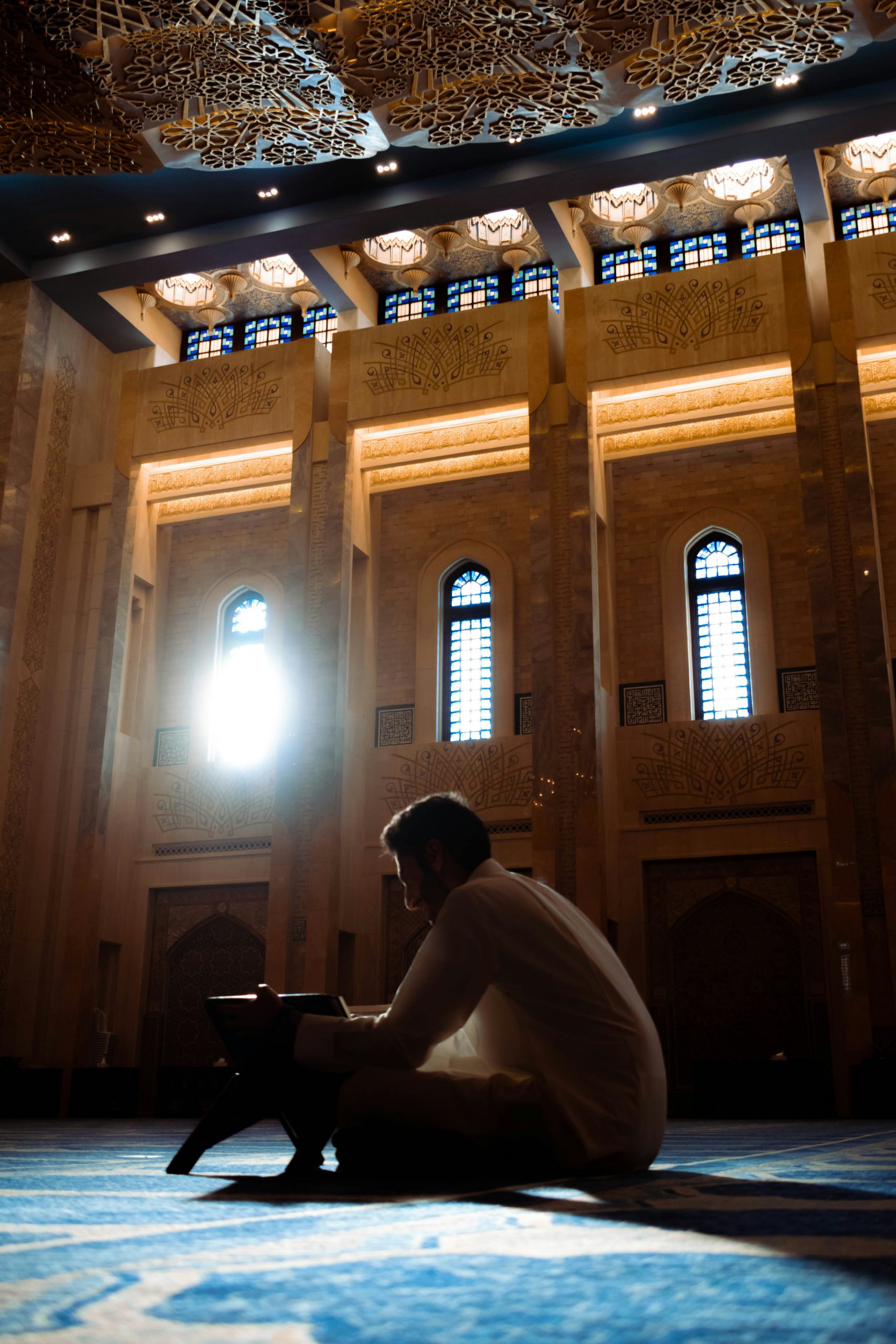
“Ramadan is already built, functioning to perfection. We just need to show up and commit to it.” [PC: Shahed Mufleh (unsplash)]
One of the things that has always fascinated me about Ramadan is that even Muslims who are not the most devout usually show up. Some mock them as “Ramadan Muslims,” but I see beauty in this. Allah has given us training wheels, a concentrated month to practice, and everyone is entitled to it regardless of their past or how devoted they’ve been. It’s an access point for all, born from the mercy of Allah .
This is both discipline and gift. In secular frameworks, people have to organize social gatherings, plan acts of resistance, and build alternative communities from scratch. It’s exhausting work that often fizzles out. But Ramadan is already built, functioning to perfection. We don’t need to invent the cure to modern isolation and passivity. We just need to show up and commit to it. A month where everyone is connected in a conscious effort to reclaim closeness to Allah and to live actively, not passively.
It’s a cure to modern malaise.
From Passivity to Agency
So how can we make the most of this blessed month to move from passivity to agency? It’s a sequence where each act of reclaiming builds the capacity for the next.
- Reclaiming Time
It starts with prayer as the structure that organizes everything else. This means praying consciously, not performatively, for at least five minutes before returning to work. Prayer builds rhythm, and it resists the tyranny of notifications and the manufactured urgency of productivity culture. But this only works if you bring full presence to it. Without agency, prayer becomes a hollow ritual.
- Reclaiming Consumption
Fasting teaches us about desire and control, but not in the way most people think. Abstinence for a set period is only the beginning. Far more valuable is understanding why we abstain and what consumption does to us. The goal extends beyond prohibiting yourself from eating, but rather to reach a point where you don’t even want to consume mindlessly because you see how it cuts you off from yourself.
This is the space Ramadan creates. In that space, the dopamine cycle breaks. You start to notice how much of your day was spent chasing the next hit of stimulation, scrolling, snacking, streaming, anything to avoid stillness. The physical fast only works if it’s paired with a fast from distraction.
When consumption no longer controls you, attention becomes possible.
- Reclaiming Attention
Treating the Qur’an as deep reading in an age of skimming. I’m less concerned with how many times you complete the Qur’an than with whether you’re actually reading, pondering, going deep. Allah asks us: “Do they not reflect upon the Qur’an?” [Surah An-Nisa; 4:82]. Reflection requires time, attention, presence – everything the spectacle denies us. The same applies to taraweeh. Twenty rak’ahs done on autopilot mean less than four done with deep, sustained focus. The discipline of being fully there for one thing, not half-there for many things.
This kind of attention is impossible when you’re still plugged into the spectacle. But when you’ve reclaimed your time and broken the consumption cycle, attention stops being a struggle.
- Reclaiming Community
When Ramadan becomes a social media show; elaborate spreads photographed and posted before anyone eats, or funny reels about relatable Ramadan behavior, we’ve turned the sacred into content. There’s a difference between communal practice and social media solidarity. One builds real relationships while the other maintains audiences.
This Ramadan, I’m using the month to reconnect with people I’ve been too distracted to talk to. Not through a story or a post, but through an actual message, better yet, a call. “Ramadan Mubarak. How are you planning to use this month? What are your resolutions?”
We’re all so connected through our devices. There’s no excuse not to connect as human beings.
Beyond Ramadan: The Training Ground
Ramadan is practice for the other eleven months. That’s the point many of us miss. We treat it as a month of peak devotion, then the gloves come off, and it’s back to business as usual. But the month was never meant to stand alone. It’s a training ground for a life lived consciously.
Small acts of agency compound. You don’t transform your entire life in thirty days. You build capacity, practice choosing, and strengthen the muscle of presence. The habits you build within Ramadan’s structure can sustain you through the chaos waiting outside it.
The test is whether these practices outlive the month. Can you pray Fajr when Ramadan ends? Can you resist the scroll when fasting is no longer required? Can you maintain real community when the ummah disperses back into routine?
Consciousness is a continuous effort, not a one-time Ramadan achievement. This is where many of us fall short, myself included. We mistake intensity for transformation. We think because we felt close to Allah in Ramadan, we’ve arrived. But closeness requires maintenance, and agency requires practice.
Ramadan gives you the tools. What you do with them in Shawwal, in Rajab, in the dead of winter when motivation is gone, that’s where the real work begins.
The Sacred as Resistance
One month later.
You open your eyes. The phone is still on the nightstand, but you don’t reach for it. Not yet. First, Fajr followed by du’a. A moment of stillness before the world makes its demands.
You still have work, and browser tabs still multiply. The dunya hasn’t become simple, but it no longer controls you the way it did. You move through it differently now. Prayer structures your day. You eat consciously, not compulsively. The Qur’an sits open more often than closed. When evening comes, Netflix is a choice, not a reflex. Instagram is something you check, not something you sink into.
You fall asleep without the glow. You wake without reaching for the buzz.
Some days you slip, and some days the spectacle wins. But the capacity is there now. You know what it feels like to live consciously because you practiced it for thirty days. You know what it feels like to have agency because Ramadan gives you the structure to remember.
The rhythm of modern life can be broken. You are no longer just a spectator. You are a participant, deliberate and awake.
That is the gift of Ramadan. Not that it saves you once, but that it shows you how to save yourself, again and again, month after month, for as long as you live.
Allah gives us the tools. The question is whether we’ll keep using them.
Related:
– [Podcast] Dropping the Spiritual Baggage: Overcoming Malice Before Ramadan | Ustadh Justin Parrott