Poland to use EU money for drone defence despite president’s veto
Unlock the Editor’s Digest for free
Roula Khalaf, Editor of the FT, selects her favourite stories in this weekly newsletter.
The Polish government will press ahead with plans to build an anti-drone system with EU loans despite the country’s Eurosceptic president having vetoed the funding.
Magdalena Sobkowiak-Czarnecka, the Polish government official in charge of the EU defence funding mechanism known as Safe, told the FT on Monday that President Karol Nawrocki’s veto would not deter the government from seeking ways to still access nearly €44bn in EU loans.
“The decision of the president does not change anything between the Polish government and the [European] Commission,” Sobkowiak-Czarnecka said. “The only thing that has changed is that we need to find another way to put this money inside our Polish system.”
Prime Minister Donald Tusk’s pro-EU government is now working on a plan to channel the Safe funds into an existing Polish army fund that would not require Nawrocki’s approval.
Sobkowiak-Czarnecka said Warsaw was confident this would allow Brussels to proceed with future Safe disbursements. Poland is the largest beneficiary of the €150bn in EU loans awarded last year to member states as part of Europe’s rearmament efforts in the face of Russia’s threat.
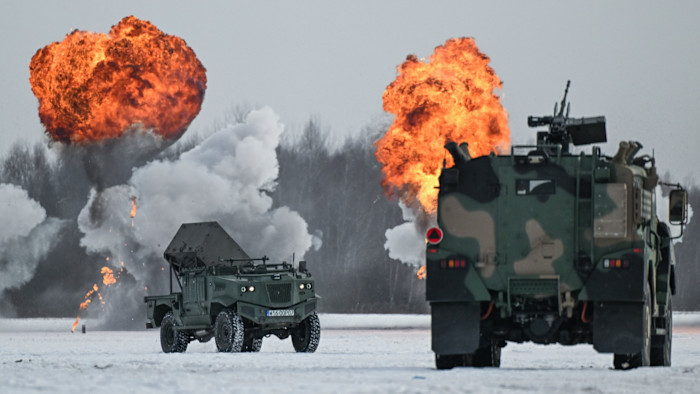
The European Commission on Friday said it was ready to release €6.5bn in Safe pre-financing next month. Sobkowiak-Czarnecka said the money would be used to build a flagship €3.5bn anti-drone system as well as for other military manufacturing projects.
“Time is of the essence and we’re committed to implement the plan without delay. This is why the Commission is signing the loan agreement with Polish authorities . . . in order to disburse the initial amount already in April,” a Commission spokesperson said.
However, Sobkowiak-Czarnecka acknowledged there were still some unknowns about the extent to which Safe loans could be spent by law enforcement beyond military expenditure.
Before Nawrocki’s veto, Tusk’s government had planned to allocate some Safe money to the police and border guards and to support infrastructure projects.
“At this moment, it’s not easy to find a way,” she said. But she added that EU rules allowed governments to amend their investment plans.
The clash over Safe is the latest in a long-running conflict between Tusk and the rightwing opposition, which nominated Nawrocki ahead of presidential elections last year.
Nawrocki claimed Safe would give Brussels a say in Polish national security matters and would be too expensive to repay — even though the interest rate on the EU loans is lower than the one for Polish sovereign debt.
Tusk accused Nawrocki of having “lost his chance to act like a patriot” at a time when Russia continues to wage war in neighbouring Ukraine. The anti-drone system Warsaw seeks to build with Safe money was prompted by Moscow’s unprecedented incursion in Polish airspace last year, when Nato fighter jets were scrambled and opened fire on Russian drones.
A Polish-Norwegian consortium was recently awarded contracts to build the anti-drone system. Sobkowiak-Czarnecka said the system, known as San, was already drawing interest from other EU countries and could eventually be exported via their own Safe financing programmes.
“San is the answer to what happened in September and is also the project that everybody in Europe is looking for,” she said. “You could use this system on the border but also to guard airports and other critical infrastructure.”
The Safe dispute has also fed into a longstanding feud with the rightwing Law and Justice (PiS) party about Poland’s role in the EU. On Sunday, Tusk accused PiS and far-right politicians of wanting a Polish exit from the bloc.
“Polexit is a real threat today,” Tusk wrote on X. “Those who want to destroy the Union are: Russia, American Maga, and the European right wing led by [Hungary’s Eurosceptic PM Viktor] Orbán. For Poland, it would be a catastrophe. I will do everything to stop them.”
Przemysław Czarnek, a PiS politician expected to challenge Tusk for the premiership in next year’s parliamentary elections, denied that his party was interested in leaving the bloc and said it was only defending Poland’s national priorities. “We are staying in the European Union, but unlike Tusk, we will use the European Union for Polish interests,” he said.