Olympic Pairs Short Program Results: Hase And Volodin Take Lead In Tight Race For Gold
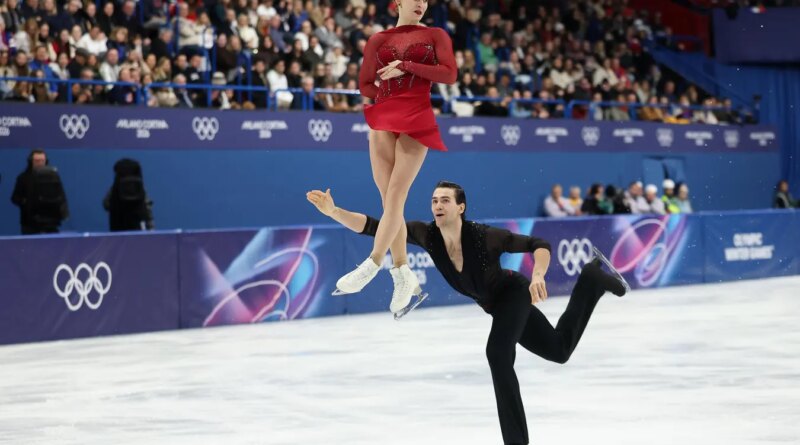
MILAN, ITALY – FEBRUARY 15: Minerva Fabienne Hase and partner Nikita Volodin of Team Germany compete in Pair Skating – Short Program on day nine of the Milano Cortina 2026 Winter Olympic games at Milano Ice Skating Arena on February 15, 2026 in Milan, Italy. (Photo by Joosep Martinson/Getty Images)
Getty Images
Minerva Hase and Nikita Volodin of Germany took the lead after the short program in the Olympic pairs figure skating competition on Sunday in Milano-Cortina.
With little separating the top teams, the pairs competition did not disappoint. The German pair edged out top contenders from Georgia, Italy, and Japan to lead heading into Monday’s free skate.
Though unexpected to contend in Milan, Canadian champions Lia Pereira and Trennt Michaud soared to a personal best score (74.60) and a surprise top-three finish over multiple gold medal contenders.
Hungary’s Maria Pavlova and Alexei Sviatchenko also capitalized on the top group’s mistakes. The European bronze medalists scored a strong 73.87 to place fourth.
With a sizable lead heading into Monday’s competition, the Germans are within striking distance of gold. Though “there aren’t heavy favorites like there are in the other disciplines,” NBC’s Johnny Weir reminded viewers, Sunday’s results did not come without surprises.
Though Hase and Volodin delivered a spectacular skate to clinch first place, their performance came after three uncharacteristically shaky performances from their top competitors in the final group.
Team USA entered two teams in the Olympic pairs competition, with neither likely to contend for the podium. However, both pairs impressed on day one of the competition, finishing in seventh and ninth, respectively.
The outing was successful, with both teams finishing in the top 16 to secure spots in Monday’s free skate.
Olympic Pairs Short Program Results: (Top Ten)
1. Minerva Hase/Nikita Volodin (Germany) – 80.01
2. Anastasiia Metelkina/Luka Berulava (Georgia) – 75.46
3. Lia Pereira/Trennt Michaud (Canada) – 74.60
4. Maria Pavlova/Alexei Sviatchenko (Hungary) – 73.87
5. Riku Miura/Ryuichi Kihara (Japan) – 73.11
6. Wenjing Sui/Cong Han (China) – 72.66
7. Ellie Kam/Danny O’Shea (United States) – 71.87
8. Sara Conti/Niccolo Macii (Italy) – 71.70
9. Emily Chan/Spencer Akira Howe (United States) – 70.06
10. Rebecca Ghilardi/Filippo Ambrosini (Italy) – 69.08
Pairs Skating Action Begins
Emily Chan and Spencer Akira Howethe 2026 U.S. Pewter medalists, would skate first of the two American pairs in Milano-Cortina. After sitting out the team event, today’s skate marked the duo’s Olympic debut.
Under the bright lights in Milan Ice Arena, Chan and Akira Howe skated with confidence, hitting their lifts, throws, and jumps with minimal technical errors. The judges awarded the pair a strong 70.06, just short of their SP personal best (71.17).
The top American duo, Ellie Kam and Danny O’Sheatook to the ice for the second time in Milan – this time, as Olympic gold medalists. Kam and O’Shea were integral to Team USA’s gold in the team event, delivering a personal best skate to keep the Americans in gold medal contention.
Though unlikely to contend for the medals, the pair looked to close their Olympics in style. In their opening twist lift, a triple twist, the height and catch position were nearly perfect. Kam “floated down like a feather,” reaching a maximum height of 11 feet, 5 inches, NBC’s Tara Lipinski remarked.
USA’s Ellie Kam and USA’s Danny O’Shea compete in the figure skating pair skating short program during the Milano Cortina 2026 Winter Olympic Games at Milano Ice Skating Arena in Milan on February 15, 2026. (Photo by WANG Zhao / AFP via Getty Images)
AFP via Getty Images
The pair nailed their side-by-side triple jumps, a skill integral to strong technical marks. Though Kam put her hand down to catch herself on the throw triple loop jump, the performance was a resounding success.
Kam broke into a beaming smile while O’Shea held her high above the Olympic ice. “This Olympics could not be going better for this team,” Lipinski remarked.
The 2024 world champions, Canada’s Deanna Stellato-Dudek and Maxime Deschampsfollowed Kam and O’Shea. With 42-year-old Stellato-Dudek breaking barriers in a sport dominated by younger skaters, “she’s an inspiration to so many people,” NBC’s Johnny Weir remarked.
After a courageous start to their program, disaster struck for the history-making pair. As Deschamps placed Stellato-Dudek on the ice after their final lift, their skates appeared to clip, and Stellato-Dudek dramatically crashed to the ice. The result was devastating: tenth place, with many skaters to go.
With the final group of four to go, both American teams ranked in the top five.
Battle of the Top Group
2026 European champions Anastasiia Metelkina and Luka Berulava would be the first of the final four to compete in the short program. Showcasing perfect unison, the pair flew into synchronized triple Salchow jumps to start their program.
Just seconds later, Metelkina stumbled out of the throw jump. Not disastrous, but costly. In a competition as tight as the Olympic pairs, “one step off…could cost you,” Lipinski reflected.
Despite the noticeable error on their throw jump, the Georgian champions received a 75.46, good for first with three teams to go. Next up: the Italians.
Sara Conti and Niccolo Macii already pocketed bronze medals from the historic team event, but the pair is hungry for a medal of their own. The pair has excelled on the world stage before, winning bronze medals at the 2023 and 2025 world championships.
While Conti nailed the landing on their throw jump, she stumbled out of the pair’s side-by-side triple Salchow. Like Metelkina’s landing, the error was significant, but not disastrous. Though the pair skated cleanly through the remainder of the program, they lost difficulty on their elements, resulting in a technical score well below that of their Georgian rivals.
The hometown favorites received a disappointing 71.10 for the sixth spot with two pairs still to go.
While the Italians weathered their disappointment, the two-time world champions Riku Miura and Ryuichi Kihara of Japan skated onto the ice. If anyone was favored here in Milan, it was the Japanese pair.
Through their first two key elements, the pair looked primed to cruise to a lead.
However, like the top teams preceding them, the veterans committed a crucial and costly error. Kihara appeared to drop Miura in their lift, incurring a significant deduction. At the close of their skate, Kihara slumped over in frustration.
MILAN, ITALY – FEBRUARY 15: Riku Miura and partner Ryuichi Kihara of Team Japan react after competing in Pair Skating – Short Program on day nine of the Milano Cortina 2026 Winter Olympic games at Milano Ice Skating Arena on February 15, 2026 in Milan, Italy. (Photo by Elsa/Getty Images)
Getty Images
“You can’t win in the short program…but you can certainly lose,” Weir reflected. Were the favorites already out of gold medal-contention?
Miura and Kihara received a 73.11, slotting the pair into fourth place.
Last up were the 2025 World silver medalists, Minerva Hase and Nikita Volodin of Germany. In the pair’s Olympic debut, the opportunity was there for a top spot heading into the free skate. Just hit and win day one.
Opening with a triple twist, the pair looked sharp. Hitting their side-by-side triple Salchows, the team had one more obstacle to overcome: the throw triple loop.
Unlike their competition, the Germans looked unfazed. Volodin launched Hase into a huge triple loop, and the 26-year-old landed with ease.
“Nailed it,” Lipinski declared. “This changes the game.”
With their confident performance, the Germans distanced themselves from a tightly packed field, earning an 80.01. Heading into Monday’s free skate, the gold medal is theirs to lose.