Never Underestimate ‘The Night Manager’
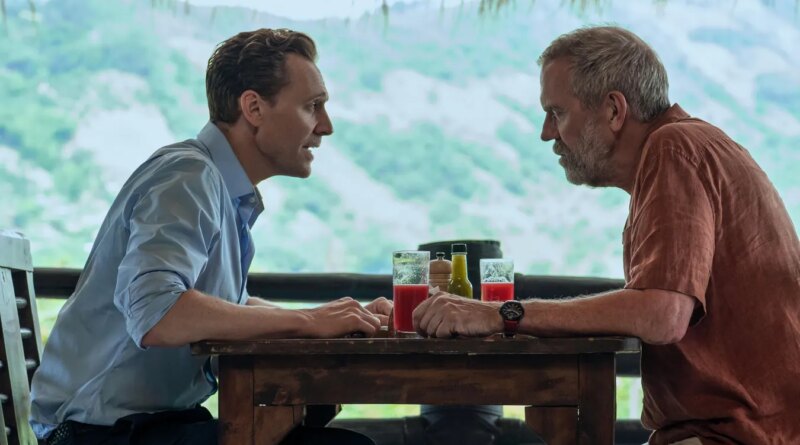
Jonathan Pine (Tom Hiddleston) and Richard Roper (Hugh Laurie)
Des Willie/Prime
There are lots of ways to tell stories on film, probably as many as there are people who make films and episodic series. But when the production is continuing The Night Manager, a stand alone novel by John le Carré, after the (brilliant) author’s death and with the blessing of his literary estate, there is a pressure to achieve a certain level of quality which other projects, even the most prestigious, simply do not experience.
le Carré’s novel, first published in 1993, first became a limited series in mid-February of 2016, adapted from the source material by David Farr, who also serves as showrunner. It was faithful to the novel while managing to update the story for a modern audience, and was the recipient of a bevy of awards.
So, coming back to the story, almost a decade later and with no le Carré writing to work from, seems like it would be a rather daunting challenge. But Farr was into it, once he knew le Carré’s sons and heirs were, as was much of the original cast, and now, after literal years of work, all of Season Two is available to stream on Amazon Prime.
I was able to sit down with the costume designer, Oliver Cronk, and production designer, Victor Molero, to talk about how they picked up at the end of the novel and brought one of le Carré’s most popular characters into the world of today. As always, which my Lovely Readers are likely to know very well, the fabulous final product is proof that if you hire the very best people, give them the tools (and budget) they need to succeed, and foster a collaborative atmosphere behind the camera, then it is possible to capture actual magic on film.
The Modern Spy
I started off by asking them a general sort of question. I wanted to know how they decided what a spy looked like in 2026, how the spaces a MI6 agent would cultivate would look like.
“From a costume perspective,” Oliver Cronk told me, “a lot of it is about aliases and disguise. There was a lot of influence taken from what had been established as this character in the first series. For instance, we took signature colors, pale blue and khaki, which very much came out of Season One, and kept that as the core point in the costumes. When we see Tom Hiddleston living as Alex Goodwin in episode one, living this persona, a very low profile existence, we were looking towards London architecture on a rainy day. The dark greys, the navies, but this idea that you could blend in with the city environment. That could be on public transport, on the Tube or on a bus, being able to disappear into that, which then explodes into something which is much more exuberant in a way when he gets to Columbia, which is a very different persona he’s occupying.”
Jonathan Pine (Tom Hiddleston), Roxana (Camila Morrone), and Teddy (Diego Calva) dance in literal and metaphorical ways.
Des Willie/Prime
“For me,” Victor Molero said, “The space needs to tell something of the character, and that’s needed to make a good companion to the story. So for example, Oliver was talking about London, with the director of photography, Tim Sidell, and the director, Georgi Banks-Davies, we tried to recreate a London that was muted, but at the same time was very bright. That kind of London that is grey and without richness. At the same time, we have like 10 years between the first and second season. We were trying to feel that the old characters have changed. And that was very crucial, to feel the conflict of the character between these two men, of the story that is Roper and Pine.”
All The Details Matter
Whenever I watch any show or film I plan to write about, inevitably it takes much longer than the actual run time for me to get through it. I spend a lot of time pausing to double check what I think I’ve seen on screen, rewinding to make sure I saw what I thought I saw, and while watching shows like The Night Manager, I often enjoyed something so much that I simply had to see it again.
While doing all of the above, it came to my attention that Teddy, and the men (and children) which make up Teddy’s army, all wear a gold hoop earring. Then, after seeing Danny Roper’s silver hoop earring at the end, I had to go back to the first episode and confirm that, yes, he was wearing it every time we see him.
Teddy (Diego Calva) with his earring and necklaces.
Des Willie/Prime
As I’ve told my Lovely Readers many times before, when patterns emerge in storytelling on film, it is never an accident. To repeat something I’ve often preached about in the past, to quote the great Ian Fleming (from his James Bond novel, Goldfinger) “Once is happenstance. Twice is coincidence. Three times is enemy action.”
I knew the earrings meant something, and with those who hid the Easter Eggs in front of me, there was no way I wasn’t going to ask about this detail. Because details, whether or not they are where the devil hides, are cumulatively the source of quality filmmaking.
“I liked that little signature,” Cronk told me. “They’re so connected, those characters. The environment of the recruits to Aurora, which is kind of a paramilitary outfit, that Teddy’s setting up. It felt nice that he was this icon to them in a lot of ways, although what he’s selling is disingenuous in almost all respects. But I wanted there to be this kind of throughline of style, an aspirational point because Teddy is very charismatic. Then I liked the tension between the two sons, between Danny and Teddy. And although they never meet, there’s an antagonism, which is quite specific to that relationship.”
Teddy (Diego Calva) is a dangerous man.
Des Willie/Prime
Another piece of jewelry I was curious about was the saint medal we see Teddy wear. It was obviously important to the character, he wears it constantly, but as a Jewish woman I didn’t feel comfortable guessing which one it was or what the icon was meant to represent.
“It’s a particular Santa Maria,” Cronk explained. “It’s a Santa Maria which is used as the Virgin Mary, but this particular one is very distinct to Columbia. We went through the gold markets in Bogota, looking at very, very many medals before we found that one. Honestly, hundreds of them. And then this one just really shone out the most. It’s very beautiful. And then it’s worn with a garnet necklace as well.”
Like blood? I couldn’t help but ask.
Sally (Hayley Squires), Basil (Paul Chahidi), and Jonathan Pine (Tom Hiddleston)
Des Willie/Prime
“Yeah, like blood,” the costume designer said with a small smile. “A nice dark blood for that. It’s worth saying, in relation to what Victor was saying, a lot of the costume work is very much in response to what Victor has discussed with Georgi and with Tim. Starting a project, one of the first things which I do is look at what, in this case, Victor has done in terms of ideas for the set, perhaps recces they’ve been on. A lot of the costume is very responsive to what the environments are going to be like.”
A Truly International Production
This is a story about espionage, and gun running, on an international scale and its filming took place on multiple continents. BAFTA-winning director Georgi Banks-Davies did all six episodes, something rare in the world of episodic television and which the costume and production designer both credit for the narrative’s cohesive outcome.
“Georgi really put her trust in every one of us,” Molero told me. “And she made a space where everyone could work together.”
“For a director to really have this very precise blueprint,” Cronk said, “very specific in certain regards, but I think it allowed us to develop a kind of shorthand and an understanding of how different departments were going to work. It becomes more instinctive. I got a lot of freedom to run with ideas from Georgi after we understood that we were aligned in terms of what, collectively, the show might look like.”
Roxana (Camila Morrone) looks like trouble.
Des Willie/Prime
The production designer described the filming process as a puzzle, which made sense when I understood that it happened in Spain, Columbia and the UK.
“The most difficult thing,” Molero explained, “was to put all the pieces together and create that continuity that will create the whole world. That’s what I think the biggest challenge was.”
“I think what you did Victor,” Cronk said to his colleague, “in terms of recreating a lot of Columbia in Spain, is an extraordinary thing in terms of what you’re actually able to shoot in a place and then working with it in a completely different country to create that sensation of being on the other side of the world. It’s amazing to see.”
“Thank you,” Molero responded. “That’s really nice to say. I’m Spanish, I have long experience working in the UK, but this was my first time working in Columbia. When I arrived there, I took the Colombian art department as an anchor to understand so that we didn’t do any cliches about that culture. I was really impressed when I arrived there, it’s a country that has evolved in the right way. And I think it was important for the story to show that Columbia was in a good position, one that someone could completely destroy. It was a nice experience to have and to respect.”
Jonathan Pine (Tom Hiddleston) and the wiley Roxana (Camila Morrone)
Des Willie/Prime
Of course I wanted to know the costume side too.
“I started working with a Colombian assistant designer from when we were in the UK,” Cronk explained, “and I would call her up and it was kind of wild because of the time zones. We’d shoot days in London, and then I’d get on the phone to her after we finished filming, and we’d talk for a long time, getting her feedback, because we were designing characters who were going to appear in Columbia from London. We were trying to piece together what we could buy in London, but then also what we could preemptively buy from Bogota or other cities there. And then actually to arrive in Columbia and have, as you say, that anchor, but an amazing team of Colombian costumers, including designers and supervisors, but people who could really go to and say, does this feel, does this feel right? Does this feel like an interpretation, which is interesting and up to date and relevant? I think that watching out for some of those cliches, which, you know, those representations of Latin America, it’s very easy to slip into. It was really important, having these sounding boards, to play with ideas and explore where the edges of that kind of cliche is. It’s important how design works.”
Tom Hiddleston as Jonathan Pine
Des Willie/Prime
A Believable Military and Jungle
Anyone who has read my work knows that I have a fascination with uniforms, and this series has so very many of them. Before I dove into that, I wanted to know about the camo I kept seeing in the jungle scenes in Columbia. It felt specific, maybe specific to the region, and I asked the costume designer if he would tell me about it.
“It’s a digi print camo,” Cronk explained, “which had been used until very recently. The Columbia military introduced a new one within the past five or six years, they swapped over to a slightly more modernized version of that digipack. We sourced that in Bogota through a man called Sergeant Ramirez, who was very helpful and opened a lot of doors in terms of getting hold of it in the volume which we needed. But that felt right. The alternative with a camo military uniform for a costume department is, if you can’t get the exact thing, then you design and print something which is very close to it, which was an option, which we were exploring. But to me, it felt much better to get the real thing and also worn garments, which we wanted. By the time we’re in the jungle and they’re real working soldiers effectively in fatigues, then you want it to feel like those costumes are lived in. The generals, their thing was different, it was a crossover between Victor’s department and us in costume. And David Alba, who was the graphic designer on the project, was brilliant.”
There are a lot of details that go into making a believable military uniform, and the production end of The Night Manager was committed to perfecting every one of them.
Richard Roper (Hugh Laurie)
Des Willie/Prime
“We looked very closely at the insignia,” Cronk told me, “for the cap badges, all of the ribbons, all of the metalwork on those top ranking military costumes. We were unable to use the genuine Colombian article, so that all got redesigned very much in the spirit of what the real McCoy looks like, but an interpretation, which we then had 3D printed and metal plated and the rest of it.”
I asked the production designer about the spaces these military, and paramilitary, characters inhabit. Between boardrooms and jungles, the challenges and potential issues seemed near infinite, yet watching the final product it felt as though the places and spaces were real ones that the series had gained permission to film in.
“We started very early to find locations in Colombia and Spain,” Molero said. “We spent almost four months traveling between the continents, and we understood that to shoot in the jungle in Colombia was almost impossible. So,we decided to do it in Tenerife, Canary Islands. We created Syria, we created a different part of Colombia, many roads, and because it was easier to be in Europe to do all that kind of work. But the funny thing is, we hoped to find a good jungle for Tenerife. We couldn’t. It was a long scene and it’s very important. So at the end, we created the jungle in a kind of back lot in the middle of the countryside. It was quite a challenge because we decided that very in the last part of the production, and we had a restrained budget to create that kind of greenery, it’s like a set. We created the whole jungle in the middle of back lots. We had an amazing team and they did an amazing job in a very short time.”
Richard Roper (Hugh Laurie) in the jungle.
Des Willie/Prime
Every Character and Space Got Attention
There’s a scene early on when we meet a Colombian private detective named Martín Álvarez (Diego Santos) and from the moment I saw a velvet painting of a dog on his office wall, I knew I had to make time to ask about him. His clothes, which are somehow both loud and provide camouflage, to the obviously cultivated space he works in, everything about this guy seemed like it was worth knowing about.
“When I read the script,” Molero told me, “it was the character that I really fell in love with. I think the actor did an amazing job. And it’s a guy that really cared about things. He really cared about Colombia. So he’s really a sweet character, but at the same time, very bold. So we wanted to create a space that was not decoration. I think it’s our job, if you want to do it right, you need to put elements in that are helping to illustrate the character. His space is very chaotic, because he’s really focused on the job and in his way. Very chaotic, but at the same time, very effective and very passionate about what he was doing. And I think I tried to humanise the character with the set deck.”
And the clothes he wears? Or his costumes?
Jonathan Pine looks out at London.
Des Willie/Prime
“Glamor does draw attention,” Cronk said to me. “But something which is interesting about costume design, I think, in relation to fashion design, is that in costume, there are moments where we play towards the glamour, the high-end designer dresses for Camilla, for instance, and the suits cut for Tom. But that’s from a costume perspective. I liked finding for him a lot of these Hawaiian shirts, and there’s something quite casual and that image of him, the set I thought his office was, was brilliant. And I loved that little dog painting, but for him to be in there looking totally casual in a loose fitting printed, you know, a Hawaiian kind of shirt, short sleeves with a pair of slacks on feet-up-on-the-desk type of guy. But then, what was exciting was for those shirts to then play out in the jungle. We were talking a bit about camouflage earlier. We looked at a lot of different variants on that idea of printing for something which could allow him to slightly disappear when he was in there, staking out the estantia and microphone tagging the dogs. But how different that Hawaiian shirt feels when you change the environment it’s in. And then it does feel like it’s playing this kind of disguise, disappearing into the foliage type role, but also feels like a casual guy’s casual shirt when you see him in the office.”
All episodes of The Night Manager are now available to stream on Amazon Prime.
Follow me for more stories that take you behind the camera to learn all about the best costume designers in Hollywood and International Filmmaking!