Middle East crisis live: JD Vance says US and Iran fail to reach deal; Iran state media blames ‘unreasonable’ US demands
No deal reached between US and Iran, JD Vance says
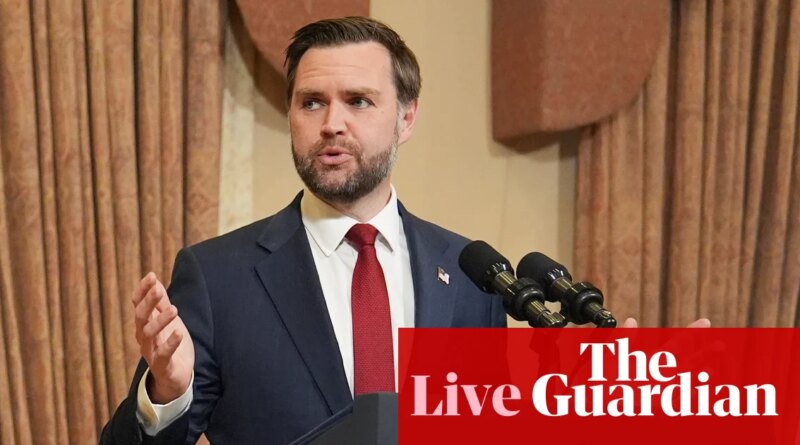
JD Vance is speaking now, and says “substantive discussions” have been ongoing with Iran for 21 hours.
“The bad news is that we have not reached an agreement,” he says.
Key events
Iran state media says talks failed over ’unreasonable’ US demands
“Unreasonable demands” by the US scuppered talks in Islamabad to end the war in the Middle East, Iranian state broadcaster IRIB said on Sunday, per the AFP news agency.
“The Iranian delegation negotiated continuously and intensively for 21 hours in order to protect the national interests of the Iranian people; despite various initiatives from the Iranian delegation, the unreasonable demands of the American side prevented the progress of the negotiations.
“Thus the negotiations ended,” IRIB said on Telegram.
According to the White House press pool, JD Vance boarded the Air Force Two aircraft at 7.08am local time, and is about to depart from Pakistan.
Photos showed him waving and giving a thumbs-up from the top of the stairs.
Associated Press notes that JD Vance’s entire remarks last just over three minutes – and that the US vice-president only took three questions from reporters before walking away.
You can read more of the latest updates from the talks here:
US delegation was ‘consistently’ talking to Trump throughout negotiations, Vance says
“Obviously we were talking to the president consistently,” the vice-president tells reporters: … “half dozen times, a dozen times over the past 21 hours”.
We obviously also talked to Admiral [Brad] Cooper [head of the US central command]to Pete [Hegseth, defense secretary]to Marco [Rubio, US secretary of state]to the entire national security team. We talked to [treasury secretary] Scott Bessent a number of times, so look, we were constantly in communication with the team, because we were negotiating in good faith …
We leave here with a very simple proposal, a method of understanding that is our final and best offer. We’ll see if the Iranians accept it.
Vance claims US delegation was ‘quite flexible, quite accomodating’ but Iran would not accept terms
Another reporter asks if the discussion produced any kind of framework, and if the issue of Iranian frozen assets had been raised.
“Certainly those things came up,” Vance replies.
But again, we just could not get to a situation where the Iranians were willing to accept our terms.
I think that we were quite flexible. We were quite accommodating.
The president told us, you need to come here in good faith and make your best effort to get a deal. We did that and unfortunately we weren’t able to make any headway.
Vance is asked by a CNN reporter which of the US’s terms Iran has not accepted.
Well, I won’t go into all the details because I don’t want to negotiate in public after we’ve negotiated for 21 hours in private.
But the simple fact is that we need to see an affirmative commitment that they will not seek a nuclear weapon, and they will not seek the tools that would enable them to quickly achieve a nuclear weapon.
That is the core goal of the President of the United States, and that’s what we’ve tried to achieve through these negotiations.
Again, their nuclear program, such as it is – the enrichment facilities that they had before – they’ve been destroyed.
But the simple question is, do we see a fundamental commitment of will for the Iranians not to develop a nuclear weapon, not just now, not just two years from now, but for the long-term?
We haven’t seen that yet. We hope that we will.
More from JD Vance who says the US and Iran have not come to any deal:
We go back to the United States having not come to an agreement.
We’ve made very clear what our red lines are, what things we’re willing to accommodate them on and what things we’re not willing to accommodate them on.
And we’ve made clear as we possibly could.
And they have chosen not to accept our terms.
No deal reached between US and Iran, JD Vance says
JD Vance is speaking now, and says “substantive discussions” have been ongoing with Iran for 21 hours.
“The bad news is that we have not reached an agreement,” he says.
US-Iran talks hinge on refraining from ‘excessive demands’: Iran foreign ministry
The success of this weekend’s peace talks depends on Washington avoiding “excessive demands” and “unlawful requests,” the Iranian foreign ministry’s spokesperson said early today, reported by AFP.
“The success of this diplomatic process depends on the seriousness and good faith of the opposing side, refraining from excessive demands and unlawful requests, and the acceptance of Iran’s legitimate rights and interests,” Esmaeil Baqaei wrote on X.
He added that the two sides had discussed a range of issues including the strategic “Strait of Hormuz, the nuclear issue, war reparations, the lifting of sanctions, and the complete end of the war against Iran.”
JD Vance to give update on peace talks in Islamabad
The US vice president is due to speak shortly, with his remarks to be streamed by the White House. Vance has led the American delegation at the talks, with the Iranian side led by parliament speaker Mohammad Bagher Qalibaf and Abbas Araghchithe foreign minister.
They have discussed with Pakistan how to advance the ceasefire already threatened by deep disagreements and Israel’s continued attacks against the Iranian-backed Hezbollah in Lebanon, whose health ministry said the death toll has surpassed 2,000.
Two Pakistani officials have told Associated Press that discussions between the heads of the US and Iran delegations will resume following a breakafter the historic face-to-face negotiations reportedly paused before dawn.
The officials, who spoke on condition of anonymity because they were not authorized to brief the press, said some technical personnel from both teams are still meeting – as the Iranian government said earlier.
A Pakistani official has told the Agence France-Presse news agency that talks are “progressing in the right direction”.
“I can say that discussions are moving positively and the overall atmosphere is cordial,” they said, speaking on condition of anonymity.
‘Mood swings from the two sides’ in first round of talks
In a post on XIran’s government said that after 14 hours, the talks had concluded and technical experts from both sides would exchange documents.
“Negotiations will continue despite some remaining differences,” the post added, though it did not say when they would restart. An Iranian state TV reporter said the talks would continue on Sunday, according to Reuters.
The Trump administration has not yet commented on whether the negotiations had concluded and what, if any, differences remain. Asked about the progress of the talks, a senior White House offical earlier told media: “15 hours and counting!”
“There were mood swings from the two sides and the temperature went up and down during the meeting,” a Pakistani source told Reuters in reference to the first round of talks.
Summary of the day so far
-
High-stakes negotiations between the US and Iran took place in Islamabad, with the talks lasting several hours and confirmed by the White House to be face to face. The meeting marked the highest-level direct engagement between Washington and Tehran in decades, aiming to secure a peace agreement to end the weeks-long war. The core US delegation is led by US vice-president JD Vance.
-
The strait of Hormuz remains among the main points of “serious disagreement” in talks between the US and Iran in Islamabad, Iran’s Tasnim news agency reported on Saturday. It added that consultations were continuing despite what it described as excessive US demands, while Iran insisted on preserving its military gains.
-
Israeli prime minister Benjamin Netanyahu said on Saturday that Israel remains committed to keep fighting Irandespite ongoing negotiations between the US and Iran. “Israel under my leadership will continue to fight Iran’s terror regime and its proxies,” Netanyahu wrote on social media. Israel is not present at the US-Iran talks in Islamabad.
-
Donald Trump told reporters outside of the White House that it makes “no difference” to him if a deal is reached with Iranamid the ongoing peace talks in Pakistan. “Regardless of what happens, we win,” Trump said. “Whether we make a deal or not, makes no difference to me.”
-
The latest Israeli attacks on Lebanon have pushed the death toll to over 2,000 with more than 6,300 wounded, according to the Health Ministry. Earlier, the Iranian negotiators demanded a ceasefire in Lebanon, reparations and commitment to unblock frozen assets as part of a peace deal in a preliminary meeting with Pakistani mediators.
-
The US military says it “began setting conditions for clearing mines in the strait of Hormuz” in an update released on Saturday afternoon, saying two navy destroyers had transited the strait. A spokesperson for Iran’s joint military command later denied the claim by the US military that the navy destroyers transited the waterway.
US-Iran peace talks expected to continue later Sunday
Historic talks between the US and Iran appeared to have concluded for nowIran’s government said early on Sunday, following several hours of talks in Pakistan that are aimed at ending the weeks-long war between Washington and Tehran.
Different Iranian media outlets, including Fars news agency and Tasnim news agency, are reporting that “serious disagreements” remain but at the suggestion of Pakistan, another round of talks will be held on Sunday morning.
Qatar has announced the full resumption of all maritime navigation activities beginning on Sunday. The Ministry of Transport confirmed that “all categories of marine vessels and transport modes” will be permitted to operate between the hours of 6am and 6pm.
In an official statement, the ministry emphasized that all maritime operators must strictly adhere to safety protocols, including the continuous operation of tracking and communication systems.
It was not immediately clear whether the announcement meant that Qatari vessels would be allowed to transit the strait of Hormuz, which remained effectively closed as of Saturday.
Iran’s Islamic Revolutionary Guard Corps has warned that any attempt by military vessels to transit the strait of Hormuz would be met with “a strong response”, saying only non-military vessels would be allowed to pass under specific regulations, the IRGC said in a statement carried by Iranian media.
It is now in the early hours of Sunday morning in Islamabad, around 3am local time, and negotiations are still reportedly ongoing.
A US delegation led by JD Vance and an Iranian delegation led by parliament speaker Mohammad Bagher Qalibaf first met with Pakistani prime minister Shehbaz Sharif before rounds of direct talks Saturday.
The meeting marks the highest-level direct engagement between Washington and Tehran in decades, aiming to secure a peace agreement to end the weeks-long war that has caused thousands of deaths and disrupted the global economy, particularly through Iran’s closure of the strait.