How Police In Europe Are Adapting To Counter Hybrid Drone Attacks
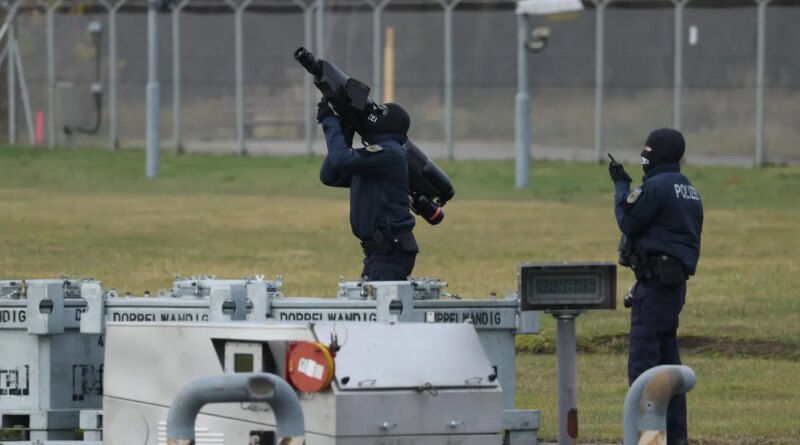
A member of Germany’s newly formed federal police anti-drone unit aims a drone capture system during a December demonstration. (Photo by Sean Gallup/Getty Images)
Getty Images
Hybrid drone attacks on airports and drone surveillance of military bases in a “gray zone” of asymmetric warfare across NATO countries are transforming the way police in Europe and the United Kingdom operate.
Police forces are turning to new technology and tactics as they adapt to protecting the public in hybrid drone warfare and increased drone use by organized crime groups.
According to a December report by Europol, the European Union Agency for Law Enforcement Cooperation, state actors can hide behind the anonymity of drones to pose extra challenges to police.
“Unmanned systems are particularly attractive in the context of hybrid threats as the increasingly autonomous nature with which they can be operated can offer state actors certain plausible deniability,” the report notes, adding that hybrid drone attacks can be passed off as “mere criminal acts.”
How Drones Are Impacting Military Bases and Civilians
Drones disrupting airports and military sites across NATO countries are impacting both military personnel and civilians, drawing attention to the roles of police and military forces in responding.
The British government revealed this week that drone incidents around military bases in the United Kingdom doubled in 2025 from the previous year, prompting new legislation to allow military personnel to respond instead of police.
Drone defense police officers focus on a drone with a jammer and binoculars during a demonstration in Duesseldorf, Germany. Photo: Oliver Berg/dpa (Photo by Oliver Berg/picture alliance via Getty Images)
dpa/picture alliance via Getty Images
Conversely, the German government moved to expand law enforcement authority to shoot down drones and has formed a special federal police unit tasked with counter-drone operations. Debates in the legal sphere about whether the police or the military will respond to small drone threats outline how unmanned systems are redefining battlefields and civilian society at speed.
How Organized Crime Groups Are Using Drones
Police forces around the world are also facing organized crime groups using drones as tools for smuggling and as weapons at rapid scale.
In 2024, police in Spain broke up a criminal network using Unmanned Aircraft Systems made in Ukraine to smuggle drugs into the country from Morocco. Last August, a drug trafficking group in Colombia used a drone to attack a police anti-narcotics helicopter near Medellin, killing 12.
Criminal groups have also been using small drones to drop drugs and weapons into prisons across the United Kingdom, sparking increased police counter-drone operations. One operation in South London recovered a drone worth over $8,000 that could carry four loads at once.
Joint cooperation between military forces and law enforcement is useful in responding to hybrid threats and sophisticated organized crime groups, according to Europol, as this will “help law enforcement anticipate potential threats and develop effective countermeasures, as adversaries may adopt similar tactics and technologies.”
Why Police Face a Gap In Counter-Drone Technology
At the same time, however, military counter-drone systems are not always appropriate for police seeking to protect civilians around them.
To prevent potential harm from falling debris, German federal police units aim to expand their use of counter-drone nets to capture rogue drones intact. However, a lesser amount of unmanned system technologies specific to police operations exposes “a critical gap in the development of law enforcement specific capabilities,” according to Europol.
“Most of the C-UAS applications are military applications which are solely addressing the threat of the drone and stopping it,” the report points out, adding that “safety of the surroundings is a primary concern for law enforcement as they are generally tasked with stopping threats with minimal damage…For example, cars are usually stopped, not destroyed – similarly, a drone may have to be stopped.”
As hybrid drone attacks in Europe and the United Kingdom blur the line between criminal acts and warfare, police forces are adapting their role to stop threats from autonomous systems. They will continue to face heavy demands to field new technology suited for law enforcement operations while collaborating with military forces to protect members of the public as drones rapidly change society.