How Israel is destroying healthcare infrastructure in southern Lebanon
Beirut, Lebanon – Israel’s attacks on Lebanon are putting a massive strain on the Lebanese healthcare system, in what experts and analysts say is part of an effort to force people out of the south of the country.
One month into the latest intensification of strikes on Lebanon, Israel has killed 53 medical workers, destroyed 87 ambulances or medical centres, and forced the closure of five hospitals, according to Lebanon’s Ministry of Public Health.
“Israeli strikes and blanket evacuation orders are cutting people off from care and shrinking the space for health services to function,” Luna Hammad, the Lebanon medical coordinator for Doctors Without Borders (MSF), told Al Jazeera, adding that MSF has seen “a documented pattern of attacks affecting healthcare”.
Displacement fuelled by destruction of healthcare
On March 2, Israel intensified its war on Lebanon again after Hezbollah responded to Israeli attacks for the first time in more than a year.
The Iranian-backed group Hezbollah claimed the attack was retaliation for the US-Israel assassination of Iranian Supreme Leader Ayatollah Ali Khamenei two days earlier. A ceasefire between Israel and Hezbollah had ostensibly been in place since November 27, 2024, despite more than 10,000 recorded Israeli ceasefire violations by the United Nations, and the killing of hundreds of Lebanese.
Israel used the Hezbollah attack as justification to expand its strikes across Lebanon and to issue mass forced evacuation orders for the country’s south and Beirut’s southern suburbs, traditionally areas where Hezbollah has strong support. Now, 1.2 million people are displaced from their homes, while Israeli forces have begun an invasion of the south, with Israeli officials declaring an intention to occupy the region, set up a so-called security zone, and destroy more villages across the border.
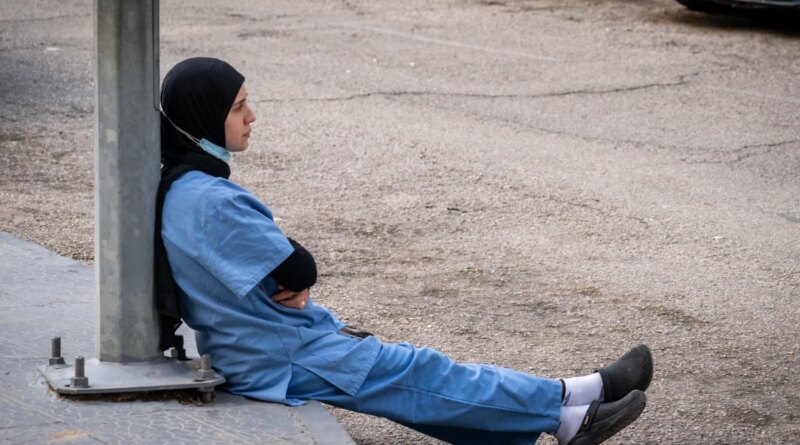
Amid the destruction of southern Lebanon has been the devastation of the region’s healthcare infrastructure, including attacks on medical workers, ambulances, civil defence centres, and hospitals.
“We have seen some health facilities directly attacked,” Dr Abdinasir Abubakar, the World Health Organization (WHO) representative in Lebanon, told Al Jazeera. He also mentioned the displacement of healthcare workers as part of the erosion of Lebanon’s healthcare sector.
On Tuesday, Jabal Amel University Hospital in Tyre, along south Lebanon’s coast, was struck for a fifth time. Five hospitals have been forced to evacuate in the last month.
Even before the war with Israel, Lebanon’s healthcare system was in poor shape due to compounding crises, including the 2019 financial crisis and the 2023-2024 war. But there has been increased strain due to Israeli attacks and mass displacement since March 2, 2026. Amidst the month-long United States-Israel war on Iran, there have also been Iranian strikes on Gulf countries, which have impacted shipping routes for crucial medicine and supplies.
The destruction of healthcare infrastructure has also spurred mass displacement, healthcare professionals say. It is all part of what they believe to be a wider strategy: to make south Lebanon uninhabitable.
“You can’t live somewhere that doesn’t have basic medical care, and of course it’s now created a strain on healthcare facilities here where people are displaced because you now have over a million extra people who are going to need the health system here,” a doctor who works on the ground treating the displaced in Beirut told Al Jazeera, asking that their name be withheld so that they could speak freely.
Trend of killing medical workers
The vast number of displaced people also means healthcare facilities are under higher strain than before. Emergency room admissions have increased exponentially, according to Abubakar.
Dr Hassan Wazni is the general director of Nabih Berri Governmental Hospital in Nabatieh, in southern Lebanon. Israeli attacks have been intense in Nabatieh and the surrounding villages. Wazni told Al Jazeera by phone that many patients needing treatments like chemotherapy, radiotherapy, and dialysis have been transferred further north.
And then there are the direct attacks on the healthcare system, including medics. Some of those attacks include reports of double-tap strikes, where an initial strike occurs and a second follows after first responders gather.
On March 28 alone, Tedros Adhanom Ghebreyesus, the director-general of WHO, counted nine paramedics killed and seven wounded in five separate attacks. And while such attacks have increased in recent days, the pattern has a precedent, with Israel killing more than 107 first responders in Lebanon between late 2023 and 2024.
The attacks on Lebanon’s healthcare infrastructure and medical workers have been documented by Human Rights Watch (HRW), which has noted “repeated, apparently deliberate, attacks on medical workers in Lebanon”, according to Ramzi Kaiss, HRW’s Lebanon researcher. “This trend, the killing of medical workers, has not stopped despite more than 270 health workers and paramedics being killed as a result of Israeli attacks in Lebanon,” he said.
Medical workers and healthcare facilities are protected under international humanitarian law. Israel’s attacks on medics in 2024 were described as an apparent war crime by HRW.
The attacks on healthcare infrastructure during times of war are not new. Forensic Architecture, a research group investigating state violence and human rights violations, said Israel had conducted “systematic targeting of hospitals and healthcare workers” in Gaza. And Israel is not unique in targeting healthcare facilities.
“Attacks on healthcare have been consolidated over the last two decades, especially with the [United States-led] war on terror, and then from Iraq to Syria to Gaza and then now to Lebanon, it has become clear that hospitals are no longer consistently treated as protected spaces,” Omar Dewachi, author of Ungovernable Life: Mandatory Medicine and Statecraft in Iraq, told Al Jazeera. “When these hospitals are repeatedly hit across different conflicts with little accountability, it creates a sense that this is becoming increasingly normalised.”
Dewachi said that such attacks have compounding effects. Treatable injuries get worse, war wounds do not heal properly, and there are other “more long-term consequences”, he said, noting, “Many patients who survive these explosions end up with chronic infections that last for years and sometimes require multiple surgeries.”
Continued impunity
The attacks are unlikely to cease, experts and analysts say, so long as the pattern of impunity continues.
“There’s been continued impunity for such acts and no accountability whatsoever,” Kaiss of HRW said. “Lebanon’s government has a responsibility to ensure that there can be accountability, to give jurisdiction to the ICC [International Criminal Court]and to allow it to investigate and prosecute war crimes that have been committed in the country, among them the repeated apparently deliberate attacks on medical workers and health facilities.”
In the meantime, medical professionals have called for international support to bolster and protect Lebanon’s healthcare.
“It should be protected under international law,” Abubakar said, adding that a de-escalation and ceasefire, “as quickly as possible”, was needed.
Wazni, the director of the hospital in Nabatieh, told Al Jazeera: “I don’t know how beneficial this will be, but we call for the respect of international law and international agreements, and to respect the safety of medical crews.”