Gold rises and stocks fall as global trade faces new Trump tariff threat
Stay informed with free updates
Simply sign up to the US equities myFT Digest — delivered directly to your inbox.
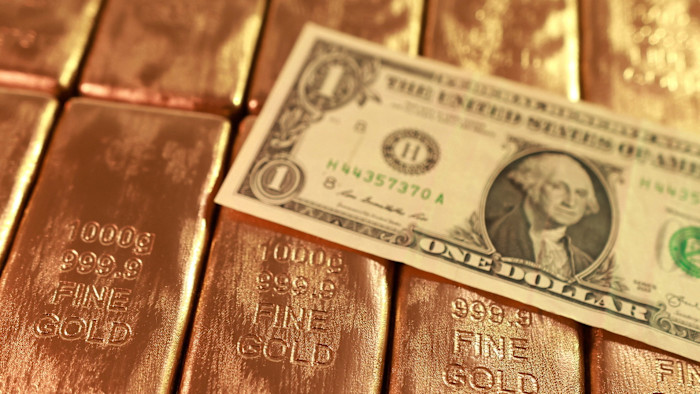
Gold rose and stocks and the dollar fell on Monday after Donald Trump deepened uncertainty over global trade by imposing a new 15 per cent tariff following a US Supreme Court ruling that his previous policy was unlawful.
The US president responded to Friday’s ruling from America’s top court by announcing a flat-rate tariff on the country’s trading partners, which is set to come into force on Tuesday.
The new duty relies on the 1974 Trade Act and will allow Trump to set import restrictions for up to 150 days. In its ruling, the Supreme Court said the president had exceeded his authority in using emergency powers to impose his “liberation day” tariffs last year.
Gold, a haven asset, rose 1 per cent on Monday to $5,154 a troy ounce. US futures contracts pointed to a 0.3 per cent drop for the S&P 500 and a 0.4 per cent fall for the Nasdaq 100 when Wall Street opens. Across the Atlantic, Germany’s Dax fell 0.5 per cent, while the broader Stoxx Europe 600 was down 0.3 per cent.
“Uncertainty is back,” said Carsten Brzeski, global head of macro at Dutch bank ING, adding that “the risk of escalation [between the US and its trading partners] is now higher than it was a year ago”.
The US dollar weakened as much as 0.5 per cent against a basket of its peers before paring losses to trade 0.1 per cent lower.
Trump’s launch of his trade war last April convulsed currency, bond and equity markets but stocks, powered by the AI boom, later recovered to hit record highs.
Mohit Kumar, an economist at Jefferies, said the 150-day limit on the new levies — after which the president needs approval from Congress — means that “we don’t really know what the tariff situation will be in six months’ time”. This could “impact capital flows” to the US, potentially weakening the currency, Kumar said.
Trevor Greetham, head of multi-asset investing at Royal London Asset Management, said the new tariff regime was “all guaranteed to be temporary” given the 150-day limit and the coming US midterm elections.
Goldman Sachs analysts wrote that the new levies slightly reduced the US’s effective tariff rate compared with prior to the Supreme Court decision. The bank said its expectations for US growth and inflation were “little changed” by the new levies.
Yields on 10-year Treasuries, which move inversely to prices, fell 0.01 percentage points to 4.08 per cent. Bitcoin dropped 1.9 per cent to $66,353 a token.
In Asia, where markets had been closed by the time Friday’s ruling landed, equities bounced on Monday as investors welcomed the prospect of lower tariffs for some exporters.
Hong Kong’s Hang Seng index led gains, adding 2.5 per cent. Taiwan’s Taiex closed up 0.5 per cent and South Korea’s Kospi climbed 0.7 per cent. Japan’s markets were closed.
Markets in mainland China, which would stand to be one of the countries with most to gain from a 15 per cent tariff, were also closed.
Morgan Stanley economists said in a report that the new headline tariff rate of 15 per cent would reduce the average weighted levy on Asian goods to 17 per cent from 20 per cent, while those on China would decline to 24 per cent from 32 per cent.
While this relief could be “temporary”, with the US expected to impose new levies on some sectors and economies, “it does appear to us that tariffs on Asia have likely peaked”, they said.
China’s commerce ministry, in its first official response to the Supreme Court ruling, said on Monday that it opposed unilateral tariffs and was “conducting a comprehensive assessment” of the ruling’s impact.
“We have also noted that the US is preparing alternative measures such as trade investigations to maintain its tariffs on trading partners,” the ministry said. “China will closely monitor this and firmly safeguard its interests.”
Additional reporting by Joe Leahy in Beijing and Ian Smith in London